

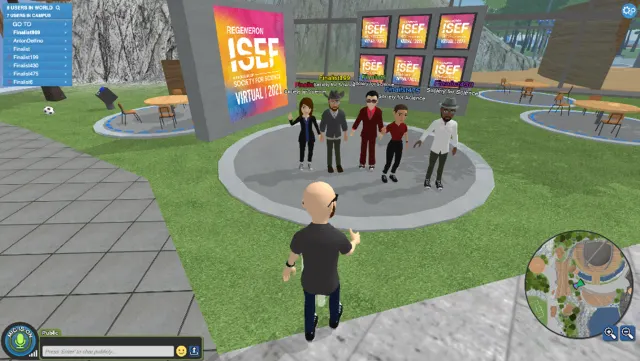
Before the COVID-19 pandemic, the Regeneron International Science and Engineering Fair did not have a system for conducting its full judging process virtually. International travel and large in-person gatherings became untenable, and the fair’s 2020 virtual program went ahead without judging. For the 2021 competition, Society for Science needed a way for students to present their research and be evaluated remotely.
The challenge was larger than arranging video calls. Students needed a fair opportunity to present their work, assistance when language was a barrier, and a safe setting for interviews with adults they had never met.
Pratham Patkar led the design and implementation of the virtual judging systems for that year’s fair as part of Society for Science’s technology team. The systems supported approximately 300 concurrent video rooms. Interviews were automatically recorded, while the broader event team recruited interpreters for students who needed language assistance and proctors to be present during judging. Together, those decisions sought to make the process fair, equitable and safe for participants across locations and time zones.
The 2021 fair brought together 1,834 finalists from 64 countries, according to Society for Science’s annual report. The organization’s published judging guidance said it would assign an adult proctor to each finalist’s room and that judges and proctors would undergo background checks and sign ethics statements.
Patkar also had to make a complex system usable. In a 2021 Engineering.com interview, he described months of work customizing the judging platform for different user groups. Staff needed extensive capabilities, while students needed a straightforward path to their interviews. The article documented a recording feature and infrastructure for more than 200 interview rooms.
“Pratham led the design and implementation of our virtual judging systems for ISEF 2021,” said James Moore, Society for Science’s Chief Technology Officer. “The design had to do more than handle a large number of interviews. It had to protect judging integrity and give students a safe, accessible way to participate. Pratham worked through how the rooms, recordings and different user roles would function together, while our wider team coordinated the interpreters and proctors the process required. His focus on what each participant needed from the system is something I also see in his later work on nonprofit data governance.”
The connection is visible in a preprint Patkar posted to SSRN in June 2026. In Reducing Friction to Mission: A Constituent-First Data Governance Framework for Nonprofits, he proposes ways for organizations with limited technology staff to manage information about the people they serve. The paper asks where information came from, which source should take precedence when records conflict, who needs access to it, and how long it should be kept. It is a preprint; its use and impact beyond Patkar’s own work have yet to be established.
For Moore, the paper addresses a practical issue that extends beyond one event. “Nonprofits need information to serve people well, but they also have an obligation to protect the people represented in their systems,” he said. “The paper gives practitioners concrete ideas to examine, particularly its approach to tracking where data came from and setting rules for conflicting records.”
Patkar calls the approach “constituent-first” because it begins with the person represented in a record. A student might later return to an organization as an alumnus, volunteer, judge, or parent. Information about that person may arrive from a school, an event registration form, or the person directly. Those sources do not always agree.
His framework proposes recording the origin of important information and applying different rules to different fields. A recent entry may be the best source for a mailing address. For an identity detail, information supplied by the person concerned may carry more authority than a newer third-party entry. The aim is to make those decisions explicit, rather than leaving staff to resolve each conflict through guesswork.
He also asks nonprofits to consider whether information needed for one program belongs in a permanent central record. That question carries particular weight when an organization holds sensitive information about minors.
Patkar’s interest in mission-driven work predates his career in technology. His parents, Pravin and Priti Patkar, co-founded Prerana, an organization in Mumbai that works to protect women and children from commercial sexual exploitation and trafficking. He says growing up around social-service work made him attentive to the administrative demands placed on people whose primary job is to help others.
“A good day is one where nobody notices the technology,” Patkar said in written responses for this article. For the virtual fair, that meant a student could concentrate on presenting research rather than navigating the judging platform. In his governance work, it means staff can use the information they need while treating the person behind each record with care.