


As AI workloads squeeze electrical and thermal margins, one engineer’s research proposes a way for specialized software roles to coordinate across domains while an independent safety check and a qualified person keep the final say.

Raja Kumara Swamy Donthula, Senior Member, IEEE. Digital overlays are illustrative. (Image courtesy of Raja Kumara Swamy Donthula)
AI accelerators have changed what a data center asks of its electrical and cooling plant. Racks that draw far more power per footprint compress the margins that UPS systems, medium-voltage switchgear, generators and cooling equipment once had to spare. Facilities designed around N+1 or 2N redundancy can now run closer to their thermal, capacity and protection limits, which raises the cost of any single misstep.
Raja Kumara Swamy Donthula, a data-center electrical and commissioning engineer based in the Atlanta area, argues that the answer is not a better dashboard for each system in isolation. In a research manuscript on safety-critical data-center electrical operations, he proposes a decision-support framework in which specialized software roles reason across domains together, under explicit uncertainty, with an independent safety check and a qualified person in the decision path.
One facility, several conversations
In practice, power, cooling and commissioning are often managed by different teams, tools and checklists. Yet the physical plant does not respect those boundaries. A load increase on the IT side shows up as less electrical headroom and more heat to remove. Taking a UPS string out for maintenance changes the redundancy that the rest of the plant depends on. A gap in commissioning records changes how much of the as-built system anyone can vouch for.
The research starts from that coupling. The practical question is how engineering teams can coordinate these domains when the data is imperfect, the margins are thin and the consequences of a wrong action are high.
Why alarms and thresholds are not enough
Most building-management and infrastructure-management workflows remain built around alarms and thresholds. They are good at reporting that a value has crossed a line. They are less suited to weighing power quality, breaker and relay status, battery health and thermal state at the same time.
Newer agentic AI assistants could fill part of that gap, but they bring their own risk: a fluent recommendation that carries no calibrated confidence and no independent check against interlocks and protective coordination. That is the failure mode the framework is designed to contain.
Specialized roles, one shared record
The proposal divides the work among six logical roles. One tracks equipment condition and aging. One maintains a live model of the electrical one-line diagram and the redundancy state. One fuses the evidence into a calibrated risk score. One ranks corrective actions, putting safety ahead of efficiency. One independently verifies every candidate action. One presents verified, explained options to the operator.
In the proposed architecture, each role would record its inputs and recommendations in a shared logical audit ledger, so that a reviewer could later see what each role knew, how sure it was and what it recommended. The manuscript describes this as an audit requirement; it does not claim a tamper-proof or cryptographically protected log. The framework is deliberately agnostic about how each role would be implemented: it specifies the interfaces and the safety logic rather than a particular learning algorithm.
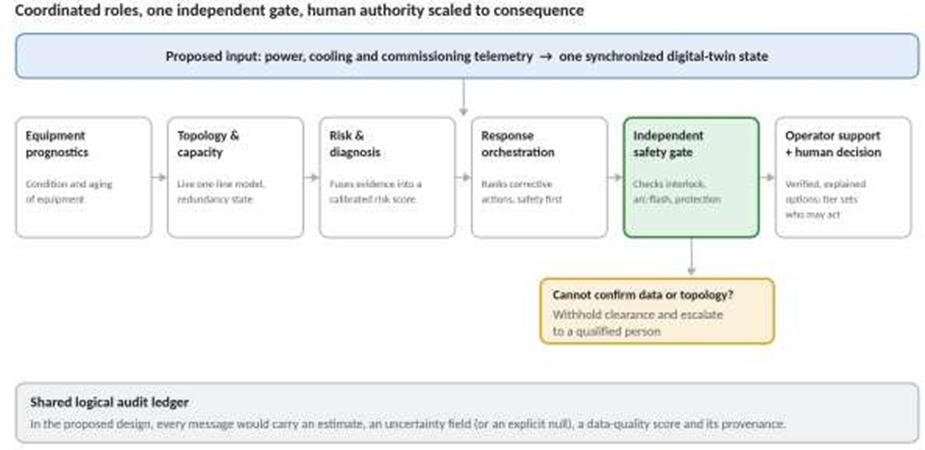
Conceptual diagram of the proposed decision-support framework: six logical roles, an independent safety gate and a shared audit ledger. A research concept, not a deployed system.
Uncertainty travels with every message
In the proposed design, each message between roles would carry a state estimate, an uncertainty field, a data-quality score and its provenance, including source identifiers, timestamps and model version. The data-quality score would take the weakest of four components (freshness, completeness, channel health and consistency with the one-line model) rather than an average, so a stale input cannot hide behind healthy ones.
Where a role cannot produce a probabilistic uncertainty estimate, the field would be explicitly marked null, and the framework states that a null must never be read as high confidence.
An independent gate that fails closed
The safety role is separate from the roles that propose actions. The separate safety-gate role is designed to check candidate actions against facility-approved interlock, arc-flash and protective-coordination constraints that qualified personnel derive from approved one-line diagrams, protection studies and switching procedures, and to withhold clearance when required information cannot be verified.
If topology, telemetry freshness, protection-study validity or interlock state cannot be confirmed, the gate is designed to withhold clearance and escalate. A favorable risk trade-off would never substitute for its approval, and even fallback options would have to pass the same check before reaching an operator.
Human authority scaled to consequence
The framework is designed to tie how much a system may do on its own to the consequence and reversibility of the action. Under the proposal, high consequence, high uncertainty or low reversibility would keep a recommendation advisory only. Moderate-consequence actions that can be reversed through a pre-approved recovery procedure could move to approve-to-execute. Only low-consequence, bounded and pre-approved actions inside a validated envelope would be candidates for limited automatic execution, with review afterward.
Consequence and reversibility would act as hard ceilings; low uncertainty alone could not raise the level of autonomy.
What the framework deliberately does not do
The manuscript draws firm boundaries around automation. The framework is decision support, not autonomous control: most roles would be advisory and non-executing, the safety role would only grant or withhold clearance, and the operator-support role would present and route recommendations. Bounded automatic execution would explicitly exclude protective-relay actions, energization, breaker or automatic-transfer-switch transfers, generator paralleling, bypass operations and changes to lockout-tagout or arc-flash exposure.
If authorization is unavailable, the action would stay blocked and escalate; there would be no timeout-to-execute path. The framework also does not calculate arc-flash incident energy itself. It would consume facility-approved study results, performed under IEEE Std 1584 and combined with NFPA 70E work-practice constraints, as external safety inputs.
A cross-domain test case: compute, cooling and a shared bus
The coordination idea is easiest to see in one of the manuscript’s simulated scenarios. A compute load and a cooling load share an electrical bus, and an injected event derates that bus for part of the run. In the uncoordinated baseline, each load submits its own locally sensible request with no view of the other, so the shortfall is spread across both and nothing protects a minimum level of cooling.
In the coordinated configuration, the response-ranking role curtails compute first, and the safety role enforces a floor on the cooling that is served, cutting cooling only as a last resort. In that simulation, both bus-capacity violations and cooling-floor breaches fell to zero.
The author is careful about what that does and does not prove. Because the coordinated arm was given a cooling floor that the baseline lacked, a zero-breach result is guaranteed by construction. When the manuscript added a deterministic real-time rule that used the same bus limit, floor and telemetry, that simple rule matched the coordinated arm on every matched trial. The manuscript flags this as an important negative result for any claim that agentic reasoning itself adds value in that scenario. In other words, there the explicit constraint, not the sophistication of the reasoning, does the work.
How the framework would be tested
The manuscript formalizes risk, uncertainty and the safety gate mathematically, and it specifies, but does not yet carry out, a fuller evaluation on a physics-informed digital twin. The twin would combine an electrical one-line and power-flow model with thermal and cooling co-simulation and a fault-injection engine. Four scenario families are planned: UPS degradation, medium-voltage feeder overload with the loss of a feeder, cooling-driven derating after a loss of cooling capacity, and integrated systems test (IST) sequencing with stale breaker status.
Comparisons would include a threshold-and-rule baseline, a single-agent optimizer and a strong non-agentic supervisory controller, along with ablations that remove uncertainty propagation, the independent safety gate or the human feedback loop. The proposed protocol calls for the toolchain, solver settings, topology, ratings and random seeds to be frozen before the full comparative evaluation, and its statistical plan calls for at least 30 matched replications per condition, set in advance. Planned metrics include detection latency, mitigation time, calibration error, unsafe-action rate, veto rate and residual constraint violations.
What the first-pass simulations do and do not show
The manuscript reports two sets of five small illustrative pilot tests, separate from the fuller physics-informed digital-twin validation that remains future work. The pilots use illustrative parameters rather than facility measurements, and the author describes the results as preliminary and non-conclusive; several are mixed. A predictive feeder controller, for example, did not improve redundancy-margin compliance at its default setting; the manuscript treats that as a design lesson about how the target ceiling trades compliance against load shed. In the cooling scenario, predictive throttling reduced temperature violations only partly, because some degraded cases cannot be recovered by throttling alone.
A commissioning-sequencing pilot found that most of its gain came from simply reassigning crews when tasks slipped, not from the more sophisticated prioritization layered on top of it.
That candor is part of the argument. The full digital-twin study remains future work, and no deployment on live data-center equipment is claimed.
Key takeaways for operators
- Treat power, cooling and commissioning as one coupled system when evaluating any AI-assisted recommendation.
- Require each recommendation to state its evidence, its uncertainty and the quality of the data behind it, and treat missing uncertainty as unknown, not safe.
- Keep an independent check that can say no, and that fails closed when data or topology cannot be confirmed.
- Match the level of automation to consequence and reversibility, not to model confidence alone.
- Benchmark AI-assisted tools against a strong non-AI baseline; in some scenarios a simple, explicit rule may deliver most of the benefit.
- Keep commissioning and as-built records current; decision support is only as reliable as the evidence it reads.
For data centers adding capacity and intelligence at the same time, the more useful question may not be whether AI can recommend an action. It may be whether the surrounding engineering system can show why, check the recommendation independently and hand the decision to the right person.
About the research
Raja Kumara Swamy Donthula, Senior Member, IEEE, is a data-center electrical and commissioning engineer based in the Atlanta area. The framework discussed here is described in his research manuscript, “Uncertainty- and Risk-Aware Multi-Agent Decision-Support Framework for Safety-Critical Data-Center Electrical Operations.” The concept and early pilots have not been validated in a live facility.