Small business owners generally don’t open up shop in order to do paperwork. They do it for the development of the craft they love, the relationships, the value they deliver and the feeling of independence. All too often, the work itself isn’t where their time goes. Administrative tasks like invoicing, scheduling and chasing down leads eat up the hours that would ideally go to the job they love.
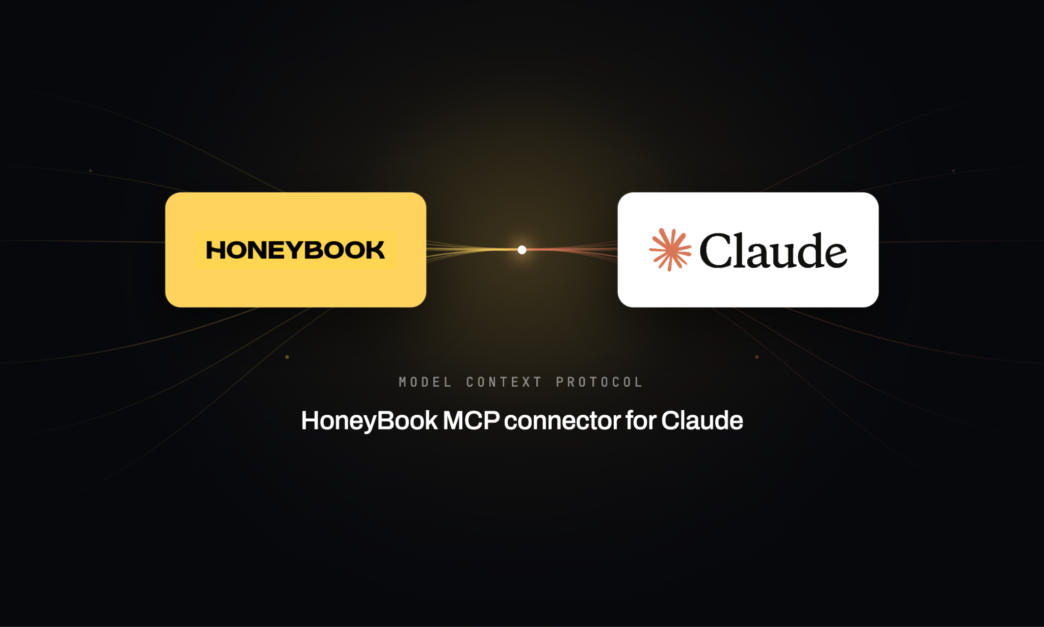
It’s these people that HoneyBook has in mind with the launch of its latest feature, HoneyBook MCP, which integrates the powerful customer relationship platform with the AI assistant of the user’s choice. With this launch, HoneyBook MCP also arrives as a community-verified connector in the library of Anthropic’s Claude chatbot, promising to bring some much-needed order to the chaos of business administration.
The root of the problem is often to be found in the tools that SMBs use. Contending with a fragmented software stack, SMBs often work with up to a dozen applications, such as one app for email, another for chatting to clients, a third platform for invoicing, yet another that they use for accounting, and so on. Many don’t have access to a single platform that can handle every aspect of their customer relationships, and among those who do, surfacing the right information at the right moment is a challenge unto itself. HoneyBook’s native modules and third-party integrations help SMB leaders to consolidate these records, while the new Claude connector enables further data enrichment, easier access to records, and the creation of custom automations based on signals from across the software ecosystem.
Agentic Automation Eliminates Workflow Fragmentation
To a large degree, the HoneyBook MCP is an effort to give business owners a better picture of the current state of their business relationships. The idea is that by integrating the HoneyBook platform and all of its data with AI services, they’ll be able to view the entire lifecycle of any client, without constantly switching between different apps and tools.
A venue operator, for instance, can ask Claude in plain language about how many presale tours they have booked for this week, and the chatbot will dig into the live data in HoneyBook to let them know the names of each prospect and the time and date they’ll arrive.
Alternatively, a photographer might ask Claude which of their clients are still waiting for their galleries to arrive after a photoshoot, eliminating the need to check manually. Going further, Claude can automatically create a gallery for each client based on the photographer’s chosen templates and distribute them the moment they’re ready. When a photo shoot ends, it can quickly generate an invoice and send that out, too.
While HoneyBook already offers AI features within its app, the MCP connector is the company’s first foray into AI agents and the idea that these models can automate work on behalf of small business owners.
It’s easy to see why HoneyBook wants to go in this direction. In a recent study, the company found that SMBs that already use AI tools generate $400,000 more in annual revenue than competitors that haven’t yet jumped on the AI bandwagon.
Keeping a Finger on the Pulse
HoneyBook has a strong track record of talking to its customers to understand their pain points in order to address them. In a study on self-employed photographers it commissioned earlier this year, HoneyBook found that far too many find themselves deluged with manual work, which prevents them from spending more time actually taking photos or hunting for new customers.
Just 5% of respondents in that survey said they have a fully-integrated workflow to run their business. The other 95% are forced to flit between multiple tools to get their work done, and it’s a real time killer. For instance, 51% of photographers are still manually copy-pasting data from their CRM to their gallery software, while 55% have to email gallery links to their customers once they’re ready. Such tasks take anywhere from 30 minutes to an hour for each client. It means the more clients they pick up, the less time they have to actually perform photoshoots.
Similarly, a recent HoneyBook’s study on the hassles that venue operators face found that tour scheduling becomes a major challenge as the business grows. Among wedding venues that host nine or more events per month, 89% say tour scheduling is a major time sink, compared to 74% at lower-volume venues. Many wedding venue operators also report frustration using email to coordinate tour slots with prospective clients, while calendar conflicts become a real risk for multi-use venues juggling weddings, corporate events, and social bookings in the same space.
With this release, HoneyBook gives its user community the tools they need to fix their biggest pain points and free themselves from the drudgery and snafus associated with manual admin work using a sprawling tech stack. Representatives of the company say that a small group of users who were given pre-launch access to MCP connector found it to be especially useful when it comes to reconciling information. Users can prompt Claude for a list of unpaid invoices or ask it to follow up with inquiries, without the business owner having to track each one down themselves.
HoneyBook also understands the importance of protecting its clients’ business data. To that end, the MCP processes every prompt inside a secure sandbox, so sensitive information is never exposed to or retained by the underlying AI model. Business owners also have granular control over what HoneyBook data Claude can access, whether that’s limiting it to certain projects, clients, or record types, so they can decide exactly how much of their business they want to open up.
That combination of access and control reflects HoneyBook’s broader positioning, giving small business owners tools that fit how they actually work, without asking them to hand over more than they’re comfortable with.