


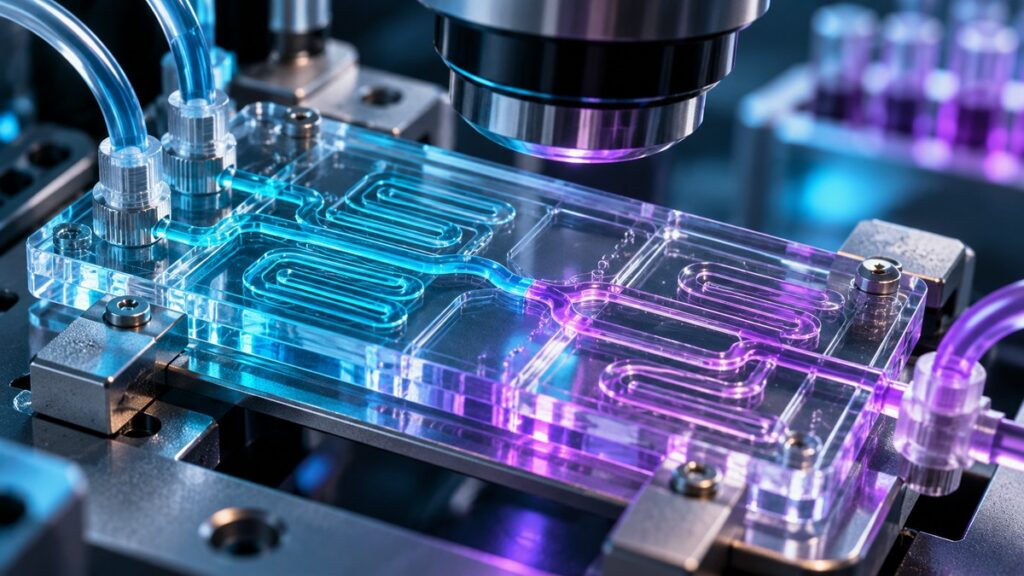
A laboratory instrument does not need to occupy an entire room to reveal important information about molecular biology. Some modern analytical devices contain networks of channels so small that their dimensions are measured in micrometers. Within these miniature environments, researchers can investigate chemical interactions, observe cellular responses and collect molecular measurements using relatively small quantities of material.
This field of technology, known as microfluidics, brings together engineering, analytical chemistry, materials science and biology. Its applications extend from laboratory automation to the development of experimental models that reproduce selected characteristics of human tissues.
For peptide research, microfluidic systems offer opportunities to examine molecular behavior with greater control over the physical environment. They also introduce new engineering challenges that must be addressed before their measurements can support reliable scientific conclusions.
How Microfluidic Technology Changes the Traditional Laboratory
Conventional laboratories frequently rely on separate instruments for handling liquids, separating chemical components and detecting molecular signals. Samples may need to move between several pieces of equipment before researchers obtain the information required for an investigation.
Microfluidic technology approaches these tasks through miniature networks of interconnected channels. Depending on the design, a single device can incorporate several functions that would otherwise require separate laboratory components.
In July 2006, Harvard chemist George M. Whitesides published an influential discussion in Nature examining the development and potential applications of microfluidics. His work identified the importance of manipulating small volumes of liquid across scientific disciplines, including chemical analysis and biological research.
The concept remains relevant to researchers investigating peptides, proteins and cellular communication. Educational platforms such as Peptides Savannah introduce readers to the broader scientific context in which these molecules are studied.
Understanding the technology behind molecular investigations helps explain why the quality of scientific evidence depends not only on the compound being examined but also on the instruments used to examine it.
Why Fluid Behavior Changes at Small Physical Scales
Reducing the dimensions of a liquid-handling system changes the relative importance of several physical processes. Surface interactions become more significant, while the movement of liquids can behave differently from the flow observed in larger containers.
Within many microfluidic devices, fluid movement is predominantly laminar. This means that adjacent layers of liquid can move in relatively organized patterns rather than mixing through the turbulent motion commonly associated with larger systems.
The movement of molecules between these layers may depend substantially on diffusion and the geometry of the channels.
These characteristics allow engineers to design devices that create carefully defined environments for studying molecular interactions. However, they also require researchers to consider whether the physical behavior of liquids introduces limitations into their experiments.
A device that provides precise control over fluid movement does not automatically guarantee accurate molecular measurements. The properties of the surrounding materials and the characteristics of the substances being studied remain important.
Integrating Peptide Analysis Onto a Single Chip
One of the most practical applications of microfluidics involves the integration of multiple analytical functions within a compact platform.
In January 2005, Hongfeng Yin and colleagues published a study in Analytical Chemistry describing a microfluidic device developed for peptide analysis. Their design incorporated components for sample enrichment, chromatographic separation and connection to electrospray mass spectrometry.
The investigation demonstrated how analytical components that normally require separate connections could be integrated into a miniature device.
This type of engineering is valuable because the connections between instruments can introduce additional complexity. Material may remain within connecting components, and the movement of samples between different analytical stages can affect measurement performance.
Integrating multiple functions can reduce some of these challenges. Nevertheless, the resulting device still requires appropriate validation to determine whether it performs reliably for the intended application.
A successful demonstration involving one group of molecular samples should not automatically be interpreted as evidence that the same device will perform equally well with every peptide or biological material.
Connecting Microfluidic Devices With Mass Spectrometry
Mass spectrometry provides researchers with information about the mass-to-charge characteristics of molecular ions. It is widely used in analytical chemistry to investigate peptides, proteins and other substances.
Microfluidic systems can contribute to this process by incorporating components that help separate and transfer molecular samples before detection.
In 2020, researchers published an investigation describing a thiol-ene microfluidic platform that combined sample processing, chromatographic separation and electrospray ionization for the analysis of peptide and protein mixtures.
The study represented an example of how engineering innovations can combine several stages of molecular analysis within one device. Its findings were specific to the analytical platform and samples investigated.
This distinction is important because detecting molecular ions does not independently establish every characteristic of a substance. Additional evidence may be required to determine molecular identity, distinguish structural alternatives or establish whether particular compounds possess measurable biological activity.
Microfluidic technology can improve how researchers collect analytical information, but it does not eliminate the need to interpret that information within the boundaries of the method.
What Organ-on-a-Chip Technology Adds to Biomedical Research
Beyond chemical analysis, microfluidic technology has contributed to the development of experimental systems commonly described as organs-on-chips.
These devices combine engineered physical environments with living cells to reproduce selected characteristics of biological tissues. Their designs may incorporate separate cellular compartments, controlled fluid movement and physical features intended to represent aspects of natural tissue organization.
In June 2010, Dongeun Huh and colleagues published a landmark study in Science describing a microengineered model of the interface between air sacs and blood vessels in the human lung.
The device incorporated interacting cell layers and mechanical movement intended to represent selected characteristics of breathing. The researchers demonstrated that physical movement could influence biological responses within their experimental model.
Although this investigation was not a demonstration of peptide treatment, its engineering principles are relevant to molecular research more broadly. The work illustrated how the physical environment surrounding cells can influence the results scientists observe.
An organ-on-a-chip system should not be confused with a complete human organ. It reproduces selected features for defined scientific purposes, and its findings must be interpreted in relation to those features.
Measuring Natural Peptide Signals in Real Time
Traditional biological experiments sometimes rely on measurements collected at separate intervals. This approach can provide valuable information, but it may leave important changes between measurement points unobserved.
Microfluidic devices can offer opportunities to collect measurements more frequently and examine dynamic patterns of biological activity.
In October 2023, a study published in Cell Reports Methods described a microfluidic system for investigating C-peptide secretion from individual pancreatic islets. C-peptide is a naturally occurring molecular fragment generated during the biological processing of proinsulin.
The researchers combined molecular measurements with live-cell imaging, allowing them to investigate relationships between secretion patterns and cellular metabolic activity.
The system could examine up to four individual islets in parallel and collect secretion measurements at approximately seven-second intervals.
This investigation illustrates how improved measurement frequency can reveal information about biological processes that might be obscured by less frequent observations.
However, its findings concern a defined experimental platform. They do not establish the clinical effectiveness of an experimental peptide or demonstrate that a laboratory device can independently reproduce all aspects of human metabolic regulation.
The Engineering Challenges Behind Miniaturized Laboratories
Miniaturization introduces technical advantages, but smaller instruments can also create new sources of measurement uncertainty.
For example, molecules interacting with the internal surfaces of a device may affect the amount of material available for subsequent analysis. The properties of the device materials can therefore influence experimental performance.
Air bubbles, inconsistent fluid movement and manufacturing differences can introduce additional complications. These issues may be particularly important when researchers are working with small quantities of biological material.
Engineers must also consider how consistently a device can be manufactured. A prototype that performs successfully in its original laboratory may require additional development before other institutions can use comparable devices reliably.
For biotechnology companies, this distinction separates an interesting technological demonstration from a dependable analytical platform. Manufacturing quality, instrument compatibility and independent performance testing are important parts of that transition.
Why Better Instruments Still Require Better Scientific Interpretation
Advanced laboratory equipment can produce measurements that appear unusually precise. Digital displays, detailed molecular profiles and high-resolution images may create a strong impression of scientific reliability.
Nevertheless, measurement precision and scientific validity address different questions.
A device may consistently detect a particular signal without establishing whether the signal supports the biological interpretation presented by researchers. That interpretation depends on experimental design, appropriate controls and the relationship between the measurement and the scientific question.
Readers exploring the educational background of Peptides Savannah can apply this distinction when assessing information about emerging molecular technologies.
The ability to measure a peptide, identify a molecular interaction or observe a cellular response should not be confused with evidence of clinical safety or therapeutic effectiveness.
Technological sophistication strengthens scientific research when the instrument is appropriate for the question and the resulting evidence is interpreted accurately.
What Technology Companies Need to Consider When Developing Research Platforms
The commercialization of microfluidic systems involves more than demonstrating that a miniature device can perform a laboratory task.
Developers must consider whether researchers can operate the platform consistently, whether replacement components remain available and whether the system can integrate with existing laboratory infrastructure.
Software compatibility is another important consideration. Instruments increasingly generate digital measurements that researchers need to store, review and compare across different experiments.
Clear documentation of device characteristics and analytical limitations helps laboratories determine whether a platform is suitable for their intended work.
These considerations become particularly relevant when a technology moves from a specialized academic environment into broader commercial or institutional use. An instrument designed for one research application may require substantial modification before it can serve another.
The commercial value of scientific technology ultimately depends on its ability to address a genuine research need while maintaining dependable performance.
Building Scientific Literacy Around Emerging Laboratory Technology
Readers following developments in biotechnology can benefit from understanding the difference between a technological demonstration and a validated scientific application.
A useful starting point is identifying what a particular device measures. Additional questions concern the type of material investigated, the conditions under which measurements were collected and the limitations acknowledged by the developers.
General educational inquiries through the Peptides Savannah contact page can complement independent reading of original scientific publications. Educational resources should remain separate from personalized medical guidance.
As laboratory instruments become smaller and more technologically integrated, the principles governing reliable research remain consistent. Measurements need appropriate validation, experimental conditions require documentation, and conclusions must reflect the evidence actually obtained.
Microfluidic technology demonstrates how engineering innovation can expand the questions scientists are able to investigate. Its greatest contribution is not simply reducing the physical size of laboratory instruments, but creating new opportunities to observe molecular and cellular behavior within carefully defined research environments.
For peptide science and the wider biotechnology industry, these developments provide valuable research capabilities without removing the need for rigorous experimentation, transparent reporting and responsible scientific interpretation.