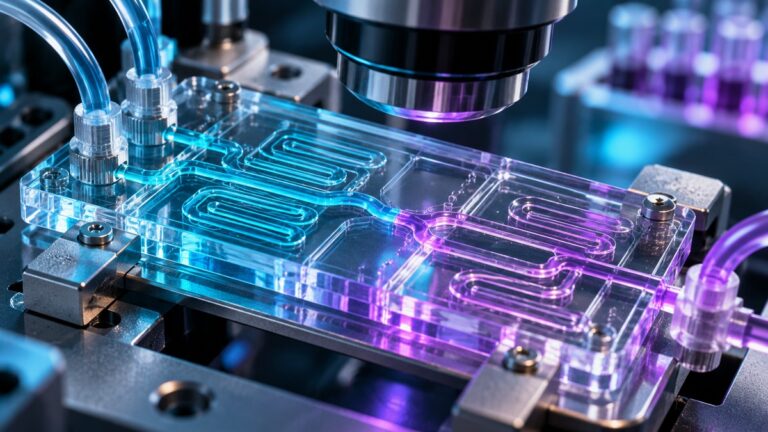


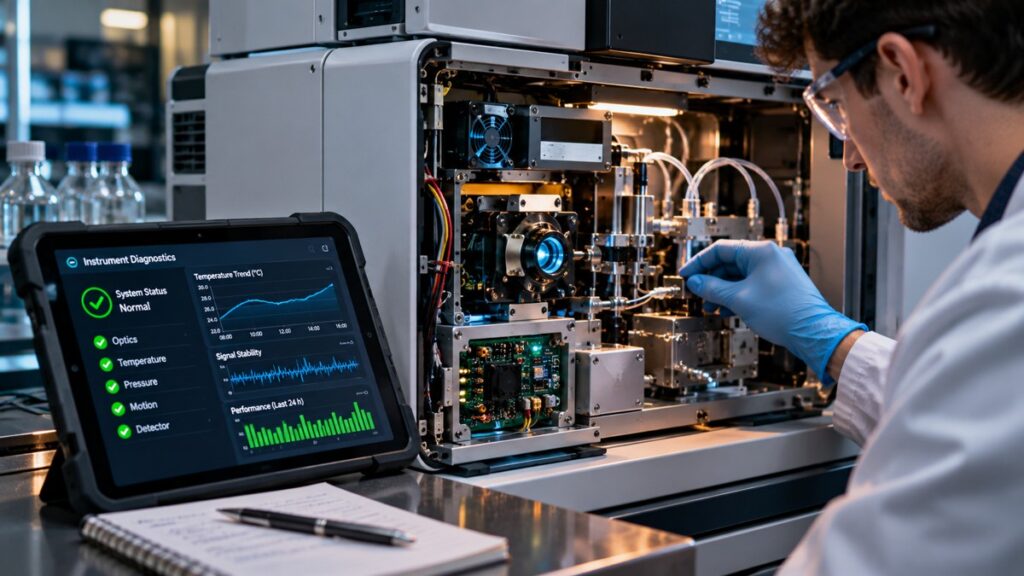
An analytical instrument can continue producing apparently normal measurements even when its internal performance has begun to deteriorate. A gradual change in detector sensitivity, an unstable temperature controller or an unexpected variation in operating pressure may influence scientific observations long before the equipment displays a recognizable failure message.
For biotechnology laboratories, this creates a significant technological challenge. Researchers depend on instruments to examine molecular structures, characterize chemical properties and investigate complex biological relationships. When instrument performance changes without detection, the resulting measurements may become increasingly difficult to interpret.
Modern instrumentation is introducing new ways to address this problem through integrated sensors, automated diagnostic software, remote performance monitoring and predictive maintenance technologies.
These developments are contributing to the emergence of the self-monitoring laboratory, an environment in which analytical equipment can provide information about its own operating condition alongside the scientific measurements it produces.
Why Instrument Failure Is Not Always Immediately Visible
Equipment failure is often associated with a sudden interruption. A machine stops operating, an application displays an error message or an instrument becomes unable to complete its intended function.
However, analytical instruments can experience less obvious performance changes that develop gradually.
Optical components may become less responsive over time. Mechanical assemblies can experience wear, while electronic components may respond differently as their operating characteristics change.
These developments do not necessarily prevent an instrument from generating results. Instead, they can influence the relationship between the property being investigated and the measurement recorded by the equipment.
For researchers, the difficulty lies in recognizing when a change in scientific observations reflects a genuine characteristic of the research material and when it may be associated with instrument performance.
Traditional maintenance schedules provide opportunities to inspect equipment at predetermined intervals. However, gradual performance changes may develop between those scheduled inspections.
Automated diagnostics offer an additional mechanism for observing equipment behavior throughout its operating life, potentially helping laboratory personnel identify emerging concerns before they become obvious operational failures.
Embedded Sensors Provide Information Beyond Scientific Measurements
Modern analytical instruments frequently contain components that monitor internal operating conditions.
Depending on the equipment, these components may measure temperature, electrical characteristics, pressure, mechanical movement, vibration or other physical variables relevant to instrument operation.
Unlike the primary analytical detector, which generates information about the material being investigated, diagnostic sensors provide information about the equipment itself.
Consider an instrument designed to perform optical measurements. Its diagnostic infrastructure might record characteristics associated with the stability of its illumination system or the temperature of particular internal components.
These observations can help engineers investigate whether unexpected analytical behavior corresponds to changes in the instrument’s operating environment.
However, the usefulness of embedded sensors depends on how their measurements are interpreted. A temporary change in an operating variable may be entirely normal under certain circumstances while indicating a problem under others.
Diagnostic software must therefore consider the characteristics of the equipment and the conditions associated with its intended operation rather than treating every variation as evidence of a failure.
Molecular Research Depends on Appropriate Analytical Performance
Biotechnology investigations frequently involve molecular materials that possess complex structural and chemical characteristics. Researchers may use different analytical techniques to examine their identity, composition or behavior within defined experimental environments.
The reliability of those investigations depends partly on whether the selected instruments provide measurements appropriate for the scientific question.
Educational websites such as peptidesworcester.com provide background information for readers exploring peptide-related scientific terminology and molecular research categories.
Understanding those categories is useful, but establishing the characteristics of an individual research material requires appropriate analytical evidence.
An instrument that successfully completes a measurement sequence does not automatically establish that the resulting information is scientifically reliable.
Researchers must also consider the suitability of the analytical procedure, the performance of the equipment and the limitations associated with the reported observations.
Automated diagnostics contribute information about one important part of this process. They help investigators examine whether equipment behavior remains consistent with expectations, while scientific interpretation continues to require additional forms of evaluation.
Detecting Analytical Drift Before It Affects Research Conclusions
Analytical drift refers to gradual changes in measurement behavior over time. Such changes can make observations increasingly difficult to compare, particularly when research projects extend across multiple days or involve numerous measurement sequences.
Imagine a laboratory conducting a hypothetical series of measurements involving materials with stable characteristics. If the instrument’s response gradually increases despite the relevant property remaining unchanged, the resulting dataset could suggest a relationship that does not originate from the research materials themselves.
Identifying this possibility requires a suitable basis for evaluating measurement performance independently of the experimental samples.
The National Institute of Standards and Technology discusses these challenges in its Engineering Statistics Handbook section on statistical control of measurement processes. The guidance explains how measurement systems can experience changes in bias and variability and describes statistical approaches for investigating those changes.
Monitoring instrument performance over time can help researchers recognize patterns that might remain difficult to identify when individual measurements are examined separately.
The objective is not to assume that every change originates from equipment deterioration. It is to provide investigators with additional evidence for distinguishing possible technical influences from genuine scientific observations.
Control Charts Help Transform Diagnostic Information Into Useful Evidence
A laboratory instrument may generate substantial quantities of operating information. Temperature readings, detector responses and other measurements can accumulate rapidly during routine operation.
Without an appropriate analytical framework, these records may be difficult to interpret.
Control charts provide one method for examining whether measurements remain consistent with an established pattern of variation.
Rather than evaluating each observation entirely in isolation, the approach considers measurements in relation to historical performance and statistically defined boundaries.
A sudden departure from an established pattern might justify investigation. A sequence of smaller changes moving consistently in the same direction could also deserve attention.
NIST’s guidance on controlling the measurement process explains the role of check standards in examining changes in measurement bias and instrument precision.
Importantly, statistical control does not establish absolute measurement accuracy when the underlying measurement process is incorrectly calibrated or specified.
This limitation demonstrates why automated monitoring should complement appropriate scientific measurement practices rather than replace them.
A stable operating pattern can provide useful information about consistency, but consistency alone does not establish that the system is measuring the intended property correctly.
Predictive Maintenance Changes How Laboratories Approach Equipment Reliability
Traditional equipment maintenance often follows one of two approaches. Organizations may schedule maintenance at predetermined intervals, or they may respond when equipment experiences a recognizable problem.
Predictive maintenance introduces another possibility by using information about equipment condition to help determine when further inspection or servicing may be appropriate.
In a biotechnology laboratory, this could involve examining historical diagnostic information to identify patterns associated with changes in equipment performance.
For example, a mechanical component might exhibit increasing operational variability before reaching a condition that prevents the instrument from functioning normally.
Monitoring software could identify that developing pattern and notify laboratory personnel that additional examination may be warranted.
However, predictive systems depend on the availability and quality of relevant information. A model developed from limited historical observations may struggle to distinguish an emerging problem from ordinary changes in operating conditions.
Organizations should therefore evaluate predictive maintenance systems according to their actual ability to identify meaningful equipment concerns, rather than assuming that computational sophistication guarantees dependable predictions.
Analytical Diagnostics Cannot Establish Biological Effects
Instrument monitoring is especially valuable in scientific disciplines where measurements contribute to interpretations of complex molecular behavior.
Nevertheless, maintaining reliable equipment performance does not eliminate the need to distinguish between different categories of scientific evidence.
Research involving molecular characteristics, cellular mechanisms and wider biological processes addresses questions that cannot necessarily be answered through the same analytical procedures.
Readers examining analytical evidence in metabolic peptide research should recognize the distinction between chemical characterization and evidence concerning biological mechanisms.
An appropriately functioning analytical instrument may provide dependable information about a particular molecular property. That information does not independently demonstrate biological activity in another research environment or establish clinical effectiveness and safety.
Similarly, a diagnostic system indicating that an instrument is operating within its expected parameters does not establish the validity of every scientific conclusion derived from its measurements.
Reliable biotechnology research requires several complementary forms of evaluation. Equipment monitoring supports the technical foundation of an investigation, while experimental design and appropriate biological interpretation determine what the resulting evidence can establish.
System Suitability and Analytical Validation Remain Essential
Equipment diagnostics, system suitability assessments and analytical procedure validation address related but distinct questions.
Diagnostic systems provide information about the condition and operation of analytical equipment. System suitability assessments help establish whether an analytical system is performing adequately for a particular measurement procedure. Analytical validation examines whether the procedure itself is appropriate for its intended purpose.
In March 2024, the United States Food and Drug Administration published the International Council for Harmonisation guidance Q2(R2) Validation of Analytical Procedures.
The guidance provides a framework for evaluating analytical procedures within its pharmaceutical regulatory context. It addresses principles that are relevant to demonstrating whether analytical procedures can fulfill their intended objectives.
Independent research laboratories should not interpret pharmaceutical regulatory guidance as an automatically applicable legal requirement for every research activity.
However, its underlying distinction between instrument operation and analytical suitability illustrates an important scientific principle.
An instrument may function according to its technical specifications while the selected analytical procedure remains unsuitable for a particular research material or measurement objective.
Automated monitoring cannot independently resolve that problem because equipment condition represents only one component of the broader analytical process.
Remote Monitoring Creates New Opportunities and Responsibilities
Connected analytical equipment can allow authorized personnel to examine instrument information without being physically present beside the equipment.
Depending on the infrastructure, remote monitoring applications may display operational status, historical diagnostic records and notifications associated with unexpected equipment behavior.
These capabilities can be particularly useful for organizations operating multiple research facilities or managing instruments that perform extended analytical sequences.
Personnel may be able to investigate an equipment notification sooner than would be possible through periodic physical inspections alone.
However, remote access introduces additional considerations concerning network security, user authorization and the integrity of diagnostic records.
Laboratories must distinguish between systems that allow users to observe equipment behavior and systems that also permit users to modify instrument configurations.
These different capabilities involve different operational responsibilities.
Organizations should establish appropriate controls around connected instruments, including clear authorization boundaries and procedures for investigating unexpected configuration changes.
Remote monitoring becomes scientifically useful when the information it provides remains accurate, appropriately protected and connected to the equipment it describes.
Diagnostic Alerts Need Context Rather Than Constant Attention
Automated monitoring systems can generate notifications whenever measured variables depart from predefined expectations.
While these notifications are intended to support operational awareness, an excessive number of low-value alerts can make important warnings more difficult to recognize.
A laboratory employee repeatedly receiving notifications associated with ordinary operating variations may become less responsive when a genuinely unusual event occurs.
Effective diagnostic systems therefore require carefully established alert logic that reflects the characteristics of the instrument and the importance of the monitored variable.
Organizations may distinguish notifications requiring immediate investigation from those that simply indicate a developing trend worth examining during routine performance reviews.
They should also consider whether a notification provides enough contextual information for personnel to understand why it was generated.
A warning that identifies an unusual measurement without explaining its relationship to historical performance may provide limited practical value.
Clear diagnostic communication supports better decisions by helping researchers distinguish observations, possible explanations and confirmed equipment problems.
Maintenance Records Connect Equipment History With Scientific Evidence
Biotechnology research often involves comparing measurements generated at different points in time.
When those comparisons involve the same instrument, its operating and maintenance history can provide useful information about the circumstances surrounding the measurements.
A component replacement, software update or significant equipment adjustment may influence how subsequent measurements relate to earlier observations.
Maintaining appropriate records of those changes helps investigators determine whether an apparent scientific difference corresponds to a relevant change in the analytical infrastructure.
The same principle applies to public scientific communication. Background information associated with Peptides Worcester or similar educational resources should be interpreted alongside original scientific evidence when evaluating particular technical claims.
Whether information originates from an analytical instrument or a scientific publication, its reliability cannot always be assessed from the final reported result alone.
Understanding how that information was generated and which circumstances influenced it provides a stronger foundation for responsible interpretation.
How Biotechnology Organizations Can Evaluate Monitoring Technology
Adopting self-monitoring instrumentation involves more than purchasing equipment with advanced diagnostic features.
Research organizations should first identify which equipment-related problems have the greatest potential to influence their scientific operations.
Relevant evaluation questions may include:
- Which instrument characteristics are monitored automatically?
- Does the diagnostic system distinguish normal operating variation from meaningful performance changes?
- Can personnel examine historical observations and investigate the circumstances surrounding an alert?
- How are maintenance activities and equipment configuration changes documented?
- Can diagnostic information be connected to the relevant scientific measurement records?
- What limitations apply to the instrument’s automated monitoring capabilities?
These questions help organizations evaluate whether a proposed technology addresses genuine operational requirements rather than simply introducing additional information displays.
Where appropriate, pilot evaluations can help laboratories determine whether new monitoring capabilities improve their ability to recognize equipment concerns and investigate analytical inconsistencies.
The Self-Monitoring Laboratory Still Depends on Scientific Judgment
Automated instrument diagnostics offer biotechnology organizations additional ways to understand the condition of their analytical infrastructure.
Embedded sensors, statistical monitoring tools and connected maintenance systems can help researchers investigate changes that might otherwise remain difficult to identify.
These capabilities are particularly valuable when scientific projects involve extended measurement periods, multiple instruments or extensive collections of analytical information.
However, self-monitoring technology should not be interpreted as a substitute for appropriate measurement practices, independent scientific evaluation or professional responsibility.
A diagnostic system can identify an unusual equipment characteristic. Determining whether that characteristic affects a scientific observation requires further examination.
The most valuable laboratory technologies will therefore be those that provide researchers with meaningful information about instrument performance while preserving the ability to investigate, question and interpret that information independently.
As biotechnology laboratories become increasingly automated, scientific reliability will continue to depend on understanding not only what instruments measure, but also how those instruments behave while generating the evidence on which research conclusions depend.