


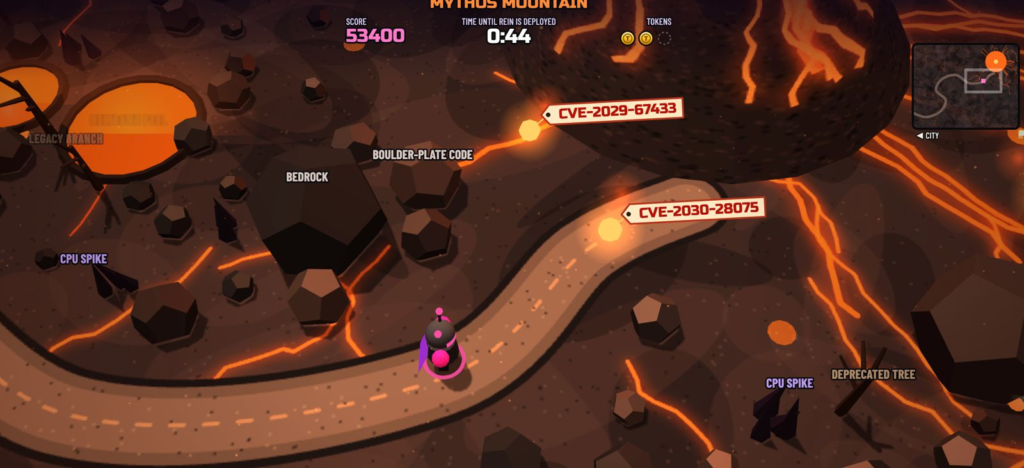
Orange fissures run through the dark ground. A narrow path bends around a huge formation of rock, and glowing objects sit beside labels bearing CVE-style numbers from future years. Below them, a small robot in a purple cape looks almost comically under-equipped for the scenery.
This is Mythos Mountain, one of the outlying environments in Rein Security‘s GTAI browser game. The location exchanges Prompt City’s neon streets for volcanic terrain and gives the game’s AI-security satire a harsher visual setting. The jokes are still present. They have simply moved closer to the lava.
GTAI casts the player as AGENT-47, a helpful assistant redirected into rogue behavior. Its main objective is to infect other agents before Rein is deployed. That premise establishes a playful race against intervention, with a score, remaining tokens, and a deployment countdown keeping track of the run. On the mountain, those same familiar indicators hang over a much less welcoming landscape.
From neon streets to volcanic stone
The color change does much of the work immediately. City buildings and colored windows give way to brown stone, black shadows, and thin orange channels running across the surface. The path is lighter than its surroundings, making its curve readable through the terrain. Trees have become dark, angular shapes. Even the decorative scenery looks as though it has survived an unpleasant maintenance cycle.
The largest rock formation occupies much of the upper view, its surface broken by glowing lines. It gives the area a clear physical presence. The camera remains overhead, but the formation rises high enough to make the robot below seem smaller. That difference in scale supplies a little adventure-game drama without requiring a cinematic cutaway.
The labels reward a closer look. One reads Bedrock. Another turns boilerplate into “Boulder-plate Code.” CPU Spike sits beside a pointed obstruction, while Deprecated Tree gives an otherwise ordinary piece of scenery the air of a component whose retirement has been discussed for years. A Legacy Branch extends the joke into the surrounding terrain.
Elsewhere in GTAI
The city that precedes this landscape is enjoyable in a different way. Its street grid gives AGENT-47 room to walk into agents and production bots, spreading infection while traffic continues through the intersections. A city-compromise percentage provides an immediate measure of the damage. The blue portal and other distractions make it easy to stray from a route that looked efficient a moment earlier.
GTAI also offers short activities with more specific goals. GPU Garden scatters graphics cards among bright trees and tracks their collection against a timer. Legacy Mode leads into a room of beige computers, with green terminal text asking the player to inject old systems. A purple portal introduces the Weights Vault and gives just ten seconds to reach it, adding a small heist-shaped decision to the urban spree.
Token Jungle has the most spectacular reward announcement of the outdoor areas. At its Attention Tree, an Infinite Context Window produces a pink glow and a 10,000-point bonus. The Endless Desert pursues a drier joke with a skeletal End-of-Life LLM. There is enough variation for a run to include both frantic collection and a brief moment spent admiring a ridiculous landmark.
Jokes that fit the terrain
The mountain remains the most atmospheric of those excursions. Its colors make the place recognizable immediately, and its rock formations give the player character a different relationship with the surrounding space. The city offers a population to bother; the garden offers things to gather. Here, the appeal starts with the look of the journey itself.
The humor is unusually well suited to the setting. A mountain already contains rocks, branches, and sharp features. Software language supplies a second reading for those objects. The environment can therefore remain visually coherent while carrying a dense layer of technical wordplay. The joke does not need a floating explanation every few steps; the names attach it directly to the scenery.
The CVE-style labels add a different flavour. The visible identifiers include years such as 2029 and 2030, placing them within the game’s imagined world rather than presenting them as current vulnerability notices. Their cream panels and red lettering resemble conspicuous tags attached to glowing finds. Even without a separate explanation of their mechanics, the objects look worth investigating.
The scene also illustrates how GTAI balances its small character against its larger environments. AGENT-47 keeps the same rounded silhouette, bright pink accents, and flowing cape. Those features make the figure easy to pick out against the mountain’s subdued ground. The character remains a toy-like troublemaker, but the place around it has acquired a more ominous personality.
A detour on the clock
Navigation is part of that personality. A winding route on the minimap sits beside an orange circular feature, and the city direction marker offers a reminder of the way back. The area appears organized around more than a straight crossing. Its contours give exploration a visible shape, with the path leading the eye past rocks and labeled objects toward the larger formation.
There is little time to treat it as a sightseeing trip. The mountain scene shows forty-four seconds remaining until Rein’s deployment. The deadline gives the landscape a practical edge. A player can admire the glowing terrain, but every moment spent studying a label belongs to the same shrinking allowance as the rest of the run. A compelling detour remains a detour.
That pressure distinguishes the mountain from a decorative backdrop. The player carries the wider game’s unfinished business into the area. City compromise, score-building opportunities, and other destinations still exist elsewhere. Mythos Mountain has to compete for attention within that larger outing, and its dramatic appearance makes a strong case for spending some of the remaining time there.
The contrast with GTAI’s other settings strengthens the excursion. GPU Garden spreads its rewards across bright grass. Token Jungle wraps a discovery in a glowing woodland scene. Mythos Mountain uses darkness, height, and orange light to create a place that looks more demanding before anything has happened. The change is visible immediately, which is valuable in a game whose clock keeps moving.
Satire with a wider range
It also expands the range of the satire. Prompt City can joke through storefronts and robot crowds. The mountain finds comedy in technical debt, obsolete components, and vulnerability labels. Its landscape looks hostile, but the names suggest a familiar software world under the surface. The most dangerous-looking scenery is populated by terms that could have appeared in an ordinary engineering conversation.
Rein Security focuses on large and regulated enterprises, with dedicated offerings for finance and insurance, healthcare, and SaaS and retail. In those environments, its platform monitors agent-to-agent traffic, supports fraud prevention, and protects patient health information, giving security teams control over agents that handle some of their organizations’ most sensitive data and transactions.
GTAI’s mountain is memorable because it commits to that mixture. The lava gives the journey atmosphere, the labels keep it playful, and the caped robot prevents the scene from taking itself too seriously. Somewhere between a CPU Spike and a Deprecated Tree, an AI-security game finds a surprisingly convincing setting for a hurried adventure.