

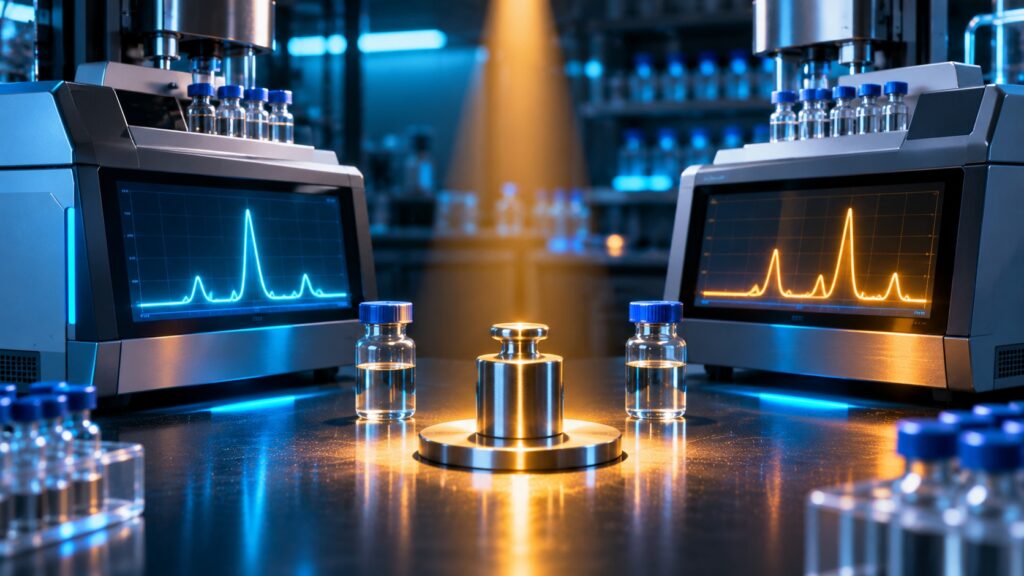
Two sophisticated laboratory instruments can examine the same material and produce different numerical results. Both instruments may appear to be operating normally, their software may report no errors, and their measurement displays may suggest considerable precision. Nevertheless, the results may disagree in ways that affect the interpretation of a scientific investigation.
This challenge illustrates why calibration technology occupies an important position in modern laboratory science. Instruments do not automatically produce dependable measurements simply because they incorporate advanced electronics, sensitive detectors or sophisticated analytical software.
For scientists investigating peptides and other biomolecules, measurement reliability depends partly on understanding how instruments respond to known references, how their performance changes over time and how uncertainty influences the conclusions drawn from experimental observations.
Why Digital Precision Can Create False Confidence
Modern laboratory instruments frequently display measurements with several decimal places. This level of numerical detail can create the impression that the underlying measurement is exceptionally accurate.
However, the number of digits displayed by an instrument does not establish how closely its reading corresponds to the quantity being measured.
A digital balance, for example, may consistently display a detailed numerical value while exhibiting a systematic measurement bias. Its readings could be highly repeatable without accurately representing the actual mass of the material under examination.
Similar considerations apply to temperature sensors, optical detectors and other measurement technologies used throughout scientific laboratories.
Readers consulting this scientific information resource or other websites covering emerging peptide research can benefit from recognizing the distinction between numerical precision and demonstrated measurement reliability.
Scientific instruments provide information through physical and electronic processes. Understanding the performance of those processes remains essential, regardless of how sophisticated the resulting digital display appears.
Calibration Establishes a Relationship Between an Instrument and a Reference
Calibration allows measurement specialists to examine how an instrument responds when compared with appropriate reference standards. The resulting information helps establish the relationship between the instrument’s indications and the quantities those indications are intended to represent.
Calibration should not be confused with automatically repairing or adjusting an instrument. A calibration exercise may reveal a difference between an instrument’s response and an established reference without physically changing the instrument itself.
Adjustment, when necessary, is a separate activity intended to modify instrument performance. Subsequent measurements may then be needed to evaluate the consequences of that adjustment.
This distinction matters because a calibration record can contain valuable evidence about measurement behavior even when an instrument does not require modification.
For researchers, the important question is whether the available calibration information supports the intended scientific measurement. Different investigations may require different levels of measurement performance, depending on the quantities involved and the significance of potential errors.
A measurement system suitable for one investigation may not necessarily provide adequate performance for another.
Instrument Drift Is Often Gradual Rather Than Obvious
Laboratory equipment can experience changes in performance throughout its operational life. Electronic components age, mechanical systems experience wear and environmental conditions can influence sensitive measurement processes.
These changes do not always produce obvious equipment failures. An instrument may continue generating results while its response gradually moves away from previously established behavior.
This phenomenon is commonly described as drift.
Consider a hypothetical research facility that repeatedly measures a stable reference material over several months. Individual results might appear reasonable when examined independently. However, a chronological comparison could reveal a gradual movement in the reported values.
Without historical performance records, researchers might not recognize that the measurement system itself is changing.
Monitoring instrument behavior over time provides a way to identify patterns that may be difficult to detect through isolated measurements. Such monitoring becomes particularly valuable when researchers need to compare experimental observations collected across extended periods.
The objective is not simply to determine whether an instrument remains operational. It is to understand whether its measurement performance continues to support the scientific questions being investigated.
How Environmental Conditions Affect Measurement Technology
Scientific instruments operate within physical environments that can influence their behavior. Temperature fluctuations, humidity, vibration and other environmental factors may affect different measurement systems in different ways.
An analytical balance may be sensitive to mechanical disturbances or air movement. Optical equipment can experience changes associated with detector stability or environmental temperature. Electronic measurement systems may also respond differently under changing operating conditions.
These considerations become important when laboratories attempt to compare measurements obtained in different facilities.
Two instruments of the same model may operate under substantially different environmental circumstances. Their technical specifications alone cannot establish that every measurement collected by those instruments is directly comparable.
Appropriate environmental records can help researchers investigate unexpected differences. Such information provides additional context when determining whether discrepancies originate from the material being examined or the conditions surrounding the measurement.
Modern monitoring technologies make it easier to preserve this information alongside experimental records, supporting more informed scientific interpretation.
Measurement Reliability Across Different Areas of Peptide Science
Peptide research encompasses molecules with different structures, physical properties and biological characteristics. The analytical requirements associated with these compounds depend on the particular scientific questions being investigated.
Researchers examining molecular identity may require different measurement technologies from those investigating chemical composition or biological responses.
The diversity of compounds discussed within metabolic science can be seen in resources organized around research categories, including https://peptidesriverside.com/weight-loss-peptides/.
However, belonging to the same broad research category does not establish that different compounds have equivalent properties or require identical analytical approaches.
Measurement reliability must be considered in relation to the specific material, analytical procedure and scientific objective. Calibration information that supports one type of measurement does not automatically establish the suitability of every other measurement performed within the same laboratory.
Importantly, reliable analytical measurements do not independently establish human safety, clinical effectiveness or regulatory approval. Those questions require separate forms of evidence appropriate to their intended conclusions.
Why Measurement Traceability Extends Beyond Calibration Certificates
The National Institute of Standards and Technology addresses the importance of metrological traceability in its official measurement science guidance.
Traceability connects a measurement result to an established reference through successive, documented calibration relationships. Each relationship introduces uncertainty that must be considered when interpreting the resulting measurement.
According to NIST’s policy, obtaining a calibration certificate for an instrument does not automatically establish traceability for every measurement subsequently produced by that instrument.
The complete measurement process matters. Laboratories must consider how reference information is applied within their own measurement systems and whether the relevant performance characteristics remain appropriately controlled.
This distinction has practical implications for research organizations. A certificate represents evidence associated with a particular calibration activity. The scientific usefulness of that evidence depends on how it relates to subsequent measurements.
Maintaining documented relationships between reference standards, instruments and measurement results helps researchers understand the foundation upon which their analytical conclusions depend.
Measurement Uncertainty Is Not the Same as Scientific Failure
Every measurement involves some degree of uncertainty. Even carefully maintained instruments and well-characterized measurement systems cannot eliminate all limitations associated with determining a physical quantity.
Measurement uncertainty describes the remaining doubt associated with a reported result. Its presence does not automatically indicate that an experiment was conducted incorrectly.
Instead, evaluating uncertainty allows researchers to communicate how confidently a measurement can be interpreted.
Imagine two hypothetical laboratories reporting slightly different values for the same measurable property. Without understanding the uncertainty associated with each result, observers may conclude that the laboratories disagree substantially.
However, the apparent disagreement may be compatible with the measurement limitations of the respective systems. Alternatively, the difference may be larger than those limitations would reasonably explain, indicating a need for additional investigation.
These interpretations depend on information that extends beyond the reported numerical values themselves.
Transparent communication of measurement uncertainty therefore helps prevent both unwarranted confidence and unnecessary rejection of scientifically compatible findings.
How Connected Laboratory Systems Support Equipment Management
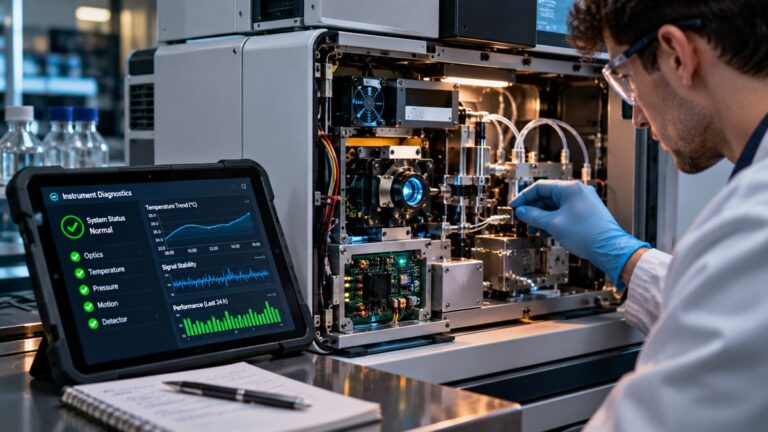
Digital laboratory platforms can help organizations maintain information about instrument performance, calibration history, maintenance activities and documented equipment changes.
By connecting these records with experimental information, researchers can more easily investigate whether changes in measurement results coincide with changes in equipment behavior.
For example, a laboratory reviewing historical analytical results may discover that an unexpected pattern appeared shortly after an instrument underwent maintenance. This relationship does not establish that maintenance caused the discrepancy, but it provides a useful direction for scientific investigation.
Connected systems can also help organizations identify equipment requiring review and make historical documentation more accessible to authorized personnel.
Nevertheless, digital infrastructure cannot guarantee reliable measurements by itself. Automated notifications, electronic records and performance dashboards remain dependent on the accuracy and completeness of their underlying information.
The value of these technologies comes from their ability to support informed measurement management rather than replace scientific judgment.
Transparency Matters When Scientific Organizations Discuss Analytical Quality
As laboratory technologies become more visible in public scientific communication, readers increasingly encounter references to calibration, analytical testing and measurement quality outside specialist publications.
Understanding the identity and stated purpose of the organization publishing that information can provide useful context. Background pages such as Peptides Riverside’s About Us page offer readers a starting point for examining organizational descriptions.
However, statements appearing on organizational websites should not be treated as independent evidence of laboratory competence, regulatory compliance or validated measurement performance.
Claims about analytical quality require appropriate supporting documentation. Researchers and readers should distinguish between educational explanations of measurement science and evidence demonstrating the actual performance of a particular laboratory or analytical procedure.
Maintaining that distinction allows scientific information to remain accessible without creating unsupported impressions about the capabilities of individual organizations.
Better Instruments Still Require Better Measurement Practices
Advances in laboratory technology continue to expand the types of scientific questions researchers can investigate. Sensitive detectors, improved electronics and connected information systems provide capabilities that earlier generations of scientific equipment could not offer.
However, technological progress does not remove the fundamental need to understand how measurements are produced.
Researchers must still consider the relationship between instrument responses and appropriate references, the influence of environmental conditions, changes in performance over time and the uncertainty associated with reported results.
These considerations become especially important when scientific findings are compared across laboratories or incorporated into broader research discussions.
Calibration technology contributes to reliable science by making instrument behavior more understandable. Its greatest value emerges when calibration information is combined with meaningful documentation, appropriate measurement controls and transparent interpretation.
A sophisticated instrument may produce an impressive numerical result, but dependable scientific evidence requires understanding why that result deserves confidence.