CPG organizations face 25%-35% forecast inaccuries annually, with inventory representing the largest asset on most balance sheets. Now you are here because you know that most of this investment doesn’t deliver expected returns. The usual culprit gets blamed—demand forecasts. But that’s not where the problem actually lives.
Machine learning delivers solid forecast accuracy on stable SKUs. Because a 65% improvement in forecast accuracy has been reported with AI-driven planning. Yet planning outcomes stay problematic: excess inventory accumulates, service levels fluctuate, capital gets locked up. The issue isn’t prediction quality. It’s that inventory decisions can’t move fast enough when demand signals shift mid-execution. This is where ai demand forecasting has improved prediction layers, but operational responsiveness still lags.
Traditional planning cycles can’t close this gap because they’re built for periodic optimization, not continuous adjustment. With 79% of organizations reporting AI agent adoption, agentic AI addresses this differently—restructuring how demand signals and inventory positions interact inside a live decision system. This structural shift is redefining Demand Forecasting and Inventory Optimization as a synchronized process rather than two disconnected activities.
Demand Forecasting Is Becoming a Continuous Control Loop
In traditional demand planning, forecasts are generated, reviewed, approved, and released. Even when AI demand forecasting is used, the forecast remains a relatively static object until the next cycle.
Agentic AI breaks this pattern. Multiple forecasts coexist by horizon and purpose. Short-term demand signals drive replenishment with tight error tolerance. Medium-term forecasts influence inventory positioning. Longer-term signals shape capacity commitments. These forecasts are continuously revised as new signals arrive, not versioned and reconciled later – an approach aligned with Agentic AI-powered demand forecasting principles.
What changes in practice: forecast revision is no longer treated as instability. It is expected behavior. Demand agents actively suppress outdated signals, adjust confidence bands, and overwrite prior assumptions when decision context changes. For planning teams, this shifts focus from “Which forecast is right?” to “Which forecast is usable right now?” That distinction matters when retailer promotional windows move by 10 days and inventory is already positioned based on outdated timing. This continuous adjustment layer strengthens ai demand forecasting in execution environments ai demand forecasting.
Inventory Decisions Move Upstream
Inventory carrying costs represent a major chunk of inventory value for CPG companies. The problem isn’t the cost—it’s adaptation speed. Traditional approaches recalculate safety stock periodically, leaving weeks between forecast updates and inventory adjustments.
Agentic AI changes this fundamentally. When demand shifts, these systems automatically adjust: restocking triggers fire, shelf availability updates in real-time, and shipments reroute around delays—all without manual intervention.
The intelligence works across multiple fronts.
– Multi-variable analysis analyses historical data alongside weather patterns and supply risks.
– Predictive restocking automatically generates purchase orders based on actual demand signals and supplier lead times. Supply disruptions get flagged months early through geopolitical and regional monitoring.
– SKU performance tracking constantly analyzes profitability versus shelf space occupancy.
–ERP integration layers predictive intelligence onto existing systems without disrupting workflows.
This is where AI in inventory management matters—not in calculating reorder points, but in deciding when inventory should contract, expand, or relocate as demand certainty evolves.
Forecasts Are Only Valuable If They Are Feasible
One of the fastest ways agentic demand systems fail is by producing forecasts that are technically accurate but operationally infeasible. For example – A forecast predicting 35% promotional lift is operationally meaningless if supplier capacity maxes out at 20% over baseline, or if lead times mean inventory can’t arrive before the promotional window closes.
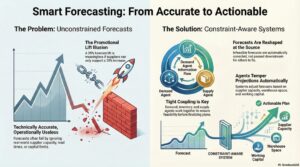
In mature agentic architectures, constraint reasoning is embedded directly into demand forecasting and inventory decisions. AI demand forecasting systems incorporate these constraints earlier in the signal lifecycle. Demand agents discount signals that cannot be fulfilled within physical or contractual limits. Inventory agents adjust positioning based on perishability and irreversible commitments. Supply constraints assert precedence when decisions cross points of no return.
This tight coupling changes forecasting behavior itself. Forecasts that violate constraints are not passed downstream for correction; they are reshaped at the point of generation. A demand agent forecasting aggressive new product velocity will automatically temper projections if supplier capacity, DC space availability, or working capital ceilings can’t support the implied inventory build. This constraint-aware interaction further advances Demand Forecasting and Inventory Optimization maturity.
Time, Not Accuracy, Becomes the Dominant Variable
Consider the temporal dominance problem: A CPG brand receives syndicated data showing competitive promotional activity will intensify in 6 weeks. If their production schedule locked 8 weeks ago, that signal—no matter how accurate—cannot change committed output. If inventory is already in-transit, the signal might influence allocation but not total volume. If the signal arrives 10 weeks out, it can reshape both production and positioning.
Agentic systems explicitly model this temporal dominance, ensuring late-arriving signals don’t destabilize locked decisions. For planning teams: not every forecast deserves action. Agentic demand planning suppresses signals that arrive too late to change inventory outcomes, preventing oscillation and over-correction. This is critical in CPG where 64% of supply chain leaders report increased complexity year-over-year—geopolitical instability, labor constraints, regulatory shifts—all generating demand signals at varying lead times. AI in inventory management plays a key role in aligning these timing constraints with stock decisions.
Orchestration Is Where Forecasting Meets Inventory
The most visible improvements in agentic systems don’t come from better models, but from better orchestration. 47% of CPG and retail companies are deploying or assessing agentic AI, but success hinges on decision precedence: Who acts first? Who can revise? When does stability override responsiveness?
The design challenge is balancing autonomy with coherence. If every agent operates independently, the system oscillates. If coordination requires constant human arbitration, execution speed dies. This is where constraint propagation and event-driven coordination become critical. When finance sets working capital ceilings, that constraint propagates to every inventory decision in real-time. When a retailer shifts promotional timing, that event triggers coordinated recalculation across demand, inventory, and replenishment agents—not sequential handoffs that introduce days of lag.
1Platform provides the unified signal foundation so agents operate on consistent truth without data reconciliation delays. Agenthood AI governs how agents sequence decisions, negotiate constraints, and learn from outcomes without collapsing autonomy into rigid workflows.
The Shift That Matters
Agentic AI does not make demand forecasting or inventory optimization magically better. It makes their interaction explicit. Forecasts only matter if they change inventory decisions in time. Inventory only improves if it reflects the economic reality of demand uncertainty.
For CPG leaders, the differentiator is no longer forecast accuracy—most organizations have mature predictive models for stable SKUs. It is whether the organization has designed a decision system where demand forecasting and inventory management reinforce each other under real-world constraints: promotional windows that shift, retailer partnerships with conflicting priorities, supply capacity that can’t scale instantly, and working capital limits that override volume optimization.
Accuracy was the old goal. Decision coherence is the new one.
At Polestar Analytics, this principle guides how demand and inventory decisions are architected—explicitly connected, economically grounded, and operationally aligned.