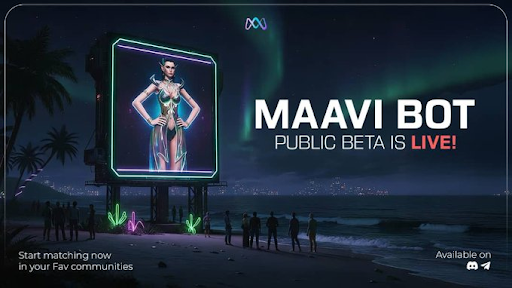
AI-driven digital identities are starting to move from concept to daily use, and several early platforms are testing how far this idea can scale. One such name is MaAvatar – a web3 dating ecosystem – which recently released the beta version of its flagship product, Maavi Bot, in January 2026.
With early access now open, the focus has shifted to how the product behaves in real environments, how users interact with it, and how this phase feeds into a broader ecosystem that includes AI avatars, meta experiences, and a native token economy.
Early adopters tend to watch these moments closely. Beta phases often show where a product is headed, how the team responds to feedback, and whether early incentives line up with long-term value. Maavi Bot sits at that exact intersection right now.
In this post, we’ll understand where the bot is headed next and what’s the growth play behind it.
Key Takeaways
- Maavi Bot’s beta launch acts as a live testing ground for product and community signals.
- Early users gain hands-on exposure before wider rollout phases.
- Feedback loops during beta shape roadmap decisions and feature prioritization.
- The bot ties directly into Maavatar’s larger AI-driven meta ecosystem.
- Early positioning often aligns with future access, rewards, and governance layers.
Why the Beta Phase Matters More Than a Launch
A beta phase filters intent. Users who join early usually explore features more deeply, break flows faster, and give clearer feedback. For Maavi Bot, this stage allows the team to observe real trading behavior, automation preferences, and usability patterns instead of relying on closed testing environments.
This phase supports two goals at once. Product refinement happens in public, and the community begins forming around shared experimentation. This dynamic often leads to stronger retention once the product moves beyond beta.
Maavi Bot is part of a modular AI system rather than a standalone tool, and the beta phase tests how smoothly that module fits within the broader architecture of the ecosystem.
Inside Maavi Bot’s Growth Strategy
Maavi Bot’s growth approach avoids aggressive exposure pushes. The strategy leans on controlled access, product-led discovery, and gradual feature rollouts.
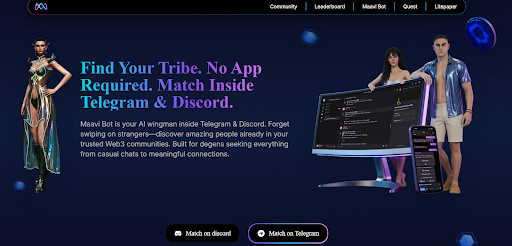
Find your matches in Telegram and Discord
Early growth is driven by:
- Limited beta availability creates a natural filter for engaged users.
- Feature visibility lets users explore real use cases rather than demos.
- Community feedback and updates reflect observed behavior.
- Clear roadmap alignment links Maavi Bot to the MaAvatar metaverse in a broader way.
This structure reduces noise and helps the product mature before scaling wider.
The Role of Early Adopters in the Ecosystem
Early users do more than test features. They shape how the platform evolves. Their usage data informs model tuning, interface decisions, and automation logic. Their feedback influences priority fixes and additions.
In Maavi Bot’s case, early adopters closely watch the ecosystem shifts. As MaAvatar expands, those who already interact with Maavi Bot gain context earlier than the broader market. Users can find their special someone on Telegram and Discord with Web3’s first AI-powered matchmaking bot.
This positioning often matters when incentives, access tiers, or ecosystem rewards come into play.
Where Maavi Bot Fits Within MaAvatar’s Bigger Picture
MaAvatar is building an AI-first ecosystem that connects digital identity, automation, and interaction across social meta environments. Maavi Bot sits at the entry layer of this system, giving users a direct way to engage with AI-driven workflows before exploring broader experiences across the MaAvatar metaverse.
Instead of relying on abstract concepts, Maavi Bot offers a hands-on AI experience that reflects how automation, user control, and personalization work inside Maavatar’s ecosystem. This early interaction helps users get familiar with the platform’s logic as it innovates and expands Web3 dating and immersive spaces within the social metaverse.
As MaAvatar rolls out additional layers, including avatar-based interactions and utility tied to Maav tokens ($MAAVI), Maavi Bot acts as a bridge between early product access and long-term ecosystem participation.
$MAAVI tokens will be launched soon, which will power premium features, NFTs, and exclusive benefits in the MaAvatar metaverse.
How the Roadmap Creates Long-Term Value for Early Contributors
MaAvatar’s roadmap outlines a phased expansion where early participation plays a direct role in shaping the ecosystem.
- The journey begins with the Maavi NFT collection launch and airdrop, followed by multi-chain token listings and liquidity expansion, setting the base for wider access to $MAAVI.
- Governance through DAO gives early users a voice in decisions that guide product direction and community priorities.
- As the roadmap moves into the closed testing phase of the MaAvatar metaverse, early contributors gain exposure to social layers that extend beyond automation.
- With staking programs, public meta launch, and ecosystem monetization scheduled across later phases, users engaging early through Maavi Bot position themselves closer to feature access, token utility, and participation as the platform scales globally.
The Bottomline
Maavi Bot’s beta phase reflects a measured growth path rather than a fast splash. Early adopters gain real exposure to the product, direct influence on its evolution, and proximity to Maavatar’s wider AI and meta roadmap. For users who value early access paired with long-term ecosystem thinking, this phase offers more than testing privileges – a ground to explore, build, and shape the network.
Plus, the Vibe Campaign is now underway on Taskon, running from February 16th. Over 30 days, members can engage with the MaAvatar ecosystem in a deeper way through quests, daily check-ins, and community activities – while earning rewards along the way. To get started, set up a profile on Maavi Bot, work through the available tasks, and check in regularly.
Visit www.maavatar.io to know more about the upcoming $MAAVI token launch and new updates.