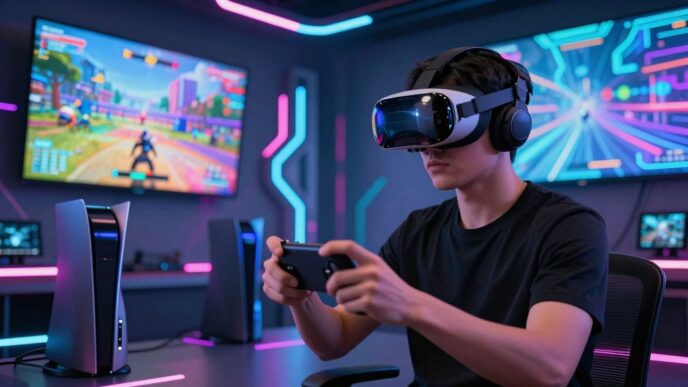

Hey everyone! So, 2026 is shaping up to be a pretty wild year for gaming. We’re seeing some seriously cool new stuff coming out that’s going to change how we play. From way more realistic graphics to games that feel like you’re actually there, it’s all pretty exciting. Let’s check out some of the most interesting emerging game technologies that are making waves.
Key Takeaways
- Displays are getting better, making games look sharper and more colorful than ever before.
- New haptic feedback tech will let you feel more in-game actions, like textures or impacts.
- AI is making game worlds smarter and more alive, with characters that react better and environments that change based on what you do.
- Cloud gaming means you can play high-end games on almost any device without needing a super powerful computer or console.
- VR and AR are becoming more common, offering deeper immersion and new ways to interact with game worlds.
The Evolution of Immersive Gaming Experiences
It feels like just yesterday we were marveling at graphics that looked "almost real." Now, in 2026, the line between the digital and the physical is blurring faster than ever, thanks to some seriously cool tech. We’re not just playing games anymore; we’re stepping into them.
Advancements in Display Technology
Remember those bulky VR headsets? They’re getting sleeker, lighter, and way more powerful. We’re seeing displays with higher resolutions and wider fields of view, making virtual worlds feel less like a screen in front of your face and more like a place you’re actually standing in. Think crystal-clear visuals that make you forget you’re wearing anything at all. Plus, the refresh rates are getting so high, motion blur is practically a thing of the past. It’s all about making that virtual reality feel, well, real.
Next-Generation Haptic Feedback
This is where things get really interesting. Haptic feedback isn’t just about a controller buzzing anymore. We’re talking about suits, gloves, and even specialized chairs that can simulate textures, impacts, and environmental effects. Imagine feeling the rumble of an engine, the subtle texture of a virtual object, or even the impact of raindrops. This level of sensory input is a game-changer for immersion. It adds a whole new dimension to how we interact with games, making every action feel more meaningful and present.
AI-Driven Dynamic Environments
Games are becoming less static and more alive. AI is now capable of creating environments that react to your presence and actions in sophisticated ways. Weather patterns might shift based on in-game events, or ecosystems could evolve over time. This means that the game world isn’t just a backdrop; it’s a living, breathing entity that changes and adapts. This makes for incredibly replayable experiences, as no two playthroughs will ever be exactly the same. It’s like exploring a world that’s genuinely unique to you, every single time you log in. The potential for emergent gameplay here is huge, leading to experiences that feel truly personal and unpredictable. The growth of the XR market is a big part of this push towards more dynamic and responsive game worlds.
AI and Machine Learning in Game Development

It feels like AI and machine learning are everywhere these days, and video games are no exception. These technologies are really changing how games are made and how we play them. It’s not just about making things look prettier; it’s about making the game worlds feel more alive and responsive.
Procedural Content Generation
Remember when games felt a bit samey after a while? Procedural content generation, or PCG, is a big reason why that’s changing. Instead of artists hand-crafting every single tree, rock, or even entire levels, algorithms can create them. This means games can have much larger worlds, or worlds that change each time you play. Think about it: an infinite dungeon, a planet with unique flora and fauna every time you land, or even just varied weather patterns that actually affect gameplay. It’s a way to get more variety without needing an army of designers.
Smarter Non-Player Characters
NPCs have always been a bit hit or miss, right? Sometimes they feel like cardboard cutouts, just standing there waiting for you. But AI is making them much more believable. We’re seeing NPCs that can react to the player’s actions in more complex ways, remember past encounters, and even coordinate with each other. Imagine enemies that learn your tactics and adapt, or friendly villagers who have their own daily routines and react realistically to events happening around them. This makes the game world feel less like a stage set and more like a living, breathing place.
Personalized Player Journeys
This is where things get really interesting for us players. AI can analyze how you play – what you like, what you struggle with, your preferred playstyle – and then tailor the game experience just for you. This could mean adjusting the difficulty on the fly so you’re always challenged but not frustrated, offering quests that align with your interests, or even subtly changing the story based on your choices. It’s like the game is getting to know you and adapting to make sure you’re having the best time possible. It moves away from a one-size-fits-all approach to something much more individual.
The Rise of Cloud Gaming and Streaming
Remember when playing the latest games meant shelling out for a pricey console or a beefy PC? Those days are fading fast. Cloud gaming and streaming services have really changed the game, making high-fidelity experiences accessible to pretty much anyone with a decent internet connection. It’s like having a super-powered gaming rig in the cloud, ready to stream directly to your screen.
Ubiquitous Access to High-Fidelity Games
This is the big one, right? No longer are you tied to specific hardware to play the newest AAA titles. Whether you’re on a laptop, a tablet, or even a smart TV, you can jump into graphically intense games. This shift is powered by sophisticated infrastructure, with platforms using Multi-CDN strategies and edge caching to make sure your game runs smoothly. It means less lag and a better experience overall, no matter where you are. It’s pretty wild to think about playing something like the latest "Cyberpunk 2077" on a device that couldn’t normally handle it.
Reduced Hardware Barriers
Because the heavy lifting is done on remote servers, the need for expensive, cutting-edge hardware is significantly lowered. This opens the door for a much wider audience to enjoy gaming. Instead of upgrading your graphics card every couple of years, you’re just paying for a subscription service. This makes gaming more inclusive and affordable for a lot of people who might have been priced out before. Think about it: you can play games that would normally cost thousands in hardware for just a monthly fee.
Cross-Platform Play and Progression
Another huge win for cloud gaming is how it breaks down platform walls. Many services now allow you to start a game on one device and pick it up on another without missing a beat. Your save data and progress travel with you. This kind of flexibility is a game-changer for how we play. You could be playing on your PC at home, then hop onto your phone during your commute, and your game state is right there waiting for you. It’s all about playing where and when you want, without the usual hassle.
Virtual and Augmented Reality’s Continued Ascent
It feels like VR and AR have been ‘the next big thing’ for a while now, right? But 2026 is really shaping up to be the year where these technologies move from niche gadgets to something much more common. We’re seeing a real push to make these experiences more believable and, honestly, more accessible.
Enhanced VR Immersion
Virtual reality is getting seriously good at making you feel like you’re actually there. The headsets themselves are lighter, have better screens, and offer wider fields of view, which cuts down on that "screen door effect" people used to complain about. But it’s not just about what you see. The real game-changer is how much more you can interact with the virtual world. Think about haptic feedback – it’s not just buzzing controllers anymore. We’re talking about gloves and even full-body suits that let you feel textures, impacts, and resistance. This makes everything from picking up an object to swinging a sword feel way more real. It’s a big step towards making VR feel less like a game and more like a place you can visit.
AR Integration in Mainstream Gaming
Augmented reality is also finding its footing, and it’s doing it by blending the digital with our everyday world. Instead of being shut off in a headset, AR games can use your actual surroundings. Imagine a puzzle game where the clues appear on your coffee table, or a strategy game where your living room floor becomes a battlefield. This kind of integration makes gaming feel more present and less isolating. We’re also seeing AR features pop up in mobile games, using your phone’s camera to bring characters and elements into your real-world view. It’s a smart way to get more people playing without needing expensive new hardware.
The Metaverse and Persistent Virtual Worlds
And then there’s the whole "metaverse" idea. While it’s still a bit fuzzy, the core concept is about creating persistent online spaces where people can socialize, play, and create. VR and AR are the main ways we’ll likely access these worlds. By 2026, expect more games and platforms that aren’t just about completing a quest and logging off. They’ll be ongoing experiences where your progress, your creations, and your social connections carry over. This shift means games could become more like virtual communities or even digital extensions of our lives. It’s a big vision, and while it’s still developing, the building blocks are definitely falling into place.
Innovations in Game Engines and Development Tools
Game engines are the bedrock of modern game creation, and the tools developers use are constantly getting better. It’s not just about making prettier graphics anymore, though that’s definitely a big part of it. We’re seeing engines become more powerful and flexible, which means developers can spend less time wrestling with code and more time actually making the game fun. This shift is pretty significant for the industry, impacting everything from indie studios to AAA giants. The whole process of game development is getting streamlined, which is good news for all of us waiting for new games.
Real-Time Ray Tracing and Global Illumination
This is a big one. Real-time ray tracing is finally becoming more accessible and practical for game engines. What does that mean for us players? It means lighting, shadows, and reflections that look incredibly realistic. Think about how light bounces off surfaces in the real world – ray tracing aims to replicate that. This technology makes virtual worlds feel so much more believable. Global illumination, which works hand-in-hand with ray tracing, simulates how light spreads throughout an environment, affecting all surfaces. It’s a complex process, but the result is a visual fidelity that was previously only achievable in pre-rendered cinematics. We’re talking about games that can look almost photorealistic, making the immersive experience that much stronger. This advancement is a key part of why games are starting to look so good, and it’s only going to get better as hardware and software continue to improve. It’s a game-changer for visual storytelling.
Advanced Physics and Simulation
Beyond just how things look, how they behave is also getting a major upgrade. Game engines are incorporating more sophisticated physics and simulation systems. This means objects in the game world will interact with each other in more believable ways. Imagine a pile of debris that actually crumbles realistically when you interact with it, or cloth that drapes and moves naturally. These systems allow for more dynamic and unpredictable gameplay moments. Developers can create more complex environmental interactions, leading to emergent gameplay that players can discover. It’s not just about explosions looking good; it’s about the entire world feeling more alive and responsive. This level of detail adds a layer of depth that makes games feel more engaging and less like static dioramas. The goal is to make the game world feel like a real place, with consistent rules governing how everything works.
Streamlined Cross-Platform Development
Making games for multiple platforms used to be a huge headache. Developers would often have to create separate versions of a game for PC, PlayStation, Xbox, and so on. But game engines are getting much better at handling cross-platform development. This means developers can write their game code once and deploy it across different systems with fewer modifications. This saves a ton of time and resources. For us, it means more games are likely to be available on our preferred platform, and we might even see better consistency in performance and features across different devices. It also makes cross-play and cross-progression much more feasible, allowing friends to play together regardless of what hardware they own. This is a huge step towards a more connected gaming future, making it easier for everyone to jump into the latest gaming trends.
Here’s a quick look at how engine capabilities have evolved:
| Feature | 2024 Capabilities | 2026 Projections |
|---|---|---|
| Real-time Ray Tracing | Basic | Advanced |
| Physics Simulation | Standard | Complex |
| Cross-Platform Tools | Improving | Robust |
| AI Integration | Growing | Deep |
| Shader Complexity | High | Very High |
The Future of Gaming Hardware

So, what’s next for the boxes and bits that power our gaming worlds? It’s a question that gets us all excited, right? We’re not just talking about incremental upgrades anymore; we’re seeing some pretty big shifts happening. Think faster processors, way more memory, and graphics cards that can do things we only dreamed of a few years ago.
Next-Gen Console Capabilities
Consoles are really stepping up their game. We’re seeing a push towards even faster loading times, thanks to advanced SSD technology that’s practically eliminating those annoying waits. Plus, the graphical power is getting seriously impressive. We’re talking about consoles that can handle incredibly detailed worlds with ray tracing that makes lighting look super realistic. It’s not just about looking pretty, though. These machines are built to handle more complex game logic and AI, meaning games can feel more alive and reactive than ever before.
Here’s a quick look at what we’re expecting:
- Smoother Frame Rates: Expect games to run at higher, more consistent frame rates, making gameplay feel fluid.
- Enhanced Visual Fidelity: Higher resolutions and more detailed textures will make virtual worlds pop.
- Faster Loading: Solid-state drives are becoming standard, drastically cutting down wait times.
- Advanced Audio: Immersive 3D audio will put you right in the middle of the action.
The Evolution of PC Gaming Components
PC gaming is always a bit of a wild west, and 2026 is no different. We’re seeing CPUs that are not only faster but also more efficient, meaning you can get more power without your rig sounding like a jet engine. Graphics cards are pushing the boundaries with AI-powered upscaling technologies that let you play games at higher resolutions without a massive performance hit. And don’t forget about RAM – more and faster RAM is becoming the norm, which is great for those massive open-world games that are becoming so popular. The real game-changer for PCs is the continued integration of AI directly into hardware, helping with everything from rendering to game physics.
Emerging Mobile Gaming Hardware
Mobile gaming isn’t just for quick sessions anymore. Phones and tablets are becoming serious gaming devices. We’re seeing screens with incredibly high refresh rates, making fast-paced games feel super responsive. Processors in these devices are getting powerful enough to handle complex 3D graphics that used to be console-exclusive. Plus, battery technology is improving, so you can actually play for more than an hour without needing to find a charger. We’re also seeing more accessories designed specifically for mobile gaming, like attachable controllers and cooling fans, turning your phone into a dedicated handheld console.
Looking Ahead
So, that’s a peek at what’s buzzing in the world of game tech. From mind-bending visuals to smarter gameplay, it feels like we’re on the edge of something big. We’ve seen cool stuff like the potential for super-wide laptop screens for gaming and even chairs that give you a massage. Plus, AI is starting to show up in ways that actually help, not just as a buzzword. And of course, games like Forza Horizon 6 are already showing us what’s possible with new locations and features. It’s an exciting time to be a gamer, and it looks like 2026 is shaping up to be a year full of new experiences and cool advancements. Keep an eye out, because the next big thing might be just around the corner.
Frequently Asked Questions
What are some cool new things happening in gaming displays?
Get ready for screens that look more real than ever! We’re seeing displays that can show way more colors and details, making games pop. Imagine screens that wrap around you or even roll up when you’re not using them, like some neat concepts shown off recently. It’s all about making games feel more like you’re actually there.
How is AI changing video games?
Artificial intelligence, or AI, is making games smarter and more interesting. AI can help create huge game worlds automatically, so there’s always something new to explore. It also means characters in the game, called NPCs, will act more like real people, reacting to what you do and making the game feel more alive. Plus, AI can help tailor the game experience just for you.
What’s the big deal with cloud gaming?
Cloud gaming is like streaming movies, but for games! It means you can play awesome, high-quality games without needing a super powerful computer or console. The game runs on a server somewhere else, and you just play it over the internet. This makes it easier for everyone to jump into the latest games and play on different devices.
Are virtual reality (VR) and augmented reality (AR) still a big deal?
Yes, VR and AR are definitely getting better! VR headsets are becoming more comfortable and realistic, pulling you deeper into virtual worlds. AR is starting to blend into regular gaming too, maybe by adding game elements to your real surroundings. We’re also hearing a lot about the ‘metaverse,’ which is like a huge, shared online world where people can play and interact.
What are game engines, and why should I care?
Game engines are the powerful tools that game developers use to build games. New engines are making it easier to create amazing graphics, like super realistic lighting. They’re also getting better at making things in games behave realistically, like how objects move and interact. This helps developers make even cooler games faster.
What kind of new gaming hardware can we expect?
New consoles are bringing more power, meaning games will look and play better than ever. PC gaming is also getting upgrades with faster parts. Even phones are becoming more capable for gaming, with better screens and processing power. It all adds up to a smoother and more exciting gaming experience across all your favorite devices.