
When you hear the word ‘teleportation,’ you might think of sci-fi shows where characters vanish and reappear somewhere else instantly. But the real deal, quantum teleportation, is quite different and totally real. It’s not about beaming people around, but about moving information using some pretty wild quantum rules. This whole teleport theory stuff is super interesting and could change a lot of things, from how we communicate to how we build computers. Let’s break down what it’s all about.
Key Takeaways
- Quantum teleportation is about transferring quantum information, not physical objects, using quantum states and entanglement.
- It relies on entangled particles, where measuring one instantly affects the other, no matter the distance.
- The process involves creating entanglement, performing a measurement, sending classical information, and then reconstructing the quantum state at the destination.
- Unlike sci-fi, quantum teleportation doesn’t allow for instantaneous travel or the cloning of quantum information due to the no-cloning principle.
- Future uses include super-secure communication, building a quantum internet, and advancing quantum computing and sensing technologies.
Understanding The Fundamentals Of Teleport Theory
When you hear "teleportation," you might picture Captain Kirk zapping from the Enterprise to the surface of a planet. That’s the sci-fi version, right? But in the world of physics, teleportation is a bit different, and honestly, pretty mind-bending. It’s not about beaming people or objects across space. Instead, it’s about transferring information – specifically, the exact state of a quantum particle.
Defining Quantum Teleportation
So, what exactly is quantum teleportation? It’s a process that allows the quantum state of a particle to be transmitted from one location to another, without the particle itself physically traveling. Think of it like sending a blueprint of a particle’s properties, rather than the particle itself. This is achieved using a clever combination of quantum entanglement and classical communication. It’s a real phenomenon that has been demonstrated in labs, and it’s a big deal for future technologies. It’s important to remember that this isn’t about moving matter, but about moving the information that defines that matter at a quantum level. You can read more about the basic protocol on quantum teleportation.
The Role Of Quantum States
At the heart of quantum teleportation are quantum states. In the everyday world, things are pretty straightforward. A light switch is either on or off. But in the quantum world, particles can be in multiple states at once. This is called superposition. A quantum bit, or qubit, can be a 0, a 1, or a mix of both simultaneously. This ability to hold multiple states is what gives quantum computers their power. The quantum state is like a particle’s unique fingerprint, defining all its properties at a specific moment. Teleportation is essentially about copying this fingerprint from one particle to another, distant particle.
Quantum Entanglement Explained
This is where things get really weird and wonderful. Quantum entanglement is a phenomenon where two or more particles become linked in such a way that they share the same fate, no matter how far apart they are. If you measure a property of one entangled particle, you instantly know the corresponding property of the other, even if it’s light-years away. Einstein famously called this "spooky action at a distance." This interconnectedness is the secret sauce that makes quantum teleportation possible. It’s the backbone of quantum entanglement theory and the reason we can even talk about transferring quantum information without physically moving anything. The core idea is that these entangled particles act as a bridge, allowing information to be transferred indirectly.
Historical Milestones In Teleport Theory

Thinking about teleportation often brings up images from sci-fi, but the actual science has a pretty interesting history. It’s not about beaming people across the galaxy, but about moving quantum information. And believe it or not, we’ve been making progress on this for decades.
The First Successful Quantum State Transfer
Back in 1997, a team in Austria led by Anton Zeilinger managed to do something pretty remarkable. They successfully transferred a quantum state from one photon to another. This wasn’t about moving the photon itself, but its specific quantum properties. They did this by entangling two photons and then measuring one of them. This experiment was a big deal because it showed that quantum teleportation, as a concept, was actually possible in the lab. It laid the groundwork for a lot of what we understand about quantum entanglement today.
Advancements In Atom And Ion Teleportation
Things didn’t stop with photons. In 2004, scientists from NIST and the University of Innsbruck took it a step further. They managed to teleport quantum information encoded in individual atoms. They used trapped and entangled beryllium ions to achieve this, moving the quantum states over a short distance. Then, around 2015, researchers at NIST really pushed the boundaries. They transferred quantum information over 100 kilometers of optical fiber. This was a huge jump from previous distances and showed that longer-range transfers were becoming feasible.
Long-Distance Quantum Information Transfer
The push for longer distances continued. In 2017, Anton Zeilinger’s team achieved another significant feat, teleporting quantum information across 143 kilometers. More recently, in 2021, the University of Tokyo demonstrated quantum teleportation over several kilometers within the city, proving its practicality. These experiments are vital because they inch us closer to building a quantum internet. The ability to send quantum information reliably over long distances is key to secure communication and connecting future quantum computers. It’s a complex process, but each successful experiment builds on the last, bringing us closer to understanding the full potential of quantum teleportation.
The Mechanics Behind Quantum Teleportation
So, how does this whole quantum teleportation thing actually work? It’s not like beaming Scotty up, but it’s pretty wild. Think of it as sending a blueprint, not the actual building. The process relies on a few key ingredients working together.
Entanglement Creation and Measurement
First off, you need two particles that are entangled. This is where quantum entanglement comes into play. Imagine you have two coins that are magically linked. If one lands heads, you instantly know the other is tails, no matter how far apart they are. That’s kind of what happens with entangled particles; their fates are intertwined. To start the teleportation process, one person, let’s call her Alice, has the particle whose state she wants to send. She also has one of the entangled particles. She then performs a special kind of measurement on her original particle and her entangled particle together. This measurement mixes their states up.
Classical Communication’s Role
Now, Alice’s measurement gives her some information, but it’s not the full picture of the original particle’s state. It’s more like a set of instructions. She needs to send this information to the other person, Bob, who has the second entangled particle. This is where regular communication comes in – like a phone call or an email. It’s important to remember that this part isn’t instantaneous; it travels at the speed of light, so we’re not breaking any cosmic speed limits here. This classical information tells Bob what to do with his particle.
Reconstructing the Quantum State
Once Bob gets Alice’s message, he performs a specific operation on his entangled particle. Based on the instructions Alice sent, he can manipulate his particle so that it perfectly takes on the exact quantum state of Alice’s original particle. It’s like Bob’s particle becomes a perfect replica of Alice’s particle’s state, even though the original particle never physically traveled. The original state Alice had is destroyed in the process, which is a good thing because it means we can’t just copy quantum information willy-nilly. This whole process is a cornerstone for future quantum information transfer technologies.
Distinguishing Teleport Theory From Science Fiction
When most people hear the word "teleportation," they probably picture something like Star Trek, right? Beaming down to a planet or zapping from one room to another instantly. It’s a cool idea, but the reality of quantum teleportation is quite a bit different, and honestly, maybe even more fascinating in its own way. Quantum teleportation is about transferring information, not matter.
Information Transfer Versus Physical Transport
So, what’s the big difference? Well, in science fiction, teleportation usually means taking a physical object, breaking it down, sending it somewhere else, and putting it back together. Think of it like a super-advanced fax machine for people or things. But in the quantum world, it’s not about moving the actual particles. Instead, it’s about recreating the exact state of a particle at a different location. This is a subtle but really important distinction. We’re talking about sending the blueprint, not the building itself. This process has been demonstrated in labs, showing it’s a real scientific concept, not just a fantasy [714c].
The No-Cloning Principle
One of the main reasons we can’t just copy quantum states is something called the no-cloning theorem. Basically, it says you can’t make an exact duplicate of an unknown quantum state. This is a fundamental rule of quantum mechanics. So, quantum teleportation doesn’t copy the state; it actually transfers it. The original state is destroyed in the process, and a perfect replica appears somewhere else. This is why it’s more like sending a message than making a photocopy.
Limitations Of Current Teleportation
Right now, quantum teleportation has some pretty significant limits. For starters, it’s been done with tiny things like photons and atoms, not people or even complex molecules. The amount of information needed to describe a human being, down to the quantum level, is astronomical. We’re talking about more data than we can currently even imagine handling, let alone transmitting and reconstructing. Plus, there are huge technical hurdles to overcome, like maintaining the delicate entangled states over long distances and dealing with environmental interference. So, while it’s a powerful tool for things like secure communication and quantum computing, don’t expect to be beaming yourself to Mars anytime soon [4ee2].
Here’s a quick look at what we can do:
- Teleporting Quantum States: Successfully transferring the properties of one particle to another.
- Entangled Particles: Using pairs of particles linked in a special way.
- Classical Communication: Sending regular information alongside the quantum data to help reconstruct the state.
It’s a complex process, but the potential applications are huge, even if human transport remains firmly in the realm of fiction for the foreseeable future.
Future Applications Of Teleport Theory
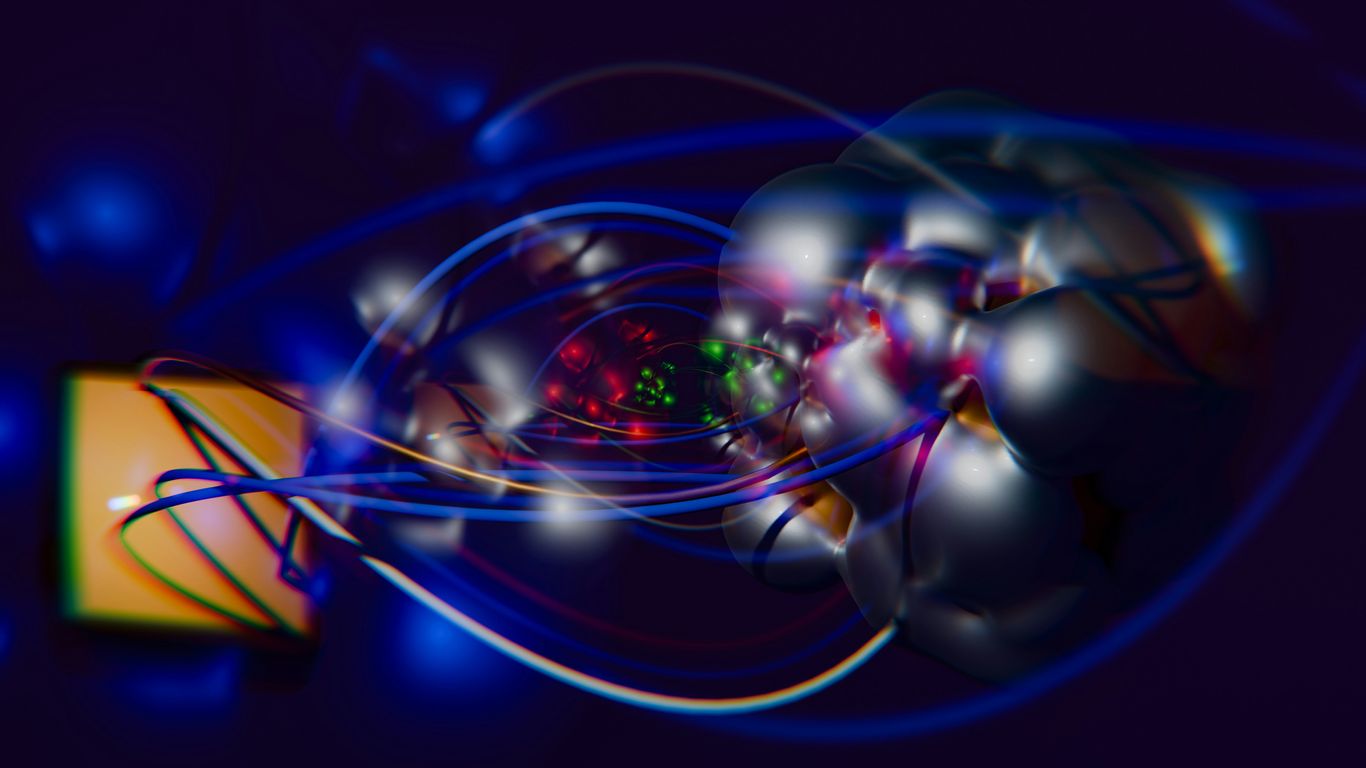
So, what’s next for quantum teleportation? It’s not just about moving tiny bits of information around in a lab anymore. We’re talking about some pretty big changes to how we do things.
Revolutionizing Secure Communication
This is a huge one. Imagine communication that’s basically impossible to hack. Quantum teleportation is key to making that happen. It’s the backbone for something called Quantum Key Distribution (QKD). Basically, if you and I share entangled particles, and I measure mine, yours instantly changes. This means any eavesdropper trying to snoop would immediately mess things up, letting us know. It’s like having a secret handshake that instantly reveals anyone trying to copy it. This could really change how sensitive data is protected, from government secrets to your personal banking information. We’re already seeing experiments that have successfully teleported quantum states between cities, which is a big step toward making this a reality.
Enabling The Quantum Internet
Think of the internet, but way more powerful and secure. That’s the idea behind a quantum internet. Quantum teleportation is what allows us to send quantum information, like those entangled states, across vast distances. This isn’t just about faster downloads; it’s about connecting quantum computers together. Imagine distributed quantum computing, where multiple quantum machines work on a problem together, or ultra-secure global communication networks. It’s a whole new way of connecting the world, and teleportation is the engine that makes it go.
Advancements In Quantum Computing
Quantum computers are already pretty amazing, but teleportation could make them even better. Right now, moving quantum information between different parts of a quantum computer, like between quantum gates, can be tricky. Teleportation offers a way to move these quantum states around without physically moving the particles themselves. This could lead to more complex quantum algorithms and help us solve problems that are currently impossible for even the most powerful supercomputers. Researchers are even looking at on-chip photonic methods that could help with larger, more complex entangled states in the future.
Enhancing Quantum Sensing And Metrology
This is about making measurements incredibly precise. Quantum teleportation can help us create networks of super-sensitive sensors. We could, in theory, teleport entangled sensors to different locations. This would allow for synchronized, highly accurate measurements across distances. Think about things like mapping the Earth’s gravitational field with unprecedented detail or developing atomic clocks so accurate they could redefine navigation and fundamental physics. It’s about pushing the limits of what we can measure and observe in the universe.
Challenges And Considerations For Teleport Theory
So, we’ve talked about how cool quantum teleportation is and what it might do for us. But, like most cutting-edge science, it’s not exactly a walk in the park. There are some pretty big hurdles we need to jump over before we can start beaming information around like it’s nothing.
Quantum Resource Requirements
First off, you need entangled particles to make teleportation work. Think of them as special pairs of particles that are linked, no matter how far apart they are. Creating these pairs is tricky, and keeping them in good shape is even trickier. For any large-scale quantum network, we’d need a constant supply of these high-quality entangled particles, and that’s a serious logistical puzzle. It’s like trying to keep a bunch of delicate balloons perfectly inflated while shipping them across the country.
The Impact Of Quantum Decoherence
Quantum stuff is super sensitive. Even the tiniest disturbance from the outside world – like a bit of heat, some stray radiation, or even just electromagnetic noise – can mess up the quantum state. This is called decoherence, and it basically makes the quantum information disappear or get corrupted. Maintaining the delicate quantum states during teleportation is one of the biggest headaches scientists face. It’s a constant battle against the environment to keep the quantum information pure and usable.
Maintaining Entangled States Over Distance
This one ties into the first two points. Getting entangled particles to a distant location and keeping them entangled is a massive challenge. We’ve seen some impressive long-distance teleportation, like the 143 kilometers achieved by Anton Zeilinger’s team, but scaling that up for a global quantum internet is another story. It requires robust infrastructure and methods to protect those fragile entangled links. We’re talking about building entirely new communication systems, not just tweaking the ones we have. It’s a bit like trying to have a perfectly clear phone call across continents without any static – much harder than it sounds. The Teleportation Identity Paradox also raises questions about what it means to truly transfer something, even if it’s just information.
The Future is Entangled
So, while we might not be beaming ourselves across the galaxy anytime soon like in the movies, quantum teleportation is already a real thing. It’s not about moving people or objects, but about sending information in a way that’s super secure and could totally change how we communicate and compute. Scientists have been doing experiments for years, pushing the limits of how far and how reliably they can teleport these quantum states. It’s a complex field, for sure, with challenges like keeping those entangled particles stable. But the potential for things like a super-secure quantum internet and incredibly precise sensors is huge. It’s a fascinating peek into how the weird rules of quantum mechanics might shape our future.
Frequently Asked Questions
What is quantum teleportation, really?
Quantum teleportation isn’t like in the movies where a person vanishes and reappears somewhere else. Instead, it’s about sending the *information* or the exact state of a tiny particle, like an electron, from one place to another without the particle itself traveling. Think of it like sending a secret message about a particle’s properties, not the particle itself.
How is quantum entanglement used in teleportation?
Quantum entanglement is like having two magic coins that are linked. If you flip one and it lands on heads, you instantly know the other one, no matter how far away, will land on tails. In quantum teleportation, scientists create these linked particles. By measuring one, they can instantly know something about the other, which helps them send the information.
Does quantum teleportation mean faster-than-light travel?
No, it doesn’t. While the entanglement part seems instant, you still need to send regular information (like a phone call or email) to tell the other person what to do with their linked particle. This regular information can only travel at the speed of light, so the whole process isn’t faster than light.
Can we teleport people or objects using this technology?
Not anytime soon, and maybe never. Quantum teleportation works with the tiniest bits of matter, like single particles. To teleport something as big as a person would require an unimaginable amount of information and control, far beyond what we can do now or even imagine doing in the future. Plus, the original object’s state is destroyed in the process.
What’s the point if we can’t teleport people?
Quantum teleportation is super important for future technologies! It’s key for creating super-secure communication networks (like a quantum internet) and for building powerful quantum computers. It helps send delicate quantum information safely and efficiently, which is vital for these advanced fields.
What are the biggest challenges in making quantum teleportation work?
One big hurdle is creating and keeping those entangled particles perfectly linked. They are very fragile and easily get messed up by anything in their environment, like heat or vibrations. Keeping them connected over long distances is also incredibly tricky.