
Advancing Materials Science Through Chemical Physics

Scope of Chemical Physics and Physical Chemistry
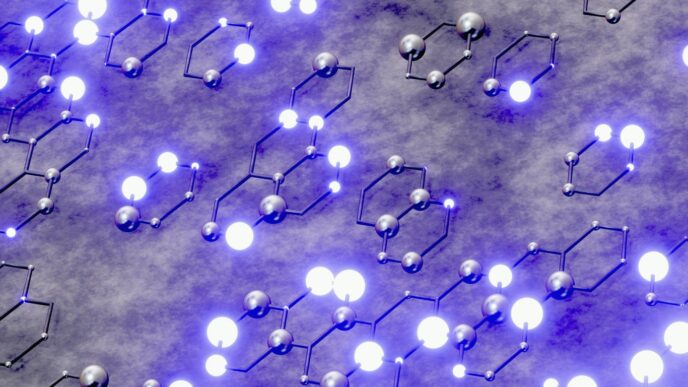
Chemical physics and physical chemistry are fields that really dig into how matter behaves at a molecular level. Think of it as the science behind why things are the way they are, using the rules of physics to explain chemical reactions and material properties. It’s all about understanding the energy, structure, and changes that happen when atoms and molecules interact. This area looks at everything from tiny clusters of atoms to how molecules behave in gases, liquids, and even on surfaces. The goal is to connect the dots between basic scientific ideas and how we can actually use them to make new stuff or solve problems.
Interdisciplinary Connections in Materials Research
Materials science isn’t just one thing; it’s a big melting pot. Chemical physics and physical chemistry play a huge role in this, but they also connect with other fields like engineering, biology, and even computer science. For example, understanding how a new battery material works involves looking at its chemical makeup, its physical structure, and how electrons move through it. That’s chemical physics in action. Researchers often find that ideas from one area can spark breakthroughs in another, leading to cool new materials for electronics, medicine, or energy.
Focus on Fundamental Principles and Applications
Journals in this area are keen on research that explains the ‘why’ and ‘how’ of material behavior. They want to see studies that explore the basic rules governing molecular interactions, like how light affects molecules or how different substances stick to surfaces. But it’s not just about theory. These journals also want to see how these fundamental ideas can be put to work. So, if you’ve figured out a new way to make solar cells more efficient based on molecular behavior, or developed a new catalyst using chemical physics principles, that’s exactly the kind of work they’re looking for. It’s about building knowledge from the ground up and then seeing where that knowledge can take us.
Disseminating Cutting-Edge Discoveries in Materials Chemistry
Getting new findings out there is a big deal in materials chemistry. It’s not just about doing the science; it’s about sharing it so others can build on it, use it, or even improve it. This section is all about how journals help make that happen, reaching scientists and industries all over the world.
Global Reach for Researchers and Industry
Journals act like a global bulletin board for science. When a paper is published, it’s not just sitting on a shelf. It’s put online, often in places that lots of people can access. This means a researcher in one country can see what someone in another country has figured out, almost instantly. This is super important for industry too. Companies looking for new materials or processes can keep up with the latest academic work. They might find a new catalyst, a better way to make a battery, or a novel coating that solves a problem they’ve been wrestling with. It’s a way for the academic world and the business world to stay connected.
Commitment to High-Quality Publication Standards
Nobody wants to read bad science, right? So, journals have strict rules. They want to make sure that what they publish is actually good, solid work. This usually involves a few steps:
- Initial Check: Editors look at the paper first to see if it fits the journal’s topic and if it seems like a decent piece of research.
- Peer Review: This is the big one. Other scientists who are experts in the same area read the paper very carefully. They check the methods, the results, and the conclusions. They’ll point out any mistakes or suggest ways to make the paper clearer or stronger.
- Revisions: If the reviewers find issues, the authors have to fix them. Sometimes this means doing more experiments or explaining things better. It’s a back-and-forth process to get the paper just right.
This whole process takes time, but it’s what makes scientific papers trustworthy.
Open Access Philosophy for Societal Benefit
There’s a growing movement towards making scientific papers freely available to everyone, not just people who can pay for subscriptions. This is called open access. The idea is that scientific knowledge should be a public good. If a discovery could help solve a big problem, like climate change or a disease, then everyone should be able to see it and use it. This speeds up progress because more people can access the information without financial barriers. It also means that the public can learn more about the science that affects their lives. Open access helps spread knowledge faster and wider, which is good for everyone.
Key Research Areas in Materials Chemistry and Physics
This section really gets into the nitty-gritty of what makes materials tick. We’re talking about the core science behind all the cool stuff you see in new technologies.
Molecular Systems and Spectroscopic Studies
This is where scientists look at how atoms and molecules arrange themselves and interact. Think about tiny building blocks and how they stick together or move around. They use fancy tools, like spectroscopy, which is basically shining light on a material and seeing how it bounces back or gets absorbed. This tells them a lot about the material’s structure and what it’s made of. It’s like taking a super-detailed picture of a molecule to understand its secrets. They study things like:
- Clusters, radicals, and ions – these are small groups of atoms or molecules that are often very reactive.
- The structure, properties, and movement of molecules in gases, liquids, or even stuck to surfaces.
- How molecules behave when they absorb or emit light.
Surface Chemistry and Interphase Processes
Materials don’t just exist in isolation; they interact with their surroundings, especially at their surfaces. This area focuses on what happens right at the boundary between two different materials or between a material and its environment. It’s super important for things like catalysts, coatings, and even how batteries work. Understanding these interactions can help us design materials that perform better or last longer. They look at:
- How different materials react when they touch each other.
- Processes happening at the very edge of a material.
- How things move across these boundaries, like atoms or energy.
Photochemistry and Energy-Related Phenomena
This part is all about how light affects chemical reactions and how materials can be used to capture, store, or convert energy. Solar cells are a big one here, but it also includes things like photocatalysis, where light is used to speed up chemical reactions, or materials that glow when hit by light. It’s a really active field because we’re always looking for better ways to use and manage energy. Some key topics include:
- Using light to drive chemical changes.
- Materials that can absorb sunlight and turn it into electricity.
- How light interacts with molecules to create new substances or energy.
Rigorous Peer Review in Materials Science Journals
So, you’ve poured your heart and soul into some groundbreaking materials science research. You’ve synthesized that new compound, characterized its properties, and written it all up. What happens next? Well, before your work can join the collective knowledge pool, it has to go through peer review. And in the world of materials science journals, this isn’t just a quick glance; it’s a deep dive.
Ensuring Scientific Integrity and Quality
Think of peer review as the gatekeeper of scientific quality. It’s the process where other experts in the field, people who really know their stuff, take a close look at your research. They’re not just looking for typos; they’re checking if your methods are sound, if your conclusions are supported by the data, and if your work actually adds something new to what we already know. This critical evaluation is what keeps the scientific record honest and reliable. Without it, it would be a free-for-all, and who knows what kind of questionable claims might end up being taken as fact.
Transparency in the Review Process
Journals handle peer review in different ways, but transparency is becoming a big deal. Many now disclose the names of the editors and reviewers who worked on an article. This isn’t just to give credit where it’s due, though that’s part of it. It also adds a layer of accountability. Knowing that your name will be attached to the review encourages reviewers to be thorough and fair. Plus, it lets readers see who vouched for the research. Some journals even have an interactive review stage where authors and reviewers can discuss comments and revisions directly, which can really help iron out any issues.
Safeguards Against Conflicts of Interest
One of the trickiest parts of peer review is making sure it’s unbiased. Reviewers and editors are usually unpaid volunteers, but journals have to be careful about potential conflicts of interest. This could be anything from a personal rivalry with an author to a financial stake in a competing company. Journals have policies in place to catch these situations. For instance, reviewers are typically asked to declare any potential conflicts, and editors can step in if something doesn’t seem right. It’s all about making sure the review process is fair and focuses solely on the scientific merit of the work.
Emerging Trends in Materials Chemistry and Physics

The world of materials science is always buzzing with new ideas, and right now, a few areas are really grabbing attention. It feels like we’re on the cusp of some big breakthroughs, especially with how we’re making and using materials.
Nanomaterials and Hybrid Composites
Think about materials that are incredibly small, like at the nanometer scale. These aren’t just tiny versions of regular stuff; they often have totally different properties. We’re seeing a lot of work with nanoparticles, nanotubes, and nanosheets. What’s really exciting is when these nanomaterials are combined with other materials to create hybrid composites. This mixing and matching allows scientists to fine-tune properties like strength, conductivity, or reactivity. For example, adding carbon nanotubes to polymers can make them much stronger without adding much weight. It’s like building with LEGOs, but on a molecular level, and the possibilities seem endless.
Advanced Materials for Optoelectronics
Optoelectronics is all about how materials interact with light and electricity. This is the stuff that powers our screens, solar cells, and fiber optics. Researchers are developing new materials that can convert light into electricity more efficiently, or create light more effectively. We’re talking about things like perovskites for solar cells, which have shown amazing progress in just a few years, or new organic semiconductors for flexible displays. The goal is to make devices faster, more energy-efficient, and even bendable.
Biomedical Applications of Novel Materials
This is where materials science really touches our lives directly. Scientists are creating new materials specifically for use in medicine. This could be for drug delivery systems that release medication exactly where it’s needed in the body, or for creating better implants that the body won’t reject. We’re also seeing materials designed for tissue engineering, helping to repair or replace damaged tissues. The challenge here is making sure these materials are safe, effective, and compatible with the complex biological environment. The development of biocompatible and biodegradable materials is a major focus, aiming to minimize long-term health impacts.
Impact and Indexing of Materials Chemistry Journals
So, you’ve done the hard work, published your groundbreaking research, and now what? You want to know if anyone’s actually seeing it, right? That’s where journal impact and indexing come into play. It’s like putting your work out there in the world, but with a little help to make sure it gets noticed by the right people.
Prominent Databases and Metrics
Think of databases as the big libraries where all the important research lives. Journals want to be listed in places like Scopus, Web of Science (especially the Science Citation Index Expanded, or SCIE), and PubMed Central. Getting into these means your articles are more discoverable. Then there are metrics, like the Impact Factor. It’s a way to gauge how often articles in a journal are cited. A higher Impact Factor generally suggests a journal is more influential. But it’s not the only thing; CiteScore is another popular metric that looks at citations over a four-year period. It’s good to keep an eye on these, but remember they’re just one piece of the puzzle.
Article Types and Submission Guidelines
Journals usually have specific types of articles they accept. For materials chemistry, you might see things like Original Research papers, Reviews (which summarize a field), Mini Reviews (shorter summaries), Perspectives (offering a specific viewpoint), and Editorials. Each journal will have its own set of rules, or submission guidelines, about how to format your manuscript, what kind of figures are allowed, and the length limits. It’s super important to read these carefully before you even start writing. They often have a section on what they don’t publish too, like papers that are just data dumps without new physical insights.
Contribution to Sustainable Development Goals
This is a newer, but really important, aspect. Many journals are now highlighting how the research they publish contributes to the United Nations’ Sustainable Development Goals (SDGs). For materials chemistry, this often ties into areas like clean energy, sustainable infrastructure, or responsible consumption and production. For example, a journal might specifically mention that it supports research contributing to SDG 9: Industry, Innovation and Infrastructure. It’s a way to show that the science isn’t just academic; it’s helping to solve real-world problems.
Wrapping Up: The Ongoing Journey in Materials Chemistry and Physics
So, after looking at all these different studies and topics, it’s pretty clear that materials chemistry and physics are moving fast. There’s a lot happening, from new ways to make better batteries to figuring out how molecules work at surfaces. The journals in this area, like Frontiers in Chemistry, are helping to get this information out there for everyone—scientists, industry folks, and even the general public. With open access, anyone can read about the latest discoveries, which is pretty cool. The peer review process is strict, so you know the research is solid. As more people from different backgrounds get involved, the field keeps growing and changing. It’s exciting to think about what’s next, and it feels like we’re just scratching the surface. If you’re curious about where science is heading, keeping an eye on these journals is a good idea.