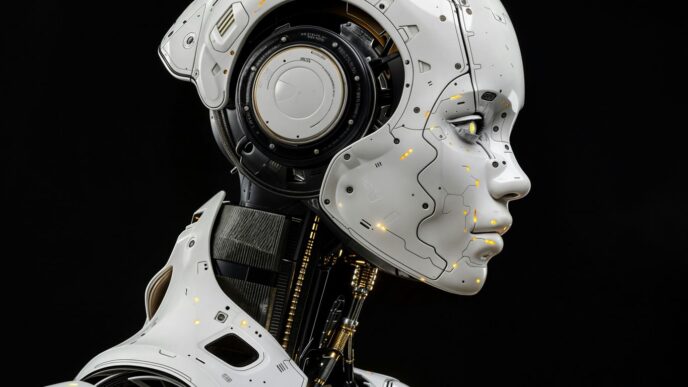

Right then, let’s have a look at what’s happening with the latest AI technology. It feels like only yesterday we were just getting our heads around chatbots, and now? Well, things are moving pretty fast. We’re talking about AI becoming more like a workmate, helping out with big jobs in companies, and even making scientific discoveries easier. It’s not just about computers anymore; it’s about how AI fits into our actual lives, from fixing health problems to making our gadgets smarter. We’ll also touch on some of the tricky bits, like making sure it’s all safe and fair.
Key Takeaways
- AI is shifting from being a simple tool to a partner, helping people with their work and creativity across various sectors.
- Businesses are looking at AI for more than just efficiency, focusing on data control and new ways of working with open-source models and agents.
- The systems that run AI are getting better and more efficient, with new types of computer chips being developed for specific AI tasks.
- AI is becoming a valuable assistant in science, helping researchers come up with ideas and run experiments.
- AI is becoming more specialised, working on smaller devices and in specific areas, and is also making big changes in healthcare, from helping doctors plan treatments to making health information more accessible.
The Evolution of AI From Tool to Partner
AI Amplifying Human Expertise
It feels like just yesterday we were marveling at AI’s ability to answer simple questions or write a basic email. Now, in 2026, we’re seeing a significant shift. AI is moving beyond just being a helpful tool; it’s becoming more like a collaborator, actively working alongside us to boost what we can achieve. Think of it as having a really smart assistant who doesn’t just follow instructions but can actually suggest better ways to do things, drawing on vast amounts of information.
This isn’t about AI taking over, though. The real magic happens when human skills and AI capabilities combine. For instance, in creative fields, AI can handle the repetitive tasks, freeing up artists and writers to focus on the core creative vision. In technical fields, AI can sift through mountains of data, spotting patterns that a human might miss, leading to quicker breakthroughs.
The future isn’t about replacing humans; it’s about amplifying them.
This partnership is changing how we approach problems. Instead of just asking AI for an answer, we’re now working with it to explore possibilities and refine solutions. It’s a more dynamic process, where human intuition and AI’s processing power work hand-in-hand.
AI as a Digital Colleague
Remember when AI agents were mostly single-task specialists? Like one for writing emails, another for research? That’s changing fast. By 2026, these agents are getting much smarter, capable of planning, using different tools, and tackling complex jobs. We’re starting to see what some are calling ‘super agents’.
These aren’t just isolated programs anymore. Imagine having a central control panel where you can kick off tasks, and a team of AI agents then works across your different applications – your web browser, your code editor, your email – all coordinated. You won’t need to manage a dozen separate tools; one interface can orchestrate them. This makes interacting with AI feel much more like working with a team of digital colleagues who understand the bigger picture.
This shift means we’ll see more integrated systems. Instead of static apps, we’ll have interfaces that adapt to what you’re trying to do. It’s like having a personal AI assistant that’s aware of your workflow and can proactively help.
Real-World Impact Across Industries
This evolution from tool to partner isn’t just theoretical; it’s having a tangible effect everywhere. In healthcare, AI is helping to bridge gaps in care, making services more accessible. Software development is seeing AI not just write code, but understand the context and purpose behind it, leading to better quality and faster development cycles.
Scientific research is also benefiting hugely. AI is acting like a tireless lab assistant, helping scientists analyse data, run simulations, and even suggest new hypotheses. This speeds up the pace of discovery significantly.
Here’s a look at how this partnership is playing out:
- Medicine: AI aids in treatment planning and helps manage patient data, improving outcomes.
- Engineering: AI assists in complex design processes and predictive maintenance, reducing errors and downtime.
- Finance: AI helps detect fraud more effectively and provides personalised financial advice.
- Education: AI tutors offer personalised learning experiences, adapting to individual student needs.
The move towards AI as a collaborator means businesses need to rethink how their teams operate. It’s not just about adopting new software; it’s about fostering a new way of working where humans and AI complement each other’s strengths. This requires careful planning and a willingness to adapt workflows to maximise the benefits of this partnership.
Enterprise AI: Sovereignty and New Business Frontiers
AI Amplifying Human Expertise
It feels like just yesterday we were talking about AI as a fancy new tool. Now, it’s really starting to feel like a partner, especially in the business world. For a lot of companies, especially the bigger ones, just having AI isn’t enough anymore. They’re worried about who’s really in charge of their AI systems and their data. This idea, called ‘AI sovereignty,’ is becoming super important. It means businesses want to control their AI, their information, and the tech that runs it all, without having to rely on outside companies. A recent survey showed that almost everyone, like 93% of bosses, thinks AI sovereignty needs to be a big part of their business plans in 2026. It’s not just about ticking a box; it’s about avoiding problems. Some leaders are already concerned about relying too much on computing power from specific places, which could lead to data getting stolen or losing access to important information. It’s a bit like wanting to keep your own secrets safe, you know?
AI as a Digital Colleague
So, what does this mean for how we actually work? Well, AI is starting to act more like a digital colleague. Think about it: instead of just doing simple tasks, AI is getting better at understanding complex requests and even showing its ‘work’ so we can see how it reached a conclusion. This is a big deal because regulators and even customers want to know how these AI systems make decisions. Building AI that can explain itself is key. This also means companies are looking at how to build AI systems in a modular way. This way, different parts of the AI, the data it uses, and the agents that do the work can be moved around between different trusted providers or locations if needed. It’s all about flexibility and keeping things secure. Plus, keeping an eye on AI performance is vital to catch any issues, like the AI starting to give biased answers, before they become major problems.
Real-World Impact Across Industries
We’re seeing AI move from just being something companies experiment with to actually being used in ways that make real money. A big part of this is the rise of open-source AI models and agents. These are like building blocks that companies can use and adapt, pushing the boundaries of what AI can do in business. But with this growth comes a need for trust and security. That’s why AI sovereignty is so important – businesses want to be sure their AI is safe and that they’re in control. It’s not just about having the latest tech; it’s about making sure it works reliably and securely for the long haul. The focus is shifting from just being excited about AI to actually getting solid results from it.
The move from AI experimentation to real-world, production-ready systems is a major shift. This requires significant investment in making AI reliable, efficient, and easy to manage. Without this investment, AI systems might not be useful, creating a cycle of underperformance.
Here’s a look at some of the challenges companies are facing:
- Evaluating AI Performance: Making sure the AI is actually doing what it’s supposed to do well.
- Reliability: Ensuring the AI systems work consistently without errors.
- Scalability: Being able to handle more work as the business grows.
- Maintainability: Keeping the AI systems up-to-date and running smoothly over time.
These aren’t small tasks, and they require careful planning and resources. It’s a complex puzzle, but getting it right means AI can truly become a valuable part of how businesses operate.
The Maturation of AI Infrastructure and Compute
It feels like just yesterday we were talking about how big AI models were getting, but the conversation is shifting. We’re not just about sheer size anymore; it’s about making every bit of computing power count. Think of it like this: instead of just building a bigger engine, we’re figuring out how to make the existing engine run much more efficiently and smartly. This means packing more processing power into smaller spaces and making sure that power is used exactly when and where it’s needed. It’s a move towards smarter, more connected AI systems that can work together across different networks, driving down costs and making things run smoother.
Smarter and More Efficient Systems
The focus is really on optimisation. We’re seeing a move away from just scaling up with massive, power-hungry systems towards making AI infrastructure more adaptable and less wasteful. The goal is to have computing power that’s distributed and managed dynamically, so nothing sits idle. If one task finishes, another one can jump in straight away. This approach promises AI systems that are not only more capable but also more sustainable.
The Role of GPUs and ASIC Accelerators
GPUs have been the workhorses for AI, and they’re not going anywhere soon. But the landscape is getting more diverse. We’re seeing a rise in specialised chips, like ASICs (Application-Specific Integrated Circuits), which are designed to do particular AI tasks really well. This means we’re getting more options for hardware, moving beyond just relying on one type of processor. It’s about finding the right tool for the job, whether that’s a powerful GPU or a more specialised accelerator.
New Chip Classes for Agentic Workloads
As AI moves towards becoming more like a ‘digital colleague’ – capable of taking on more complex, multi-step tasks – the hardware needs to keep up. This is leading to the development of entirely new classes of chips. These aren’t just for crunching numbers; they’re being designed with features that help AI systems manage memory, reason, and interact more effectively over longer periods. We might even see chips that combine different technologies, like analog computing or quantum assistance, to handle these advanced ‘agentic’ workloads. It’s a really exciting area where hardware and AI software are developing hand-in-hand.
The push for efficiency and specialised hardware means AI development will become more accessible. Instead of needing colossal data centres, we’ll see more capable AI running on smaller, more distributed systems, and even on devices at the ‘edge’ – closer to where the data is generated. This democratisation of AI compute is a significant shift.
Here’s a look at how the hardware landscape is evolving:
- GPUs: Still the dominant force for general AI training and inference.
- ASIC Accelerators: Custom-built chips offering high performance for specific AI tasks, often more power-efficient.
- Chiplet Designs: Breaking down large chips into smaller, specialised ‘chiplets’ that can be combined, offering flexibility and cost savings.
- Analog Inference Chips: Promising significant power savings for certain types of AI calculations.
- Quantum-Assisted Optimizers: Exploring how quantum computing principles can speed up specific, complex AI optimisation problems.
AI’s Expanding Role in Scientific Discovery
It feels like just yesterday AI was mostly about crunching numbers or suggesting the next movie to watch. But now, it’s really starting to get its hands dirty in the world of science. We’re not just talking about AI helping scientists sift through mountains of data anymore; it’s becoming an active participant in the discovery process itself. Think of it as a super-powered lab assistant that never sleeps and can spot patterns humans might miss.
AI as a Lab Assistant
Imagine having a colleague who can instantly summarise complex research papers, suggest new experiments based on existing knowledge, and even help run those experiments. That’s the kind of role AI is starting to play. It’s like having a tireless intern who’s read every scientific journal ever published. This frees up human researchers to focus on the bigger picture, the creative leaps, and the interpretation of results, rather than getting bogged down in repetitive tasks.
- Hypothesis Generation: AI can analyse vast datasets to propose novel scientific hypotheses that might not be obvious to human researchers.
- Experiment Design: It can help design experiments, optimising parameters and suggesting methodologies to test these hypotheses efficiently.
- Data Analysis: AI tools can process and analyse experimental data at speeds and scales previously unimaginable, identifying subtle trends and anomalies.
The shift is towards AI not just processing information, but actively contributing to the generation of new scientific knowledge. This partnership promises to accelerate the pace of discovery across all scientific disciplines.
Understanding Neural Network Insights
One of the tricky parts with AI, especially complex neural networks, is figuring out why it came to a certain conclusion. It’s a bit like a black box sometimes. However, there’s a growing effort to make these AI systems more transparent. Researchers are developing ways to peek inside these networks, understand their decision-making processes, and gain insights into how they arrive at their findings. This is crucial for building trust and ensuring the reliability of AI-driven scientific discoveries.
Hypothesis Generation and Experimentation
This is where things get really exciting. AI is moving beyond just analysing data to actively proposing new ideas and designing experiments to test them. For instance, in fields like drug discovery or materials science, AI can sift through countless molecular combinations to suggest promising new compounds. It can then help design the experiments needed to synthesise and test these compounds, dramatically speeding up a process that used to take years. This collaborative approach between human intuition and AI’s analytical power is set to redefine the scientific method itself.
| Field | AI’s Contribution |
|---|---|
| Drug Discovery | Identifying potential drug candidates, predicting efficacy |
| Materials Science | Designing novel materials with specific properties |
| Climate Modelling | Improving accuracy and speed of complex simulations |
| Astrophysics | Analysing telescope data, identifying celestial objects |
The Rise of Domain-Specific AI and Edge Computing

Moving Beyond Giant Models
Forget the idea that AI has to be enormous to be smart. By 2026, we’re seeing a definite shift away from just building bigger and bigger models. The focus is moving towards creating AI that’s really good at specific jobs. Think of it like having a specialist doctor instead of a general practitioner for every single health issue. These smaller, specialised models are proving to be just as, if not more, accurate for particular tasks. They’re also much more efficient, which is a big deal when you’re trying to get AI to work without needing a supercomputer.
- Efficiency is the new scaling: Since we can’t keep adding more and more computing power indefinitely, the industry is looking at making AI work smarter, not just bigger.
- Specialisation wins: Instead of one massive AI trying to do everything, we’ll have many smaller AIs, each expertly trained for a specific field like law, medicine, or manufacturing.
- Open source fuels diversity: Expect a wider range of models, especially from different regions, becoming available and adaptable for various needs.
The future of AI isn’t just about raw power; it’s about precision and purpose. Smaller, finely-tuned models will become the workhorses for many applications, offering tailored intelligence without the massive overhead.
Inference on Edge Devices
This move towards smaller, specialised AI models is a perfect match for edge computing. What does that mean? It means AI can run directly on devices like your phone, a smart camera, or even a sensor in a factory, rather than needing to send data all the way to a central server. This is a game-changer for a few reasons. Firstly, it’s faster because there’s no delay sending data back and forth. Secondly, it’s more private because sensitive data can stay on your device. And thirdly, it works even when you don’t have a stable internet connection. This makes AI practical for a whole host of new applications where speed and privacy are key.
- Reduced Latency: Decisions are made instantly, right where the data is generated.
- Enhanced Privacy: Sensitive information doesn’t need to leave the local device.
- Offline Capability: AI functions reliably even without constant network access.
Global Model Diversification
We’re also going to see a much wider variety of AI models popping up around the world. It’s not just going to be a few big players dominating the scene. Different countries and regions will develop their own specialised models, perhaps focusing on local languages or specific industry needs. This global spread means AI will become more accessible and relevant to more people and businesses everywhere. It’s about making sure AI development isn’t concentrated in just one or two places, but is a worldwide effort, leading to more innovation and a broader range of AI tools for everyone to use.
AI in Healthcare: Transforming Patient Care

Beyond Diagnostics to Treatment Planning
AI is really starting to move past just spotting problems in scans. We’re seeing it get involved in figuring out the best way to treat patients, which is a big step. Think about it: AI can look at a huge amount of patient data, research papers, and treatment outcomes to suggest personalised plans. This isn’t just about making a diagnosis anymore; it’s about tailoring the entire care journey. For instance, AI tools are being developed to predict how a patient might respond to different therapies, helping doctors make more informed decisions. This shift means AI is becoming less of a diagnostic tool and more of a clinical partner. It’s exciting to see these new generative AI products becoming available to more people, potentially changing how we approach medical care.
Addressing Global Healthcare Gaps
There’s a massive shortage of healthcare workers worldwide, and AI could really help fill that gap. With millions of people not getting the basic care they need, AI offers a way to extend the reach of medical professionals. Imagine AI assisting with symptom triage in remote areas or providing support for doctors in overwhelmed hospitals. This technology can help manage patient flow, offer preliminary advice, and even monitor chronic conditions, freeing up human staff for more complex cases. It’s about making healthcare more accessible, especially in places where doctors and nurses are scarce. New technology is set to transform patient care by 2026. Wearable devices will enable earlier detection of health issues, while AI tools will free up clinicians to spend more quality time with patients. These advancements are among the top five healthcare trends expected to reshape the industry. See these trends.
Empowering Patient Health and Wellbeing
AI is also starting to give individuals more control over their own health. Think about apps that can answer your health questions or help you understand your medical information. AI can process complex medical data and present it in a way that’s easier for patients to grasp. This means people can be more involved in their healthcare decisions. It’s not just about doctors having AI tools; it’s about everyday people using AI to manage their wellbeing. This could involve anything from personalised fitness advice to reminders for medication, all driven by AI that learns and adapts to individual needs.
The move towards AI in healthcare is about more than just efficiency; it’s about making care more personal, accessible, and understandable for everyone involved. It’s a complex area, but the potential benefits for patients and healthcare systems alike are significant.
Navigating the Challenges of AI Adoption
Bringing AI into the day-to-day workings of a business can sound exciting. More often than not, it turns out to be a bit messier than folks expect. There’s rarely a straight path from initial tests to company-wide transformation. With 2026 underway, it’s worth taking a closer look at the common sticking points for new AI technologies—and what can actually be done about them.
Measuring AI’s Economic Impact
Many companies still struggle to calculate the true value of their AI investments. It’s trickier than people assume to link shiny new AI systems directly to increased profits or big productivity gains. Here’s a very basic table outlining some common metrics and their quirks:
| Metric | Use Case | Complication |
|---|---|---|
| Productivity improvement | Automated workflow tools | Hard to separate from other tech upgrades |
| Top-line growth | AI-driven product launches | Often confounded by market trends |
| Cost savings | AI in resource allocation | Short-term vs long-term unclear |
For many companies, small wins hide bigger problems that don’t show up until much later on. Real, sustainable improvement usually comes only after careful focus on a few key areas—otherwise, there’s a risk of spreading efforts too thin.
Companies that take time to measure returns carefully, focusing on a few high-impact areas first, see a greater shift from pilot projects to actual growth.
Addressing Failed AI Projects
Failures and disappointments are more common than headlines suggest. According to recent surveys, successful rollout is hardly guaranteed. Attempts to crowdsource ideas or let individual employees experiment with tools rarely turn into solid results. Here are a few reasons things often go sideways:
- Lack of connection between AI projects and main business goals
- Jumping on trendy tools without planning for real use-cases
- Insufficient resources for training, testing, or scaling the technology
The most successful companies avoid these traps by:
- Choosing a handful of high-stakes business areas to try AI first
- Assigning clear leaders—a central team, sometimes called an "AI studio"
- Making sure that success in those areas leads the way for others to follow
Copyright and Ethical Considerations
As AI systems get more capable, the questions around copyright, data privacy, and ethical issues get much harder to ignore. New governance models are springing up, but these are still behind the pace of adoption. Companies face challenges like:
- Unclear ownership of AI-generated content
- Responsibility for errors made by AI agents
- Meeting local and international laws around privacy
Keeping track of changing rules, building safeguards, and making sure employees are trained in responsible use have all become part of the ongoing struggle. Upskilling teams, applying tiered risk assessments, and documenting processes are some of the main tactics. More firms are starting to take these issues seriously, but progress is uneven.
Overall, successful adoption isn’t just about having the latest AI system. It’s about picking your battles, getting leaders involved early, and being honest about what hasn’t worked yet—while always keeping a close eye on legal and ethical boundaries.
Looking Ahead
So, what does all this mean for us as we look towards 2026? It seems clear that AI is moving past just being a tool for answering questions. We’re seeing it become more of a partner, helping out in all sorts of areas, from writing code to helping doctors. There will be bumps in the road, of course, with some projects not quite hitting the mark. But the general direction is towards AI working alongside us, making things more efficient and opening up new possibilities we haven’t even thought of yet. It’s going to be an interesting few years, that’s for sure.
Frequently Asked Questions
How is AI changing from being a simple tool to a helpful partner?
AI is moving beyond just answering questions. In 2026, it’s expected to become more like a partner, working alongside people to help with tasks and boost our abilities. Think of it as a digital colleague that can help us do our jobs better and more efficiently.
What does ‘AI sovereignty’ mean for businesses?
AI sovereignty means that businesses want more control over their AI systems and the data they use. This is becoming really important as companies rely more on AI, and they want to make sure their AI is safe, secure, and follows their own rules.
Will AI replace human jobs in 2026?
The main idea for 2026 is that AI will ‘amplify’ humans, not replace them. It’s about making people better at what they do by giving them powerful AI tools to help them. So, AI will work with us, making our skills stronger.
Are smaller AI models becoming more important than huge ones?
Yes, there’s a growing trend towards using smaller, more specialised AI models. These models can work better for specific tasks and can even run on devices like phones or smaller computers, which is great for speed and privacy.
How will AI help in scientific research?
AI is becoming a real helper in science labs. It can help come up with new ideas (hypotheses), control experiments, and even work with human scientists. It’s not just about getting answers, but understanding how the AI arrives at them.
What are the biggest challenges businesses face when using AI?
Businesses face challenges like figuring out how much AI is really helping their profits, dealing with projects that don’t work out, and navigating tricky issues like copyright and making sure AI is used ethically. It’s important to learn from mistakes and use AI wisely.