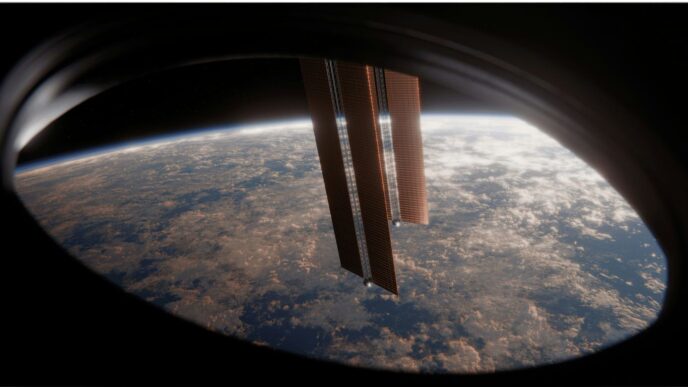
Well, they’re finally back! After what turned into a much longer trip than anyone expected, the astronauts from the historic ‘Astronaut Returns’ mission have touched down safely. What was supposed to be a short visit to the International Space Station turned into a nine-month stay, thanks to some issues with their original ride home. It’s a huge relief to see them back on solid ground after all that time orbiting our planet.
Key Takeaways
- Two NASA astronauts, Suni Williams and Barry ‘Butch’ Wilmore, have returned to Earth after a nine-month mission aboard the ISS.
- Their original return vehicle, Boeing’s Starliner, experienced issues, forcing an extended stay and a later return via a SpaceX capsule.
- The astronauts spent 286 days in space, conducting numerous research experiments and adapting to unforeseen circumstances.
- Their safe return highlights the importance of redundancy in spaceflight systems and international cooperation.
- Following splashdown, the crew underwent immediate medical evaluations and will begin readjustment to Earth’s gravity.
Historic Astronaut Returns Mission Concludes
Crew Safely Splashes Down Off Florida Coast
Well, they’re finally back! After what felt like an eternity, astronauts Sunita Williams and Barry Wilmore have returned to Earth. Their SpaceX Crew Dragon capsule splashed down safely in the Gulf of Mexico, just off the coast of Florida, marking the end of a mission that went way, way longer than anyone expected. It’s a huge relief for everyone involved, especially their families who have been waiting patiently for months. The recovery teams were right there, ready to help them out of the capsule as soon as they hit the water. It’s good to see them back on solid ground.
Extended Space Stay Ends After Nine Months
This mission turned into quite the marathon. Originally planned as a short test flight, issues with the Boeing Starliner spacecraft meant Williams and Wilmore had to stay aboard the International Space Station for a staggering nine months. That’s a really long time to be away from home, living in a tin can orbiting the planet. They ended up completing 3,920 revolutions around Earth during their extended stay. It really shows how adaptable astronauts have to be when things don’t go according to plan up there. This extended mission highlights the importance of having reliable return vehicles for space travel.
SpaceX Crew Dragon Capsule Completes Journey
The SpaceX Crew Dragon capsule, affectionately nicknamed ‘Endurance’ for this mission, really proved its worth. It was the vehicle that brought Williams and Wilmore home after the Starliner issues. The journey back involved a series of carefully managed steps:
- Undocking: The capsule detached from the International Space Station.
- Re-entry: It plunged back into Earth’s atmosphere, enduring intense heat and G-forces.
- Splashdown: The parachutes deployed, slowing the capsule for a gentle landing in the ocean.
It’s a complex process, and seeing it all go smoothly is a testament to the engineering and the teams on the ground. This successful return is a big deal for human spaceflight.
Astronauts End Long Orbit Aboard ISS
Crew Safely Splashes Down Off Florida Coast
After what felt like an eternity, astronauts Butch Wilmore and Sunita Williams finally made it back to Earth. Their SpaceX Crew Dragon capsule touched down gently in the Gulf of Mexico on March 18, 2025. This marked the end of an unexpectedly long nine-month stay aboard the International Space Station (ISS). It’s a relief for everyone involved, especially the astronauts who have been living in microgravity for so long.
Extended Space Stay Ends After Nine Months
Wilmore and Williams were originally supposed to be in space for just eight days. They launched on June 5, 2024, aboard a Boeing Starliner spacecraft for what was planned as a short visit. However, issues with the Starliner meant it had to return without a crew. This left the two astronauts on the ISS for over 286 days, a significant extension from their initial plan. While nine months is a long time, it’s not a record. For instance, astronaut Frank Rubio holds the U.S. record with 371 consecutive days in space.
Space Exploration Continues Despite Delays
Even with the extended mission, Wilmore and Williams kept busy. They conducted spacewalks, including one in January, and continued important research. Life on the ISS is highly structured, with regular exercise to combat muscle and bone loss. They also had regular contact with family and enjoyed special meals, even celebrating holidays in orbit. Their ability to adapt and remain positive throughout the unforeseen circumstances is a testament to their training and resilience. The mission highlights the importance of having backup plans and multiple ways to get astronauts to and from space, a point emphasized by NASA officials.
The Journey Home For Astronauts
Undocking From International Space Station
After what felt like an eternity, the moment finally arrived for the crew to say goodbye to the International Space Station. The undocking process itself is a carefully choreographed dance. Think of it like a gentle push away from a giant, orbiting home. The spacecraft, in this case, the SpaceX Crew Dragon, slowly maneuvers itself free from its docking port. It’s not a sudden jolt, but a gradual separation, ensuring everything stays stable. Mission control watches every move, ready to step in if anything seems off. It’s a bit nerve-wracking, honestly, seeing your ride home detach from the station you’ve called home for so long.
Re-entry and Splashdown Procedures
Once clear of the station, the real adventure begins: coming back to Earth. This is where things get intense. The spacecraft orients itself for re-entry, meaning it points its heat shield towards the direction of travel. As it hits the Earth’s atmosphere, friction creates a whole lot of heat – we’re talking thousands of degrees! This is why that heat shield is so important; it protects the crew inside. Then come the parachutes. Big ones deploy to slow the capsule down dramatically. Finally, the splashdown. The capsule gently lands in the ocean, usually off the coast of Florida. It’s a controlled descent, but still, hitting water at that speed is quite the event.
Recovery Operations in the Gulf of Mexico
As soon as the capsule hits the water, the recovery teams are on the scene. Ships and boats are waiting nearby. They’ll get to the capsule quickly to make sure the astronauts are okay. The hatch is opened, and the crew is helped out. This is the moment everyone’s been waiting for – seeing them back on solid ground, or at least, on a ship deck. They’re then taken aboard the recovery vessel for initial checks. It’s a busy scene, with lots of people working together to get the astronauts safely back. They’ll get some immediate medical attention right there on the ship before heading off for more thorough evaluations.
Post-Mission Procedures For Returning Crew
Immediate Medical Evaluations
So, the astronauts are back on solid ground. That’s a huge relief, right? But the journey isn’t quite over for them. The very first thing that happens after they’re helped out of the capsule is a quick check-up. Think of it like a doctor seeing you right after a marathon, but way more intense. They need to see how their bodies are handling being back in gravity after so long. This isn’t just a quick hello; it’s a series of tests to make sure everything is functioning as it should. They’ll be looking at everything from blood pressure to how their muscles and bones are doing. It’s all about making sure they’re healthy and ready for the next steps.
Reunification With Families
After the initial medical checks, the next big moment is seeing their loved ones. Imagine being away for nine months – that’s a really long time. The reunion is usually pretty emotional. They’ll likely get a bit of private time with their families before heading off to more formal procedures. It’s a chance for them to reconnect and for everyone to breathe a sigh of relief. This part is super important for their mental well-being after such an extended mission. It’s a reminder of what they’ve been working towards and what awaits them back home.
Readjustment to Earth’s Gravity
This is where things get interesting, and honestly, a bit tough for the astronauts. Their bodies have gotten used to floating around in space. Walking, standing, even just sitting up – it all feels different when gravity is pulling you down. They’ll experience a range of things, from feeling heavier to potentially feeling a bit dizzy or unsteady. It’s like learning to walk all over again, but with the added challenge of your inner ear and muscles needing to recalibrate. This process can take a while, and they’ll have a whole team of medical professionals helping them through it. They’ll likely start with simple exercises and gradually increase the intensity as their bodies adapt. It’s a slow and steady process, but crucial for their long-term recovery.
Scientific Contributions During Extended Mission
Even with the unexpected hiccup that kept Butch Wilmore and Suni Williams in orbit for much longer than planned, their time aboard the International Space Station (ISS) was far from idle. These astronauts are basically living laboratories, and their extended stay meant they could really dig into some important work. The data collected during these prolonged missions is invaluable for understanding how the human body handles long-duration spaceflight, which is key for future deep space exploration.
Conducting Numerous Research Experiments
While waiting for their ride home, Wilmore and Williams participated in a wide array of scientific investigations. These weren’t just quick tests; some experiments require consistent observation and data collection over extended periods. Think about studies on how microgravity affects plant growth, or how different materials behave when exposed to the harsh space environment. They also continued work on experiments that were already underway when they arrived, ensuring continuity and allowing researchers on Earth to gather more complete datasets. This kind of long-term observation is something you just can’t replicate on the ground.
Maintaining Operations on the ISS
Beyond specific research projects, the crew’s primary job is keeping the ISS running smoothly. This involves a lot of hands-on work:
- System Checks: Regularly inspecting and maintaining the station’s life support, power, and communication systems.
- Repairs and Upgrades: Addressing any minor issues that pop up and installing new equipment or scientific instruments.
- Logistics: Managing supplies, waste, and inventory, which becomes even more critical on a longer mission.
Their extended presence meant they could tackle more complex maintenance tasks that might otherwise require a dedicated spacewalk or a specialized crew.
Contributing to Future Space Exploration Goals
Every bit of data gathered, every procedure tested, and every challenge overcome on the ISS contributes to the bigger picture of venturing further into space. The insights gained from Wilmore and Williams’ extended mission will directly inform the planning and execution of future endeavors, like missions to the Moon and Mars. Understanding the physiological and psychological effects of long-duration spaceflight, as well as the practicalities of living and working in space for months on end, is what makes these long missions so important. It’s all part of building the knowledge base needed for NASA astronaut Jonny Kim and others to explore the cosmos.
International Cooperation In Space
Collaboration Between NASA and Roscosmos
Even with all the noise and political back-and-forth happening down here on Earth, the folks working on the International Space Station (ISS) have kept things pretty chill. Take this mission, for example. We had NASA astronauts Suni Williams and Butch Wilmore, along with Russian cosmonaut Aleksandr Gorbunov, all heading home together. It’s a good reminder that when you’re up there, floating around the planet, national borders kind of disappear. The ISS itself is a huge project, a joint effort between NASA, Roscosmos (that’s the Russian space agency), the European Space Agency, the Japan Aerospace Exploration Agency, and the Canadian Space Agency. It’s been up there for over 25 years, a testament to what countries can do when they put their minds to it.
Maintaining Partnerships Despite Earthly Tensions
It’s not always easy, though. You hear about tensions between the U.S. and Russia, especially since 2022. But in space, that relationship has stayed pretty steady. Russians have flown on American ships, and Americans have hitched rides on Russian ones. They live and work side-by-side on the station, sharing experiments and keeping the whole place running. It’s like a little bubble of cooperation. This mission saw the return of both NASA astronauts and a Roscosmos cosmonaut, showing that the partnership is still strong, even when things on the ground are complicated. It’s a big deal because the ISS needs everyone working together to keep it going.
Shared Goals for Human Spaceflight
Ultimately, everyone involved – NASA, Roscosmos, and the other agencies – has the same big picture in mind: pushing the boundaries of human spaceflight. They’re all working towards understanding more about living and working in space, which is pretty important if we ever want to go further out, like to Mars. The ISS is the testbed for all of that. Think about it:
- Research: Countless experiments are done up there, from studying how the human body changes in space to testing new technologies.
- Operations: Keeping a giant space station running smoothly takes a lot of coordination and shared effort.
- Future Exploration: Everything learned on the ISS helps plan for longer, more ambitious missions beyond Earth orbit.
So, while the astronauts might have had a bit of an extended stay thanks to some technical hiccups with the Boeing Starliner, the underlying cooperation between space agencies remained solid. It’s a pretty cool example of how people can work together for a common goal, even when the world below is a bit chaotic.
Home Sweet Home
Well, they made it back. After a trip that turned into a marathon, Suni Williams and Butch Wilmore are finally on solid ground. It wasn’t the quick visit they planned, not by a long shot, but they handled it. They did the work, stayed adaptable, and now they’re home. It’s good to see them back, and I bet they’re looking forward to some real food and seeing their families. This whole situation really shows how things don’t always go according to plan up there, and how important it is to have backup options. Now, the focus shifts to what’s next for the Starliner program and getting future missions sorted. For now, though, welcome back, astronauts!
Frequently Asked Questions
Why did the astronauts stay in space for so long?
The astronauts were supposed to come back much sooner. Their original ride home, a spacecraft called Starliner, had some problems with its engines and fuel leaks. Because it wasn’t safe to fly back in, they had to wait for a new ride, which took about nine months.
Who are the astronauts who returned?
The astronauts who returned are NASA’s Suni Williams and Barry ‘Butch’ Wilmore. They were joined by fellow NASA astronaut Nick Hague and Russian cosmonaut Aleksandr Gorbunov.
How did they finally get back to Earth?
After their long stay, they undocked from the space station in a SpaceX Crew Dragon capsule. This capsule brought them safely back to Earth, splashing down in the ocean off the coast of Florida.
What happens after they land?
Once they splash down, recovery teams help them out of the capsule. They then go through medical checks to make sure they are okay after being in space for so long. After that, they get to see their families again.
What did the astronauts do during their extended stay?
Even though their stay was much longer than planned, they kept busy! They did many science experiments, helped keep the space station running smoothly, and even did spacewalks. Their work helps us learn more about space and plan for future missions.
Is it normal for astronauts to stay in space for so long?
While spending nine months in space is a very long time, missions can sometimes be extended due to unexpected issues. Astronauts are trained to be adaptable and handle these situations, and their long stays help with important research.