Quantum computing has made remarkable progress over the past decade. Tech giants and well-funded startups alike are racing to build more powerful quantum processors, pushing the boundaries of what computation can achieve. But as the industry advances, a fundamental problem is becoming increasingly difficult to ignore:
Enabling quantum systems is not just a matter of better qubits; it’s a matter of infrastructure. A new player, QTREX, which was recently launched by Inspira Technologies, is positioning itself directly at the center of this challenge.
Rather than joining the crowded race to build quantum computers, QTREX is focused on something far less visible, but arguably more critical: the physical systems that allow quantum machines to function, scale, and operate in real-world conditions. At the heart of the issue is a growing bottleneck in cryogenic connectivity.
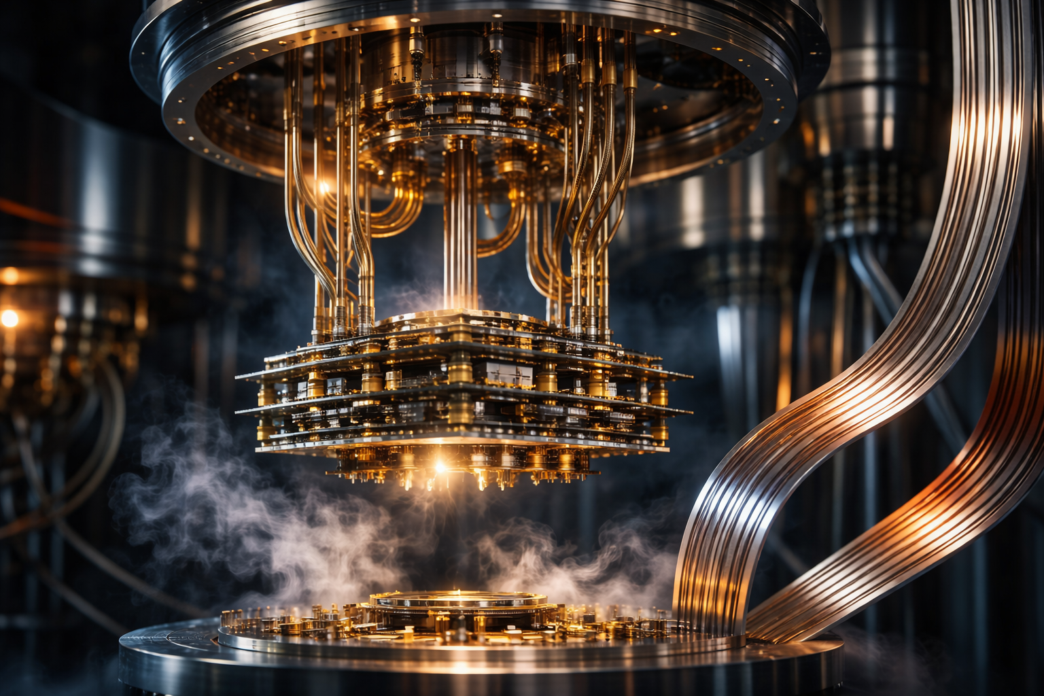
Quantum processors typically operate at temperatures close to absolute zero, requiring highly specialized environments inside dilution refrigerators. As systems scale from dozens to hundreds, and eventually thousands, of qubits, the number of signals that must be routed, controlled, and maintained increases dramatically. Today, much of this is still handled through hand-assembled wiring: complex, bulky cable systems that introduce thermal load, signal interference, and physical limitations that are increasingly constraining performance.
This is where QTREX enters the picture. The company is developing a new class of cryogenic interconnect architectures designed to replace traditional wiring approaches with integrated, high-density systems engineered specifically for quantum environments. Built using advanced additive manufacturing and materials science, these architectures aim to deliver cleaner signal paths, reduced thermal impact, and a level of precision that no other technology can provide.
The approach reflects a broader shift happening across the quantum ecosystem.
As the industry matures, it is becoming clear that long-term success will depend not only on breakthroughs in computation, but on solving deep engineering challenges across the entire system stack. Infrastructure layers – from cooling to control to interconnects – are rapidly emerging as critical areas of innovation.
QTREX is positioning itself within this evolving landscape as part of that enabling layer.
Its technology is rooted in additive-manufactured electronics, a field that allows conductive and insulating materials to be built together in highly compact, multi-dimensional structures. This opens the door to entirely new ways of designing electronic systems – particularly in environments where space, heat, and signal integrity are tightly constrained.
While quantum computing represents one of the most demanding applications for this technology, it is not the only one. Similar challenges exist across defense electronics, aerospace systems, and high-frequency communications – areas where performance requirements are extreme and traditional approaches are reaching their limits.
This multi-domain applicability gives QTREX a broader foundation than many early-stage quantum-focused companies, grounding its positioning not just in future potential, but in existing engineering realities.
The company itself emerged from a strategic realignment of advanced manufacturing capabilities, bringing together technology, infrastructure, and engineering expertise that had been developed over the years. Now, under the QTREX name, that foundation is being directed toward one of the most pressing challenges in next-generation computing.
QTREX is led by CEO Dagi Ben-Noon, a co-founder of Nano Dimension and one of the original developers behind its additive-manufactured electronics (AME) technology. That background gives the company a unique starting point: rather than developing a new approach from scratch, QTREX is building on a technology platform that has already undergone years of engineering development, now being applied to a new set of challenges in quantum computing.
If the past decade of quantum innovation has been about proving what is possible, the next decade will be about making those possibilities a reality. And increasingly, that may depend less on the machines themselves – and more on the systems that connect, support, and enable them.
QTREX is betting that this is where the real opportunity lies.