It feels like every week there’s something new popping up in the world of games. From how games look to how they’re made, and even how we play them, things are changing fast. This latest batch of gaming technology news shows just how much is going on, with AI and new ways of showing graphics really taking centre stage. It’s a lot to keep up with, but it’s pretty exciting for anyone who loves playing or making games.
Key Takeaways
- Graphics are getting a serious upgrade with things like NVIDIA RTX Mega Geometry for more detailed natural scenes and better path tracing for more realistic lighting.
- AI is showing up everywhere, from making characters talk more naturally with on-device speech models to creating smarter game characters and speeding up AI tasks in games.
- Making games is also changing, with studios using shared computer setups and better ways to manage game code to speed things up.
- New tech like spatial computing is opening up fresh ways to play, especially with devices like the Apple Vision Pro getting better streaming options.
- The way people play and buy games is shifting, with younger players favouring platform games and studios focusing more on direct connections with their players.
Advancements in Visual Fidelity and Rendering
Right then, let’s talk about how games are starting to look absolutely stunning. It feels like every year, things get a bit sharper, a bit more real, and this year is no different. Developers are really pushing the boundaries of what we can see on screen, making virtual worlds feel more believable than ever before.
NVIDIA RTX Mega Geometry for Dense Foliage
Imagine walking through a forest in a game. Before, those trees and leaves could look a bit… well, samey. Now, with NVIDIA’s RTX Mega Geometry, they’re making foliage incredibly detailed. It’s a clever system that breaks down complex scenes into smaller bits and reuses them as you move around. This means developers can create these massive, dense natural environments with millions of individual leaves and branches that all look unique and react realistically. They’ve even partnered with CD PROJEKT RED for The Witcher 4, promising fully path-traced forests. That’s going to be something else.
Path Tracing Innovations with ReSTIR PT
Path tracing is that fancy technique that mimics how light actually behaves in the real world, bouncing around and creating realistic shadows and reflections. The latest updates, especially with ReSTIR PT, are making this even better. It’s particularly good at handling tricky surfaces, like shiny mirrors or glossy materials, making those reflections look spot on. This means fewer visual tricks and more genuine-looking light in games.
Real-Time Tessellation and Advanced Detail
This is all about adding more and more detail to game worlds without slowing everything down. Tessellation basically means adding more polygons to surfaces on the fly, so things that look smooth from a distance can get incredibly detailed when you get up close. Combined with the other advancements, it means we’re seeing game environments that are not just vast, but also packed with intricate details that make them feel more solid and real. It’s a big step up from what we’ve seen before.
The push for visual realism isn’t just about making things look pretty; it’s about creating more immersive experiences that draw players deeper into the game world. When environments feel more tangible and light behaves naturally, it’s easier to suspend disbelief and get lost in the adventure.
AI Integration Transforming Gameplay
Artificial intelligence is really starting to change how games feel, moving beyond just making things look pretty. It’s about making the game world and the characters within it feel more alive and responsive. We’re seeing AI step out of the background and become a more active part of the player’s experience.
On-Device Text-to-Speech Models
One of the neatest bits of AI tech is the move towards on-device text-to-speech (TTS). This means that instead of relying on a server somewhere to convert text into spoken words, the game can do it right there on your machine. This is a big deal for a few reasons. Firstly, it makes things much faster and more reliable, cutting down on any lag or connection issues. Secondly, it opens up possibilities for more dynamic character interactions. Imagine NPCs that can respond to you in real-time, with voices that sound natural and aren’t just pre-recorded lines. NVIDIA’s ACE is pushing this forward, with models that are good enough for actual game releases, not just tech demos. This could lead to games where characters feel more like real people you’re talking to, rather than just programmed entities.
AI-Powered Game Characters and Narratives
AI is also making game characters much smarter and narratives more engaging. Developers are using AI to create non-player characters (NPCs) that can do more than just follow a script. Think about games where NPCs can react to your actions in unexpected ways, or where the story itself can adapt based on your choices. For example, some games are experimenting with AI advisors that can guide new players through complex mechanics, making the learning curve less steep. Others are looking at AI to create more personalised stories or even to generate dynamic dialogue that feels unique to each playthrough. It’s a shift from static characters to dynamic ones that can genuinely surprise you.
Accelerating AI Workloads with DirectX
Getting AI to work smoothly within a game is tricky. AI tasks need to happen super fast, often in milliseconds, without slowing down the main game visuals. Traditionally, this has been a bit of a messy process, with different bits of AI tech not always playing nicely together, leading to performance hiccups. Microsoft and NVIDIA are working together to sort this out by standardising how AI tasks are handled using DirectX. This means AI can run more efficiently on the graphics card, reducing the need for the system to switch between different tasks, which should result in smoother gameplay. It’s all about making AI a more integrated and less disruptive part of the gaming engine.
The integration of AI into games is moving beyond simple enhancements. It’s about creating more believable worlds and characters, and making the player’s interaction with the game feel more natural and less predictable. This shift promises games that are not only visually impressive but also deeply engaging on an interactive level.
Evolving Game Development Workflows
Game development is changing, and not just in terms of the games themselves. The way studios operate is getting a serious overhaul, with new tech making things more efficient and flexible. Centralising resources is becoming a big deal for studios of all sizes.
Think about it: instead of everyone having their own powerful machine, studios are looking at ways to pool resources. NVIDIA RTX PRO Server, for example, is helping to create centralised infrastructure. This means teams working on graphics, AI, or even quality assurance can all tap into the same powerful systems. It’s all about making sure everyone has what they need, when they need it, without the hassle of managing individual workstations. This approach helps standardise environments and smooths out a lot of the operational bumps that come with complex projects.
Centralised Studio Infrastructure with NVIDIA RTX PRO
This shift towards centralised infrastructure is a game-changer. It allows for graphics and AI tasks to run on the same foundation, which really boosts how well those resources are used. Plus, it makes things more secure and scalable. With plenty of VRAM available and support for multiple users on the same hardware, artists, developers, and testers can all work together more effectively. It’s about building a more adaptable studio that can keep up with modern production demands while keeping teams connected to shared resources.
Streamlined Shader Compilation with Advanced Shader Delivery
Anyone who’s spent time developing games knows the pain of long shader compilation times. It can really slow down the whole process. Microsoft and NVIDIA are tackling this head-on with Advanced Shader Delivery (ASD). Instead of compiling shaders when the game is running, which causes delays and stuttering, ASD delivers pre-compiled shaders right when the game is downloaded. This means less waiting around and a smoother experience for players right from the start. Developers can get involved with this by pre-compiling and delivering shaders through platforms like the Xbox store, making the whole pipeline much cleaner.
Virtualised Game Studio Operations
Virtualisation is another big trend. Studios can now set up high-performance virtual environments that teams can access from anywhere. This is brilliant for geographically spread-out teams, making sure everyone is working with consistent tools and making it easier to manage development across different locations. It’s a move towards more flexible studio setups that can grow with production needs. This kind of setup is really helping to speed up AI-assisted coding too, with new guides helping studios integrate AI tools more effectively into their workflows. It’s all about making development faster and more efficient, which ultimately means better games for us to play. You can find out more about how emerging technologies are changing game development here.
The way games are made is evolving just as rapidly as the games themselves. By adopting new infrastructure and workflow solutions, studios are finding ways to be more agile, reduce bottlenecks, and improve collaboration. This means developers can focus more on creativity and less on technical hurdles.
The Rise of Spatial Computing in Gaming
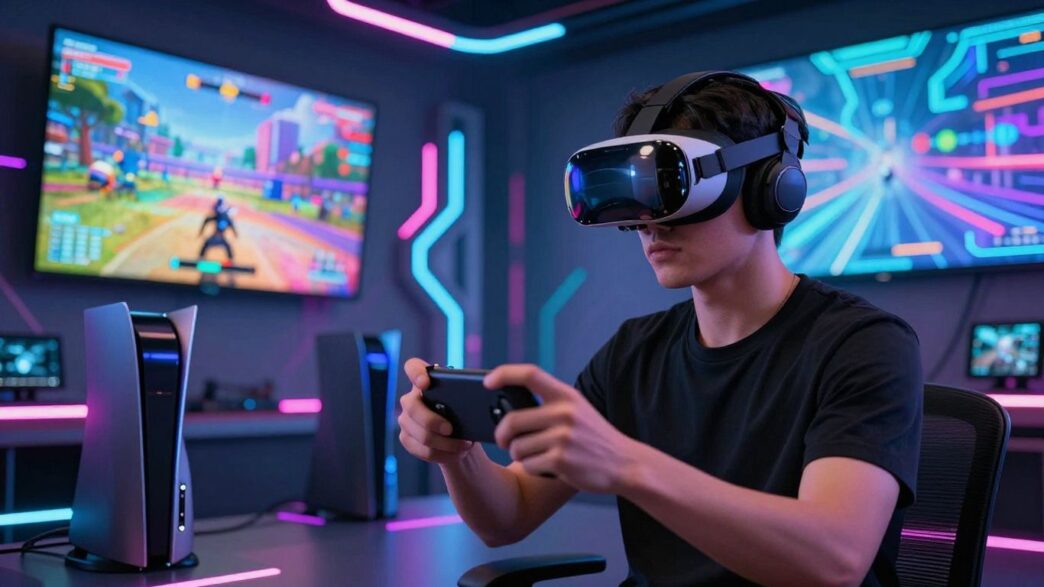
Spatial computing is really starting to change how we play games. It’s not just about looking at a screen anymore; it’s about stepping into the game world. NVIDIA CloudXR 6.0 is a big part of this, especially with its support for the Apple Vision Pro. This means you can stream really high-quality PC and cloud games directly to your headset. Imagine playing something like iRacing or X-Plane 12, but feeling like you’re actually in the cockpit. It’s pretty wild.
CloudXR itself is designed to send these detailed, lag-free experiences from your powerful PC or the cloud to your XR device. The latest version, 6.0, brings in that Apple Vision Pro compatibility and includes something called foveated streaming. This clever tech helps make the visuals look better and run smoother without developers having to completely rework their games for different headsets. For game makers, this makes it much easier to get their demanding games onto new platforms like the Vision Pro.
NVIDIA CloudXR 6.0 for Apple Vision Pro
This new integration is a direct link between Apple’s visionOS and the graphics power of NVIDIA RTX systems. It’s a pretty significant step for bringing PC-quality gaming into the spatial computing space.
Foveated Streaming for Enhanced Performance
Foveated streaming is a neat trick. It basically means the system focuses rendering power on where you’re actually looking. Think of it like your eyes – you see the bit you’re focused on in sharp detail, and the rest is a bit softer. This saves a lot of processing power, which means games can look better and run faster, especially in demanding VR or AR environments.
Immersive PC and Cloud Experiences
Ultimately, this all points towards a future where your gaming experience isn’t tied to a specific screen. You could be playing a graphically intense PC game streamed from the cloud to a headset, or even a more traditional PC game experienced in a new, spatial way. It opens up a lot of possibilities for how and where we play.
The goal here is to make these advanced spatial experiences accessible without requiring everyone to have the absolute latest, most expensive hardware. By streaming and using smart rendering techniques, the gap between what’s possible on a high-end PC and what you can experience in a headset gets a lot smaller.
Market Dynamics and Player Engagement
Younger Gamers Driving Platform-Style Success
The gaming landscape is shifting, and it’s younger players who are really pushing things forward, especially when it comes to those big platform-style games. It turns out, for this group, the social aspects and the sheer fun of playing together often matter more than how pretty the graphics are. This isn’t entirely new, but the trend is definitely getting stronger. These players are looking for experiences where they can create, connect, and just hang out. It’s less about the single-player epic and more about a persistent world they can be part of.
Direct-to-Consumer Sales and Player Relationships
We’re seeing a big move towards studios selling games directly to us, the players. This cuts out a lot of the middlemen, which means developers can keep more of the money and, more importantly, build a more direct connection with their audience. It’s like going from buying a record from a big shop to getting it straight from the band. This allows for more personalised communication and a better sense of community around a game. This direct approach is key to building lasting loyalty. It also means companies can react faster to player feedback, tweaking games and adding content that people actually want.
Cross-Media Extensions and Franchise Loyalty
Games aren’t just games anymore; they’re becoming the centre of huge entertainment universes. Think about popular franchises expanding into TV shows, movies, books, and merchandise. This strategy is all about keeping players engaged with their favourite worlds even when they’re not actively playing. It’s a smart way to deepen that connection and make sure fans stick around. When you’re invested in a story or characters across different media, you’re much more likely to keep playing the games and supporting the brand. It’s a cycle of engagement that benefits everyone involved, from the creators to the fans who get more ways to enjoy their beloved universes. Research indicates a strong correlation between consumer focus and spending, with a 10 percent increase in attention leading to a 17 percent rise in expenditure. Gaming, already excelling in capturing consumer attention, is poised for significant growth by further unlocking the value of this focus unlocking the value of this focus.
Cutting-Edge Graphics and Performance Tools
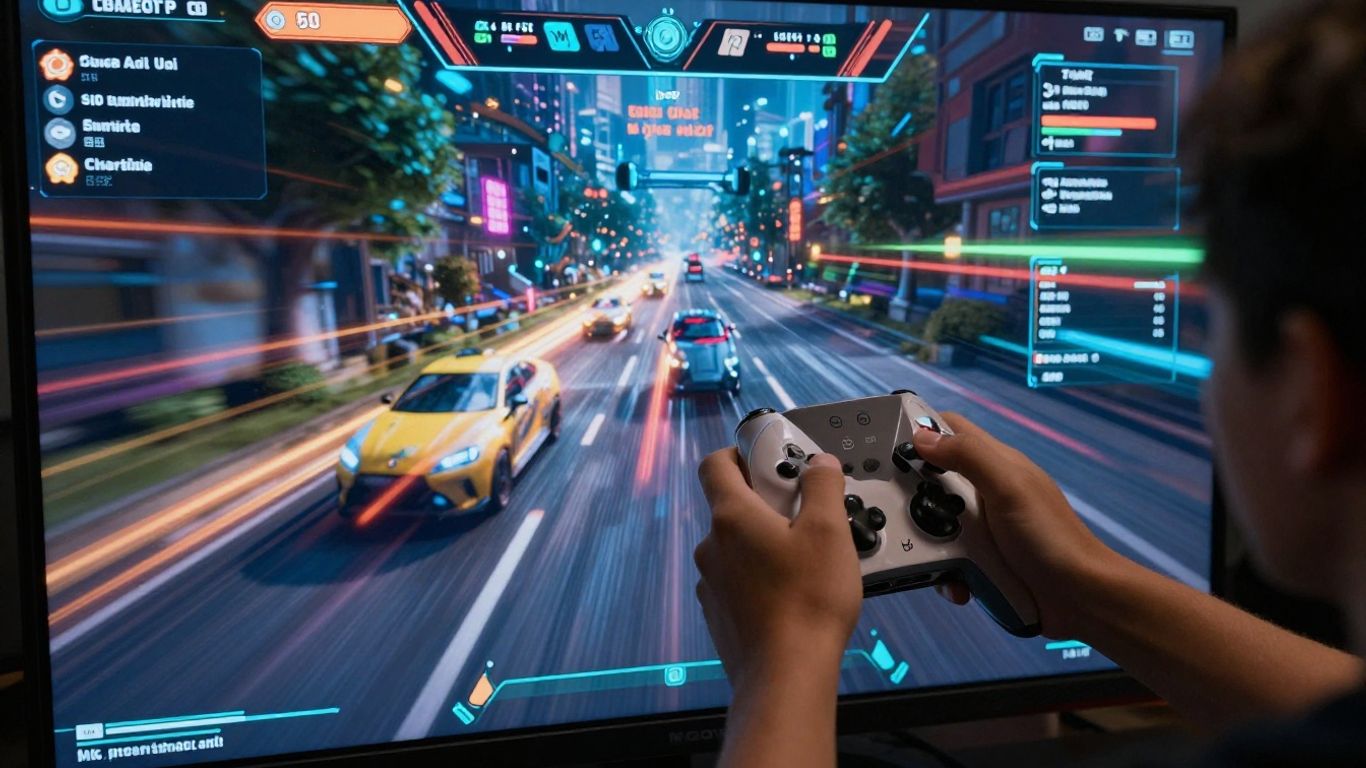
It’s pretty wild how much graphics tech has moved on recently. We’re seeing tools that used to be the stuff of sci-fi movies now becoming standard in game development. NVIDIA, in particular, has been busy rolling out updates that really push the boundaries of what we can do visually, while also trying to make things run smoother.
RTX Global Illumination and DLSS-RR
Global Illumination (GI) is all about making light behave realistically in a game world. Think about how light bounces off surfaces, creating subtle colours and shadows – that’s GI. NVIDIA’s RTX Global Illumination is a big step forward here, especially with its new ReSTIR PT (Reservoir-based Importance Sampling with Path Tracing) system. This allows for more complex light interactions, making scenes look much more natural and immersive. Coupled with DLSS-RR (Deep Learning Super Sampling – Ray Reconstruction), which intelligently reconstructs ray-traced effects, games can achieve stunning visual fidelity without a massive performance hit. It’s a clever way to get those super-realistic lighting effects without needing a supercomputer to run them.
RTX Character Rendering Updates
Characters are often the focal point of games, and NVIDIA’s latest updates for RTX Character Rendering are designed to make them look better than ever. This includes improvements to how hair and skin are rendered, making them appear more lifelike. For instance, the RTX Hair (currently in beta for Unreal Engine 5) uses advanced techniques to simulate individual strands of hair, which can make a huge difference in how characters look up close. It’s these kinds of detailed touches that really pull you into the game world.
DLSS 4.5 Super Resolution
DLSS (Deep Learning Super Sampling) has been a game-changer for performance, and DLSS 4.5 Super Resolution is the next evolution. This technology uses AI to upscale lower-resolution images to higher resolutions, meaning games can run at higher frame rates while still looking sharp and detailed. The ‘Super Resolution’ part is key here, as it focuses on reconstructing image detail with incredible accuracy. It’s like having a super-smart artist working in real-time to make your game look its best, even when the hardware is working hard. This technology is becoming increasingly vital for achieving high-fidelity gaming experiences across a wide range of hardware.
Here’s a quick look at what these tools aim to achieve:
- Improved Lighting: More realistic light bounces and reflections for deeper immersion.
- Enhanced Character Detail: Lifelike hair, skin, and facial features.
- Better Performance: Higher frame rates and smoother gameplay through AI upscaling.
- Reduced Development Burden: Tools that simplify complex rendering tasks for developers.
The ongoing development in graphics and performance tools is really about making games look and feel more real. It’s not just about prettier pictures; it’s about creating worlds that players can get lost in, and doing it in a way that’s accessible to more people. These advancements are helping developers create experiences that were previously impossible, pushing the boundaries of interactive entertainment.
Wrapping Up
So, there you have it. The world of gaming is moving pretty fast, isn’t it? From fancy new graphics tech like ray tracing to AI making characters smarter, it feels like there’s always something new popping up. It’s not just about making games look pretty anymore; it’s about how they play, how social they are, and how developers are finding new ways to connect with us. Whether you’re a hardcore player or just dip in now and then, it’s clear that games are becoming a bigger part of our lives, and the tech behind them is only getting more interesting. It’ll be fascinating to see what comes next.
Frequently Asked Questions
What’s new with graphics in games?
Graphics are getting super realistic! New tech like ‘path tracing’ makes light and shadows look incredibly real, almost like in movies. Plus, things like dense forests and detailed characters are being made to look much better and smoother, even when lots of things are happening on screen.
How is AI changing games?
Artificial Intelligence (AI) is making games smarter. It’s used to make game characters act more like real people, create more interesting stories, and even help games understand what you say. Some AI can now run right on your device, making things faster and more private.
Are game development tools getting better?
Yes, game makers have new tools to help them work faster and better. They can now use powerful computer setups from anywhere, share game code more efficiently, and even create virtual studios. This helps them make bigger and more complex games.
What is ‘spatial computing’ in gaming?
Spatial computing means gaming in 3D spaces, like with VR headsets. New technology lets you stream high-quality PC games to these devices, making the experience feel more real and immersive. It’s like stepping inside the game world.
Who is playing games the most these days?
Younger players are a big deal, especially for games where you can hang out with friends and be creative. They care more about the fun gameplay and social parts than just how good the graphics look. This is making game companies try new things to keep players interested.
What is DLSS and how does it help?
DLSS stands for Deep Learning Super Sampling. It’s a smart technology that uses AI to make games look better and run faster. It can upscale lower-resolution images to look like higher-resolution ones, giving you smoother gameplay and sharper visuals without needing a super powerful computer.