Plugging the Holes: How Consistent Social Media Activity Helps Pest Control Companies Reduce Lead Leakage
Lead leakage is the silent killer of local service businesses. In the pest control industry, it does not look like a dramatic crash; it looks like a slow drip. It occurs when an interested homeowner visits your website, considers calling, but then hesitates, compares options, and quietly abandons the process. You paid for the click, but you never got the call.
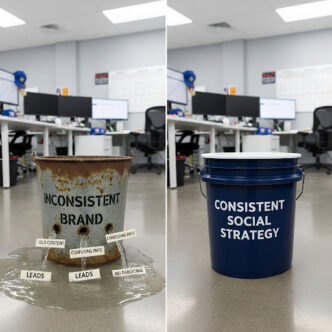
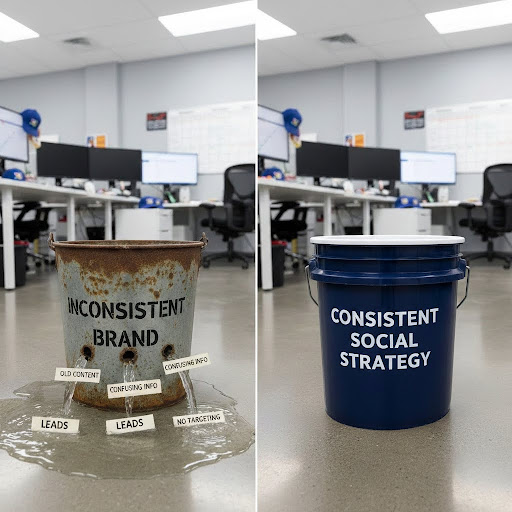
Marketing teams often focus on filling the top of the funnel with more traffic, but seasoned operators know that the real efficiency gains come from fixing the bucket. Social media is increasingly influencing this drop-off point, acting as either a sealant that reinforces confidence or a crack that introduces doubt. For pest control companies, maintaining a consistent, active social presence is no longer just about brand awareness. It is a strategic defense against lead leakage.
Homeowners rarely rely on a single source when choosing a provider. The modern buyer’s journey is non-linear. After discovering a business through a Google Ad or a map search, many people perform a “verification loop.” They cross-check social profiles to validate what they have seen elsewhere. If they find a disconnect—inconsistent messaging, outdated content, or conflicting service areas—they stall. In that moment of hesitation, the lead leaks.
The “Verification Loop” and Consumer Confidence
An industry analysis published by Social Media Explorer highlighted how pest control companies are using structured social media strategies to reduce this leakage. The analysis described social platforms as the “connective tissue” between discovery, trust, and direct contact. When this tissue is healthy, leads move smoothly from “interested” to “booked.” When it is weak, they fall through the gaps.
This “cross-check” behavior is backed by data. According to a landmark report by Salesforce, it takes between six and eight touchpoints to generate a viable sales lead. In the condensed timeline of a pest emergency, three or four of those touchpoints might happen in ten minutes: a Google search, a website visit, a check of reviews, and a glance at the Facebook page if the Facebook page contradicts the website—perhaps listing different hours or failing to mention the specific service the customer needs—the trust chain breaks.
Consistency: The Antidote to Friction
Consistency plays a key role in reducing friction. When service descriptions, service areas, and brand tone align perfectly across Google, your website, and social media, the homeowner feels a subconscious sense of safety. They do not have to do the mental work to determine whether you are the right choice.
Conversely, inconsistency creates cognitive dissonance. If your website claims you are “The #1 Termite Expert” but your Instagram feed is full of generic memes about ants from two years ago, the customer doubts your expertise. Research from Marq (formerly Lucidpress) indicates that consistent brand presentation across all platforms increases revenue by up to 23%. For a pest control company, this revenue bump comes not from charging more, but from losing fewer leads to confusion.
Social feeds that reinforce the same services and geographic focus seen in listings help eliminate this confusion. When a customer sees a truck they recognize from the website in a Facebook photo taken in their own neighborhood, the “verification loop” is closed, and they are ready to call.
Extending the Decision Window
Social media also extends the lifespan of initial interest. Not every pest problem is an immediate emergency. Some homeowners are in a “research phase” for a recurring maintenance plan or a termite bond. Even if a homeowner does not contact a company immediately, regular posts can keep the business visible during this decision window.
This is the concept of “staying power.” A homeowner might visit your site on Tuesday but wait until Saturday to make calls. If your helpful post about “Signs of Termite Damage” pops up in their feed on Thursday, you have reinforced your position as the expert. This repeated exposure tips the balance when the homeowner is finally ready to act, preventing them from drifting back to Google to start the search over with a competitor.
The Agency Perspective: Building a Safety Net
Agencies supporting pest control brands are increasingly designing social strategies with this “safety net” mentality in mind. BlakSheep Creative has positioned social media as a supporting layer that reduces lead loss by reinforcing proof, clarity, and availability throughout the customer journey. Their approach focuses on harmonizing the message, ensuring the “Open for Business” signal is clearly communicated across every channel a customer might check.
The broader implication is that social media affects outcomes even when it does not generate the first click. By maintaining consistent, credible signals, pest control companies can reduce uncertainty. In a competitive local market, the winner is often not the company that generates the most leads, but the one that spills the fewest.