You know, sometimes science feels like it’s moving at lightning speed, and companies like Resolve Biosciences are really at the forefront of that. They’re doing some pretty cool work in understanding how things work at a really tiny level within our cells. It’s all about seeing the bigger picture, but also the super small details, which can help us figure out diseases and maybe even find new ways to treat them. They’ve got this special technology called Molecular Cartography, and it seems to be making waves in the research world.
Key Takeaways
- Resolve Biosciences uses a technology called Molecular Cartography™ to let scientists see biological samples at a very high level of detail, down to the single molecule level.
- This approach helps researchers understand complex biological questions, which can be important for things like cancer research and finding new treatments.
- The company recently got a significant amount of funding, over $71 million, to help them grow and get their technology to more labs around the world.
- Resolve Biosciences has brought on new leadership, like Paul Steinberg as Chief Commercial Officer, to help guide their business growth and sales efforts.
- Their technology offers a detailed, 3D view of biological samples, preserving the sample’s integrity while providing a lot of information about gene and protein expression.
Resolve Biosciences: Pioneering Spatial Biology
Spatial biology is a pretty big deal right now in the life sciences, and Resolve Biosciences is right at the forefront with their Molecular Cartography™ technology. Think of it like getting a super detailed map of what’s happening inside cells, but way more advanced. They’re giving scientists the ability to see biology at a level of detail that just wasn’t possible before.
The Power of Molecular Cartography™
This isn’t just another fancy microscope. Molecular Cartography™ is Resolve’s own way of looking at biological samples. It uses a special method to detect individual molecules, like RNA, right where they are in the cell. This means you get a full picture of the spatial context – where everything is located – all the way down to the subcellular level. It’s like going from a blurry satellite image to a street-level view with every single person and car clearly visible. This high-resolution view is what sets Resolve apart.
Unlocking New Insights with Unparalleled Resolution
What does this mean for research? Well, it means scientists can ask and answer questions they couldn’t before. They can spot rare signals, like a specific gene that’s only active in a few cells, or see how different molecules interact within a cell. This level of detail is super helpful for understanding complex diseases and biological processes. It’s not just about seeing more; it’s about understanding the ‘why’ and ‘how’ behind biological events.
Advancing Understanding Across Critical Fields
The applications for this technology are pretty broad. Researchers are using it to get a better handle on things like cancer, where understanding the tumor microenvironment is key. It’s also making waves in neuroscience, helping to map out the complex wiring of the brain, and in infectious disease research, allowing for a closer look at how viruses and bacteria interact with host cells. Basically, anywhere you need to understand the intricate spatial relationships within biological samples, Molecular Cartography™ is making a difference.
Groundbreaking Technology and Its Applications
Single-Molecule Detection for Subcellular Detail
Resolve Biosciences has really changed the game with their Molecular Cartography technology. It lets scientists see biology at a level of detail that was pretty much science fiction just a few years ago. We’re talking about spotting individual molecules within cells, which gives you a much clearer picture of what’s actually happening. This isn’t just about seeing more; it’s about seeing better, right down to the nitty-gritty subcellular structures. This kind of precision is a big deal for understanding complex biological processes.
Automated Workflow Preserving Sample Integrity
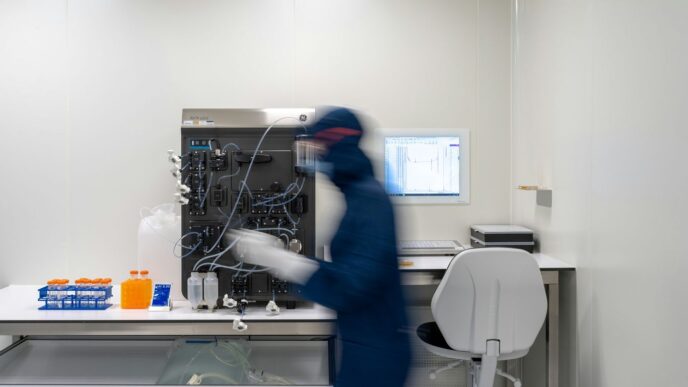
One of the coolest things about Resolve’s system is how it handles samples. It’s fully automated, which means less chance of human error messing things up. This is super important because you want to preserve the delicate nature of your tissue or cell samples. The process is designed to keep everything intact, so the data you get is reliable. It’s like having a super careful robot assistant in the lab that never gets tired or makes mistakes. This automated approach makes it easier for labs to get consistent results, which is what every researcher wants.
Sensitivity and Specificity for Rare Signal Detection
When you’re looking for something specific in a complex biological sample, you need tools that are both sensitive and specific. Resolve’s technology really shines here. It can pick up on those faint signals that might indicate rare cell types or low-expression genes, without getting confused by everything else going on. This means researchers can find those needles in the haystack, whether they’re studying rare cancer cells or looking for subtle changes in gene activity. It’s about getting a clear signal, even when the signal is weak, which opens up a lot of new research possibilities.
Driving Innovation in Life Sciences
Resolve Biosciences is really shaking things up in the life sciences world. Their technology, Molecular Cartography™, is a big deal because it lets scientists see what’s happening inside cells with amazing detail. This isn’t just a small improvement; it’s a whole new way to look at biology.
Shaping the Future of Cancer Treatment
Cancer research is a huge area where this technology is making waves. Understanding how tumors grow and interact with their surroundings at a molecular level is key to finding better treatments. Resolve’s ability to map gene and protein activity within individual cells, right down to the subcellular level, gives researchers a much clearer picture of what’s going wrong in cancer. This detailed view can help identify new drug targets and predict how patients might respond to therapies. It’s like going from a blurry photograph to a high-definition video of the disease.
Enabling New Therapeutic Approaches
Beyond cancer, this high-resolution spatial biology is opening doors for all sorts of new treatments. Imagine being able to see exactly which cells are involved in an autoimmune disease or how a virus is affecting different parts of a cell. This level of insight can lead to the development of more targeted drugs that work better and have fewer side effects. It’s about moving towards precision medicine, where treatments are tailored to the specific molecular makeup of a disease in each individual.
Interpreting Fundamental Biological Processes
But it’s not all about disease. Resolve’s technology is also helping us understand the basic building blocks of life. How do cells communicate? How do they develop? How do they respond to their environment? Answering these questions is important for everything from understanding development to figuring out how organisms age. By providing an unprecedented view of molecular interactions within cells, scientists can start to piece together these complex biological puzzles. It’s a powerful tool for anyone trying to understand the intricate workings of life itself.
Commercial Expansion and Strategic Funding
Securing Series B Financing for Global Demand
Resolve Biosciences recently brought in a significant amount of money, $71 million to be exact, through a Series B funding round. This cash infusion is a big deal because it shows a lot of confidence in what they’re doing. The money is mainly going to help them grow their business and get their technology out to more people around the world. It’s all about meeting the increasing need for their unique spatial biology tools.
Led by Patient Square Capital
This big funding round was actually led by a company called Patient Square Capital. They’re known for investing in healthcare and life sciences, so it makes sense they’d back Resolve. Other investors jumped in too, like EDBI, PS Capital, Alafi Capital, and NRW.BANK, plus some of the folks who invested before. It’s a strong group of backers who clearly see the potential in Resolve’s Molecular Cartography™.
Accelerating Commercial Expansion and Product Development
So, what’s the plan for all this new money? Resolve Biosciences is looking to speed things up. They want to expand their operations, meaning hiring more people and setting up more systems. They’re also going to put some of that cash into making their products even better and developing new ones. The goal is to make sure scientists everywhere can get their hands on this high-resolution spatial biology tech. It’s about scaling up quickly to keep pace with the demand they’re seeing.
Leadership and Expertise at Resolve Biosciences
Appointment of Paul Steinberg as Chief Commercial Officer
Resolve Biosciences recently brought on Paul Steinberg as their new Chief Commercial Officer. This is a pretty big deal for the company, especially after they secured that big Series B funding. Steinberg isn’t new to this scene; he’s got over 20 years in the life sciences tools industry, focusing on commercial teams and growing businesses. He’s known for helping bring new single-cell and spatial tech to the market. Before joining Resolve, he was the Chief Commercial Officer at LevitasBio and also held significant roles at NanoString Technologies and Fluidigm, where he was involved in launching some of the first single-cell and protein imaging platforms. He even spent time at Thermo Fisher Scientific. Basically, the guy knows how to get these kinds of technologies into labs.
Building on Success and Driving Commercial Growth
Steinberg’s main job is to build on the success Resolve has already seen and really push their commercial growth. This means leading the global sales, technical service, business development, and marketing teams. It’s about making sure more labs around the world can get their hands on the Molecular Cartography technology. The company has already installed its workflow in quite a few top labs in Europe and North America, which is impressive, especially considering the market conditions lately. With Steinberg at the helm of the commercial side, the plan is to accelerate how quickly this technology gets adopted globally.
Experienced Leadership in Life Science Tools
The team at Resolve Biosciences seems to be putting together a solid group of leaders. Besides Steinberg, you’ve got Jason T. Gammack as CEO, who also has a ton of experience, over 25 years, in the life sciences industry. He’s worked with big names like Inscripta, QIAGEN, Sigma-Aldrich, and Thermo Fisher Scientific. This kind of background is exactly what you want when you’re trying to scale a company with a groundbreaking technology. They’re bringing in people who have a proven track record of growing product lines and getting new tools into the hands of researchers. It looks like they’re building a team that really understands the life science tools market and how to make a new technology successful.
The Resolve Biosciences Advantage
Highest-Resolution View of Spatial Biology
Resolve Biosciences is really changing the game when it comes to looking at biology. Their Molecular Cartography™ technology gives scientists the sharpest possible picture of what’s happening inside cells. Think of it like going from a blurry old photograph to a crystal-clear, high-definition video. This level of detail means researchers can see things they simply couldn’t before, leading to new discoveries.
Full Spatial Context at Subcellular Resolution
What’s so cool about Resolve’s approach is that it doesn’t just show you what is there, but also exactly where it is, all the way down to the tiny structures within a cell. This isn’t just about spotting a gene or a protein; it’s about understanding its precise location and how it interacts with its neighbors. This spatial information is super important for figuring out how complex biological systems work, especially when things go wrong, like in diseases.
Proprietary, Highly Multiplexed Technology
The magic behind Resolve Biosciences is their unique technology. It’s proprietary, meaning it’s something they developed themselves and is pretty special. It’s also highly multiplexed, which is a fancy way of saying it can look at a lot of different molecules – like thousands of them – all at the same time in a single experiment. This efficiency is a big deal, saving time and resources while still providing incredibly detailed and accurate results. It’s this combination of high resolution, spatial context, and the ability to see so many things at once that sets Resolve apart.
Looking Ahead
So, what’s next for Resolve Biosciences? It seems like they’re really onto something big with their Molecular Cartography. They’ve got this cool tech that lets scientists see biology at a super detailed level, right down to the tiny parts of cells. This isn’t just some small step; it’s a pretty big leap forward for understanding diseases like cancer and brain stuff. With the recent funding and new leadership, they’re set to get this technology into more labs around the world. It feels like they’re just getting started, and it’ll be interesting to see what new discoveries come out of it.
Frequently Asked Questions
What is Resolve Biosciences?
Resolve Biosciences is a company that makes special tools for scientists. These tools help them see tiny details inside cells and tissues, like a super-powered microscope for biology. They call their main technology ‘Molecular Cartography™’.
What is Molecular Cartography™?
Think of Molecular Cartography™ as a way to map out what’s happening inside cells. It lets scientists see where different molecules, like the instructions for making things in a cell, are located. It’s like creating a detailed map of a city, but for the inside of a cell, showing every single building and street.
Why is this technology important?
This technology is important because it helps scientists understand diseases better. By seeing these tiny details, they can figure out how diseases start and grow, which could lead to new medicines and treatments for things like cancer or brain disorders.
How does Resolve Biosciences get funding?
Resolve Biosciences has received a lot of money, called Series B financing, from investors. This money helps them make more of their special tools and share them with scientists all over the world. A big investor is a company called Patient Square Capital.
Who leads Resolve Biosciences?
Resolve Biosciences has smart leaders, like Paul Steinberg, who is in charge of selling their tools and helping the company grow. He has a lot of experience working with other science companies.
What makes Resolve Biosciences’ technology special?
Their technology is special because it’s the most detailed way to see what’s happening inside cells. It can see single molecules and show their exact location within the cell, giving scientists a complete picture without damaging the sample. It’s like having the clearest, most zoomed-in view possible.