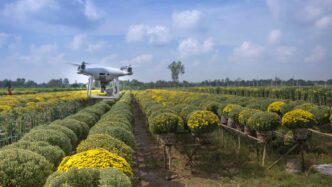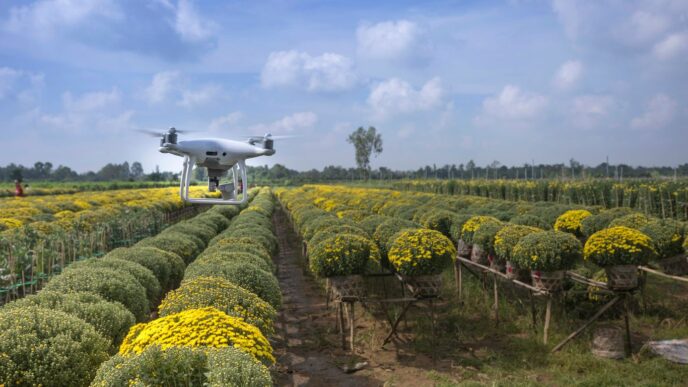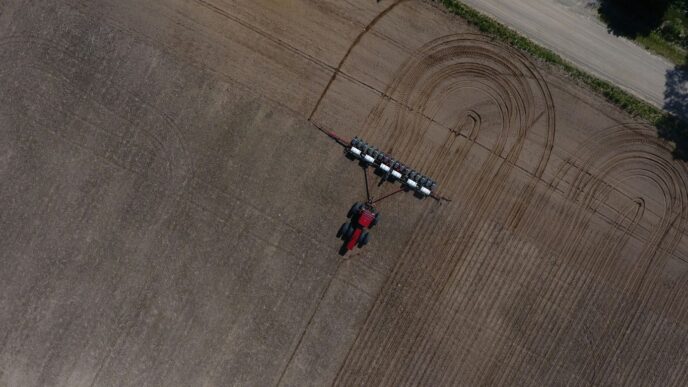
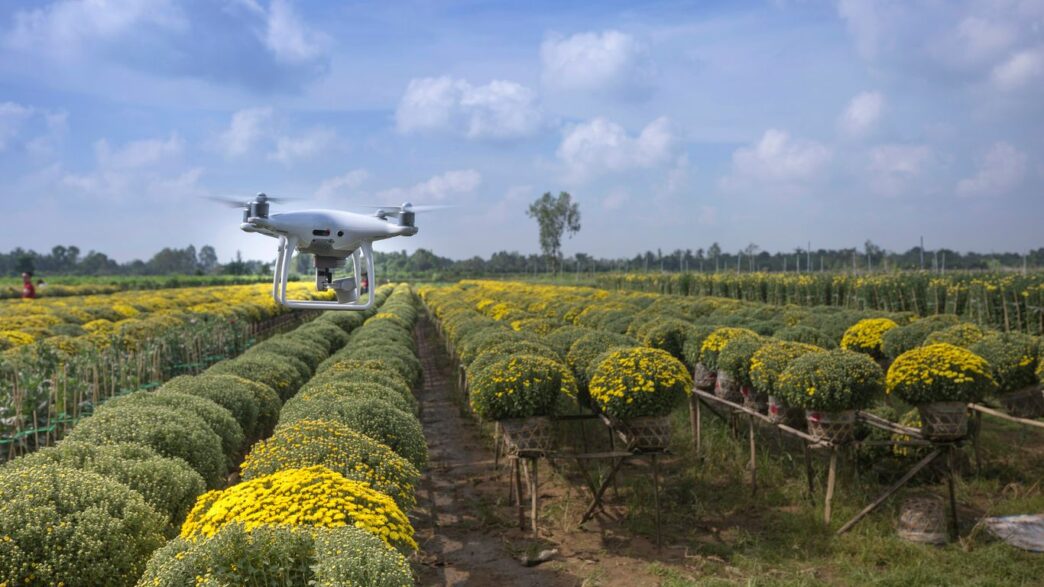
Farming is changing, and technology is a big part of that. If you’re thinking about using a drone for spraying on your farm, picking the right one is super important. It’s not just about buying the fanciest model; it’s about finding a tool that actually helps you get more done and makes your farm run smoother. This guide is here to help you figure out which drone for agricultural spraying makes the most sense for your fields and your crops.
Key Takeaways
- Different drone types, like multi-rotor, fixed-wing, and hybrids, suit different farm jobs. Multi-rotors are good for tight spots, while fixed-wings cover big areas.
- Look for drones with good cameras and sensors to see your crops clearly. Also, think about how long they can fly and how much they can carry.
- Your farm’s size, the types of crops you grow, and your budget will guide you to the best drone for agricultural spraying.
- Check how far the drone can fly, how well its software works, and how accurately it sprays to make sure it meets your needs.
- Consider the support you’ll get from the maker and if the drone can be updated for future use. Also, be aware of any rules you need to follow.
Understanding Drone Types For Agricultural Spraying
When you’re looking at drones for your farm, it’s not just about picking the flashiest model. You’ve got to think about what you actually need it to do. It’s kind of like choosing between a car and a truck – both get you places, but they’re built for different jobs. For farm spraying, there are generally three main types of drones to consider: multi-rotor, fixed-wing, and hybrid VTOL.
Multi-Rotor Drones: Agility and Precision
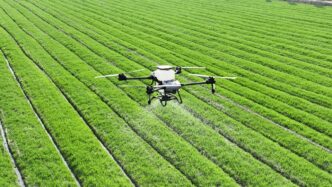
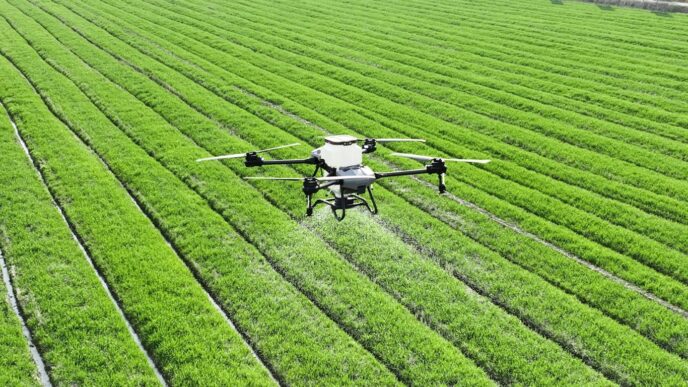
Think of these like a helicopter. They have multiple rotors (usually four, six, or eight) that let them lift straight up, hover in place, and move around with a lot of control. This makes them super handy for detailed work. If you’ve got a specific section of a field that needs attention, like a patch of weeds or a spot where disease is showing up, a multi-rotor drone can get right in there. They’re also great for spot spraying. The downside? All that hovering and precise movement uses up battery power pretty fast. So, while they’re great for detailed tasks, they can’t cover huge areas in one go.
- Takeoff and landing: Vertical, no runway needed.
- Hovering: Can stay perfectly still in the air.
- Maneuverability: Excellent for tight spaces and precise movements.
- Best for: Spot spraying, detailed crop inspection, small to medium fields.
Fixed-Wing Drones: Endurance and Coverage
These drones are built more like airplanes. They have wings that provide lift, and they need to move forward to stay airborne. Because of their design, they’re much more efficient at covering large distances. Once they’re up and flying, they can stay up for a long time and survey big areas without needing to land and swap batteries as often. If you have a really large farm and need to cover a lot of ground for spraying or general monitoring, a fixed-wing drone is often the way to go. They’re the workhorses for getting broad coverage.
- Takeoff and landing: Usually requires a runway or a catapult system.
- Hovering: Cannot hover; must maintain forward motion.
- Maneuverability: Less agile than multi-rotors, but covers ground quickly.
- Best for: Large-scale mapping, surveying vast areas, long-distance spraying missions.
Hybrid VTOL Drones: The Best of Both Worlds
Now, these are pretty neat. Hybrid VTOL (Vertical Take-Off and Landing) drones try to combine the best parts of the other two types. They can take off and land vertically like a multi-rotor, so you don’t need a runway. But once they’re in the air, they can transition to a more fixed-wing flight mode, using their wings for efficient, long-distance travel. This means you get the convenience of vertical takeoff with the endurance and coverage of a fixed-wing. They offer a flexible solution for farms that need both detailed work and broad coverage. While they can be more complex and sometimes pricier, they’re becoming a really popular choice for farmers who want versatility.
- Takeoff and landing: Vertical, like a multi-rotor.
- Flight: Can transition to forward flight for efficiency.
- Versatility: Combines hovering ability with long-range flight.
- Best for: Farms needing a balance of precision application and large-area coverage.
Key Features For Your Agricultural Spraying Drone
When you’re looking at drones for spraying your fields, it’s not just about picking the flashiest model. You need to think about what will actually get the job done efficiently and effectively on your farm. Let’s break down the important bits.
Camera Quality and Sensor Capabilities
This is how the drone sees your crops. A good camera means you can spot problems early. We’re talking about high-resolution cameras, ideally 12 megapixels or more, so you can see fine details. But it’s not just about pretty pictures. Multispectral or thermal sensors are where the real magic happens. These can show you things like plant stress, water levels, or even pest infestations before they’re visible to the naked eye. Think of these sensors as your drone’s advanced diagnostic tools for crop health.
Flight Time and Battery Life
Nobody wants to be constantly swapping batteries or waiting for charges, especially when you’ve got acres to cover. Flight time is a big deal. For larger farms, you’ll want a drone that can stay airborne for at least 30 minutes, maybe even longer. This means fewer interruptions and more ground covered in a single go. It’s a simple equation: longer flight time equals more work done.
Payload Capacity and Spraying Systems
This is pretty straightforward – how much liquid can the drone carry and how well does it spray it? Payload capacity is measured in kilograms. A higher capacity means you can carry more spray solution, reducing the number of trips back to the base. The spraying system itself needs to be reliable and capable of applying the liquid evenly. Some systems are better for fine mists, others for heavier applications, so consider what your crops need.
Durability and Weather Resistance
Farms aren’t always sunny and calm. Your drone needs to be tough. Look for drones built with sturdy materials that can handle a bit of rough treatment. Weather resistance is also key. Can it handle a bit of wind? A light drizzle? You don’t want a sudden shower to ground your operation. Checking the drone’s IP rating (Ingress Protection) can give you an idea of how well it’s protected against dust and water.
Assessing Your Farm’s Specific Needs
Alright, so you’ve looked at the different drone types and the cool features they offer. Now comes the really important part: figuring out what your farm actually needs. It’s not a one-size-fits-all deal, you know? What works for your neighbor might not be the best fit for your operation. Let’s break down how to think about this.
Acreage and Field Complexity
How big are we talking? A few acres or hundreds? This is a big one. For smaller, more intricate fields with lots of obstacles, a multi-rotor drone might be your best bet. They’re nimble and can get into tight spots. But if you’ve got vast, open fields, you’ll want something that can cover a lot of ground quickly, like a fixed-wing drone. They’re built for endurance and speed over large areas.
- Small Farms (Under 100 acres): Multi-rotor drones often shine here due to their maneuverability and ability to hover for precise application.
- Medium Farms (100-500 acres): You might consider hybrid VTOL drones, offering a balance of speed and precision, or larger multi-rotors.
- Large Farms (500+ acres): Fixed-wing drones are usually the most efficient for covering large expanses quickly, though they require more space for takeoff and landing.
Crop Type and Monitoring Requirements
What are you growing? Different crops have different needs. Some might need very specific nutrient applications, while others are prone to particular pests or diseases that you’ll want to spot early. If you’re growing something like corn or soybeans across a huge area, you’ll want a drone that can map health indicators like NDVI across that whole expanse. For orchards or vineyards, where you might have individual trees or vines needing attention, a more precise, multi-rotor system might be better for targeted spraying.
Think about:
- Early Detection: Do you need to spot subtle signs of stress or disease before they become a big problem?
- Targeted Treatment: Will you be applying pesticides or fertilizers to specific spots, or is it a broadcast application?
- Growth Stages: Do you need to monitor different stages of crop development throughout the season?
Budget and Return on Investment
Let’s be real, drones aren’t cheap. You need to figure out what you can afford and, more importantly, what’s going to give you a good return. A cheaper drone might not have the range, payload, or sensor quality you need, meaning you’ll spend more time in the air or get less useful data. On the flip side, the most expensive drone might be overkill for your needs. It’s all about finding that sweet spot where the technology helps you save money on inputs, reduce labor, or increase yields enough to justify the cost. You’ll want to look at how much you spend on chemicals, water, and labor now, and then estimate how much a drone could cut those costs or boost your harvest. It’s a calculation that really depends on your specific farm’s economics.
Evaluating Drone Performance and Data
When it comes to choosing a drone for agricultural spraying, how it actually performs in the field—and what kind of data it delivers—can make or break your operation. Some folks get caught up in specs and forget the reality on the ground: if your drone can’t cover enough land, or if the data it produces is slow and confusing, you won’t see much benefit.
Range and Coverage Area
A drone’s ability to cover large fields in a single flight changes everything for a grower. You don’t want to spend all day swapping batteries or stitching together partial maps. Here’s a quick table highlighting what to look for:
| Drone Model | Max Flight Time (min) | Max Coverage per Flight (acres) |
|---|---|---|
| Yamaha FAZER R | 55 | 200 |
| Sentera DGR60 | 42 | 120 |
| PrecisionHawk Lancaster 8 | 60 | 135 |
| Parrot Bluegrass Fields | 30 | 75 |
A few things to consider:
- Match range to your farm’s size. Big acreage needs longer flight time, plain and simple.
- Don’t forget about terrain and obstacles—they can change real-world coverage.
- Some drones are built for patches of fields, others are made for sprawling areas.
Data Processing and Software Integration
After a drone lands, the real work starts: turning a folder of images into something you can use. Here’s what you need to think about:
- Data Compatibility: The drone should work smoothly with popular farm management systems—otherwise, you’ll waste hours on conversions.
- Speed of Processing: Fast software saves time during spraying windows when crops need timely attention (sometimes, every day matters).
- Cloud Integration: Instant uploads let you review field data on the go, make decisions, and send spray teams out sooner.
If your drone, sensors, and software aren’t all talking to each other, you’ll run into maddening tech headaches—so prioritize ecosystems that play nice together.
Accuracy of Spray Application
It’s not just about getting fertilizer or pesticide on the field—it’s about putting it in the right spot every time. Accuracy can mean healthier crops and real dollar savings. Here’s how to check if a drone’s spraying is up to scratch:
- Look for drones with high-precision GPS, centimeter-level accuracy is ideal for variable rate applications.
- Consider the spray system: Can it handle variable rates? Does it respond to mapping data on the fly?
- Request demo field maps or reference results before you buy—they often show application overlap, gaps, and missed spots.
Making the effort to figure out how well a drone performs—and how clear it makes your decision-making—will pay off every single season. No one wants to babysit batteries, decode messy maps, or redo missed sections. Choose a drone that works as hard as you do, and your data will start working for you instead of the other way around.
Considering Support and Future-Proofing
Manufacturer Support and Training
When you’re looking at drones, don’t just think about the shiny tech. Think about who’s got your back when things go sideways. A good manufacturer will offer solid training for you and your team. This isn’t just about learning how to fly; it’s about understanding the maintenance, the software, and how to get the most out of your investment. Having a single point of contact for support can save you a ton of headaches. It means you’re not bouncing between different companies trying to figure out who’s responsible when a problem pops up. They should know the whole system, from the drone itself to the software you use for planning and analysis.
Software Updates and Longevity
Technology moves fast, and that’s true for drones too. You want a drone that’s going to stick around and get better over time, not become obsolete next year. Look for companies that regularly put out software updates. These updates can add new features, improve performance, and patch up any security holes. It’s like getting a new drone without actually buying one. Think about the company’s track record: have they been around? Do they seem committed to improving their products? This shows they’re invested in the long haul, which means your drone will be too.
Regulatory Compliance and Licensing
Farming with drones isn’t quite the Wild West anymore. There are rules, and they can change. A good drone provider will help you understand these regulations. They should be able to tell you what licenses you might need, how to operate legally in your area, and what data privacy considerations are important. Some manufacturers even build their drones with specific compliance standards in mind, like those related to secure supply chains. This can make a big difference, especially if you work with larger organizations or government bodies. Staying on the right side of the law means your operation can keep running smoothly without unexpected interruptions.
Wrapping It Up
So, we’ve gone over why drones are a pretty big deal for farms these days and what to look for when you’re picking one out. It’s not just about having the latest tech; it’s about finding a tool that actually makes your job easier and your farm more productive. Whether you need to keep a close eye on a small patch of crops or cover a huge field, there’s a drone out there for you. Take your time, figure out what you really need, and don’t be afraid to ask questions. Getting the right drone is a smart move for the future of your farm.
Frequently Asked Questions
What kind of drone is best for spraying crops?
There are a few kinds of drones that can spray crops. Multi-rotor drones are like helicopters; they can hover and move precisely, which is great for small areas or spot spraying. Fixed-wing drones are like airplanes and can cover large fields really fast. Hybrid VTOL drones try to combine the best of both. The best one for you depends on how big your farm is and what you need to spray.
How much land can a drone spray in one go?
It really depends on the drone! Smaller drones might only be able to spray about 20 to 50 acres before needing a battery change. Bigger, more powerful drones designed for farming can cover much more, sometimes up to 180-190 acres in an hour. This is why choosing a drone with a long flight time is important for large farms.
Can I use a drone to spray my crops when it’s windy or raining?
Most basic drones aren’t built for bad weather. But, professional farming drones are often tougher. They can handle some wind and rain, meaning you can spray more often and get the job done when it’s needed, not just when the weather is perfect. This helps you act fast to protect your crops.
Do I need a special license to fly a farming drone?
Yes, in most places, you’ll need a license or certification to fly a drone for commercial purposes, like spraying crops on your farm. Rules can change, so it’s important to check with your local aviation authority to make sure you’re following all the laws.
How much does a drone for farming cost?
The price can vary a lot. Simple drones for just looking at crops might start around $1,500 to $3,000. Drones that can spray and have advanced cameras or sensors to check crop health can cost anywhere from $8,000 to $15,000 or even more for the top-of-the-line models.
Will a drone actually save me money on my farm?
Yes, many farmers find that drones help save money in the long run. They help you use less fertilizer and pesticides by spraying only where needed. They also save time and labor because they can cover fields much faster than people walking them. Plus, catching problems early can prevent bigger, more expensive issues later on.