What if a car could be super fast, go into space, and still be something you could drive around town? That’s kind of the idea behind the Tesla Roadster. It started as this small electric sports car that really got people talking about EVs. Now, with the new one coming, it’s still all about pushing what electric cars can do. We’re going to take a look at where it came from, what makes it special, and what’s next.
Key Takeaways
- The 2008 Tesla Roadster was Tesla’s very first production car, proving that electric vehicles could be exciting and high-performance.
- It was built on a Lotus Elise chassis and offered quick acceleration, with a 0-60 mph time around 3.7 seconds.
- Around 2,450 units of the original Roadster were sold globally, with a price tag of about $109,000.
- Later versions, like the 2011 model, saw improvements in range and features, and original Roadsters now hold significant collector value.
- The Roadster, especially its journey into space via SpaceX, has become a symbol of Tesla’s ambition and the potential of electric vehicle technology.
The Genesis of the Electric Supercar: The 2008 Tesla Roadster
From Humble Beginnings: Tesla’s First Production Vehicle
Back in 2008, Tesla was still a relatively unknown name, a startup with big ideas about changing the automotive world. They decided to start with a bang, not a whimper, by creating the original Tesla Roadster. This wasn’t just any electric car; it was designed to be a performance machine, proving that electric vehicles could be exciting and desirable. It was built using a modified Lotus Elise chassis, which gave it a lightweight and sporty foundation. The 2008 Roadster was Tesla’s very first production car, a bold statement that kicked off their journey.
Challenging the Status Quo: Performance and Design
The Roadster aimed to shatter expectations. It packed a punch with its electric powertrain, offering instant torque and quick acceleration that surprised many. It looked the part too, with a sleek, low-slung sports car design that turned heads. It wasn’t just about going fast; it was about doing it silently and without burning fossil fuels. This combination of performance and eco-consciousness was revolutionary for its time.
Key features of the original Roadster included:
- Powertrain: All-electric, powered by a lithium-ion battery pack.
- Performance: Capable of 0-60 mph in around 3.7 seconds.
- Top Speed: Reached up to 125 mph.
- Range: Approximately 245 miles on a full charge (though real-world range varied).
Early Adopter Enthusiasm for the 2008 Tesla Roadster
People who bought the early Roadsters were often enthusiasts and tech lovers, willing to take a chance on something new. They weren’t just buying a car; they were buying into a vision of the future. The driving experience was unlike anything else at the time – smooth, quiet, and surprisingly quick. It generated a lot of buzz and excitement, laying the groundwork for Tesla’s future success and the broader acceptance of electric cars.
Design and Engineering Innovations
Aerodynamic Exterior and Removable Roof
The 2008 Tesla Roadster wasn’t just about going fast; it looked the part too. Its body was sculpted for the wind, featuring a low, sleek profile that helped it cut through the air. This wasn’t just for looks, though. That aerodynamic shape was key to its performance and efficiency. A really neat feature was the removable roof panel. It could be stowed away, turning the Roadster into an open-air machine for those perfect driving days. It was a simple but effective way to add versatility to a sports car.
Minimalist Interior and Advanced Technology Integration
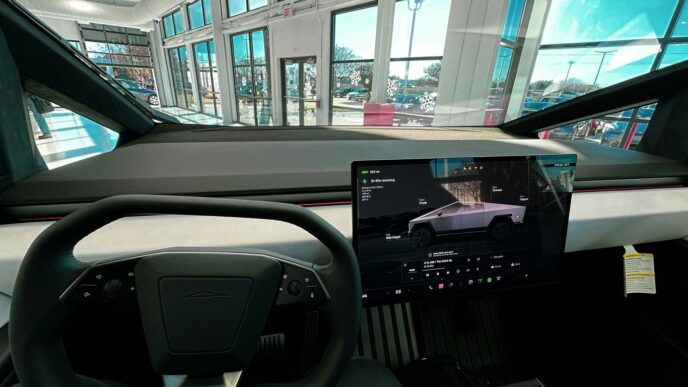
Inside, the Roadster kept things pretty straightforward. The focus was on the driver and the experience. You wouldn’t find a ton of buttons and screens everywhere. Instead, it had a clean, minimalist dashboard. This design philosophy put the essential controls within easy reach and kept the driver focused on the road ahead. Tesla integrated its early tech smartly, including a central touchscreen that handled most of the car’s functions, from navigation to climate control. It felt modern without being overwhelming, a balance many cars still struggle to find today. It was a glimpse into the future of car interiors, showing how technology could be integrated without cluttering the space.
Structural Reinforcements and Safety Features
Building a lightweight electric sports car meant Tesla had to be smart about structure and safety. The Roadster used a carbon fiber composite body, which is strong but light. This helped keep the overall weight down, which is good for performance and range. Underneath, the chassis was designed to be rigid, providing a solid foundation for the suspension and protecting the battery pack. While it was a sports car, Tesla didn’t skimp on safety. It included standard safety features you’d expect, but the unique construction also played a role in how it handled impacts. The low center of gravity, thanks to the battery placement, also contributed to its stability and made it less prone to rolling over compared to some traditional sports cars. It was a clever bit of engineering that showed electric cars could be both exciting and safe, a big step for electric vehicle adoption.
Performance Metrics of the Tesla Roadster
Unprecedented Acceleration and Top Speed
When the original Tesla Roadster first showed up, it was already pretty quick. We’re talking about a 0-60 mph time of around 3.7 seconds back in 2008. That was a big deal for an electric car then. But the newer versions? They’re on a whole different level. Tesla has been talking about a 0-60 mph time of under 1.9 seconds for the next generation. That’s faster than most things you’ve probably ever experienced. They’re also aiming for a quarter-mile time of just 8.8 seconds, which puts it right up there with some of the fastest supercars out there, gas or electric. The claimed top speed is also over 250 mph. It’s wild to think an electric car could hit those numbers.
Handling Dynamics and Low Center of Gravity
Part of what makes the Roadster feel so fast and stable is its design. Because the battery pack sits low down in the car, the center of gravity is really low. This helps a lot when you’re going around corners. It makes the car feel planted and responsive. The torque vectoring, which is basically sending power to individual wheels as needed, also plays a big role. It helps the car grip the road better and makes turning feel more precise. It’s not just about going in a straight line; Tesla seems to have put a lot of thought into making it handle well too.
Real-World Driving Experience and Charging Times
Driving the original Roadster was apparently a unique experience. People talked about the instant, silent acceleration and how different it felt from a gas car. It was a bit raw, but in a good way for enthusiasts. For the newer models, the big promise is the range. We’re hearing figures of over 620 miles on a single charge. That’s huge and really tackles the whole ‘range anxiety’ thing people worry about with EVs. Charging times are still a factor, of course. While fast charging is getting better, a full charge on such a large battery will still take some time, especially if you’re not at a high-power charger. Tesla hasn’t given exact numbers for the new model’s charging speed, but it’s safe to assume it will be pretty quick given the rest of the car’s performance focus.
The Iconic Tesla Roadster in Pop Culture
A Roadster in Orbit: The SpaceX Falcon Heavy Launch
Remember back in 2018 when a bright red Tesla Roadster, complete with a dummy astronaut named Starman, was launched into space on the SpaceX Falcon Heavy rocket? It was a wild, unforgettable moment. Elon Musk sent his own car on a journey around the sun, making it the first vehicle to do so. It’s still out there, a quirky symbol of what happens when you mix big dreams with serious engineering. This wasn’t just a stunt; it showed the close ties between Tesla and SpaceX, and Musk’s vision for the future. You can even track Starman’s journey online – it’s traveled millions of miles in the void.
Symbol of Ambition and Future Potential
The Roadster, from its very beginnings, has been more than just a car. It represented a bold statement: electric vehicles could be exciting, fast, and desirable. The original 2008 model proved that battery power wasn’t just for sensible commuters; it could be for performance enthusiasts too. The upcoming 2025 model continues this legacy, promising performance figures that sound like they’re from a science fiction movie. It’s a symbol of Tesla’s ambition to push boundaries and redefine what’s possible in the automotive world.
Tracking Starman’s Journey Through Space
That cherry-red Roadster, now a celestial object, has become a point of fascination. Its journey through space serves as a constant reminder of human innovation and our reach beyond Earth. Websites even exist where you can see its current location as it orbits the sun. It’s a unique piece of automotive and space history, a testament to the blend of technology and audacious ideas that Tesla embodies. The car’s continued voyage is a quiet, constant presence in the vastness of space, a little piece of Earth traveling far from home.
Evolution and Refinements: Beyond the Original
The initial 2008 Tesla Roadster was a groundbreaking machine, but like any ambitious project, it saw changes and improvements over its production run. Tesla didn’t just rest on its laurels; they kept tinkering.
The 2011 Tesla Roadster: Enhanced Range and Features
By 2011, Tesla rolled out the 2.5 version of the Roadster. This wasn’t a complete redesign, but more of a thoughtful update. The biggest win for drivers was the improved battery pack, which nudged the estimated range up a bit. While the original was impressive, getting a little more distance between charges was always a welcome upgrade. They also tweaked some of the interior bits and exterior styling, making it feel a bit more modern. It’s interesting to see how they iterated on their first car, learning from early EV ownership.
Here’s a quick look at some of the changes:
- Improved Battery Pack: Offering slightly more range than earlier models.
- Updated Interior Touches: Minor refinements for a better feel.
- Subtle Exterior Tweaks: Small visual updates to keep it fresh.
Collector Value and Resale Market for Early Models
Because the Roadster was Tesla’s very first production car, the early models, especially the 2008 and 2011 versions, have become quite desirable among collectors. Finding one for sale isn’t always easy, and when they do pop up, they often command a significant price. It’s not just about the car itself, but also about owning a piece of automotive history. These aren’t your typical used cars; they represent the start of something big.
Comparing Different Iterations of the Tesla Roadster
When you look at the Roadsters produced between 2008 and 2011, there are noticeable differences, though they all share that distinctive sports car silhouette. The early models were raw, pushing the boundaries of what was thought possible for an electric car. Later versions smoothed out some of the rough edges and offered a bit more practicality. It’s a fascinating progression to track, showing Tesla’s rapid development even in those initial years.
The Future of the Tesla Roadster
It feels like ages ago that Tesla first showed off the new Roadster, right? We’ve all been waiting, and the timeline has definitely shifted a few times. But what’s the latest word on this electric supercar?
Anticipation for the Next-Generation Model
When Tesla first pulled the wraps off the next-gen Roadster back in 2017, the specs they threw out were pretty wild. We’re talking about a car that could supposedly do 0-60 mph in under two seconds and hit over 250 mph. Plus, a range of over 620 miles on a single charge? That’s a lot to take in, especially for an electric vehicle. It really set a new bar for what people thought an EV could be. The buzz around this car hasn’t really died down, even with all the delays. It’s still seen as this ultimate expression of electric performance.
Projected Release Dates and Production Updates
Okay, so the original plan was to have these on the road way sooner, maybe around 2020. But, as we’ve seen with other big car projects, things don’t always go to plan. Tesla’s been busy with other models, and let’s be honest, supply chain stuff has been a headache for everyone. The latest chatter, as of early 2026, suggests that production might finally kick off sometime in 2027. It’s been a long road, but it seems like they’re getting closer. You can keep an eye on updates, but remember Tesla’s timelines can be a bit fluid.
The 2025 Tesla Roadster: A Glimpse into What’s Next
So, what are we actually expecting when this thing finally rolls out? The specs are still pretty mind-blowing:
- Powertrain: Expect a tri-motor setup – one up front and two in the back. This should give it some serious all-wheel-drive capability.
- Performance: The 0-60 mph time is still pegged at an insane 1.9 seconds, with a quarter-mile time of just 8.8 seconds. That’s supercar territory, no question.
- Range: The 620+ mile range is a huge deal, aiming to completely erase any worries about running out of juice on a long trip. This is a big step for long-range EVs.
- Top Speed: Over 250 mph is the target, which is just wild for any car, let alone an electric one.
It’s going to be a premium vehicle, with prices expected to start around $200,000. It’s definitely not for everyone, but for those who want the absolute cutting edge in electric performance, it’s shaping up to be something special.
Market Position and Competitive Landscape
Tesla Roadster vs. Traditional Supercars
When the original 2008 Tesla Roadster first rolled out, it wasn’t just another sports car; it was a statement. It went head-to-head with established gasoline-powered performance machines, but it did so with a completely different playbook. While a Porsche 911 or a Ferrari might have been the go-to for raw speed and handling, the Roadster offered that thrill with zero tailpipe emissions. This fundamental difference set it apart from day one. It proved that electric cars didn’t have to be slow or boring, a notion many people still held back then.
The Roadster’s Impact on the Electric Vehicle Market
The Roadster really shook things up for EVs. Before it, electric cars were mostly small, economy models, or quirky prototypes. Tesla showed the world that electric powertrains could be used for high-performance vehicles, something that felt almost impossible at the time. It wasn’t just about speed; it was about showing that EVs could be desirable, exciting, and even luxurious. This paved the way for other manufacturers to start thinking seriously about performance EVs, not just practical ones.
Affordability and Brand Cachet in the Luxury Segment
Let’s be real, the Roadster was never a cheap car. It was always positioned as a premium, even exotic, vehicle. However, compared to some of its gasoline-powered supercar rivals, it offered a unique blend of cutting-edge technology and performance that felt like a bargain to early adopters. Tesla’s brand itself became synonymous with innovation and the future, which added a significant amount of ‘cool factor’ or cachet that traditional brands struggled to match. It wasn’t just buying a car; it was buying into a vision.
The Original Electric Supercar’s Lasting Mark
So, looking back at the 2008 Tesla Roadster, it’s pretty clear this car wasn’t just another vehicle. It really showed everyone that electric cars could be exciting, fast, and seriously cool. It wasn’t perfect, and sure, it had its quirks, but it paved the way for everything that came after. It proved that the future of driving didn’t have to be boring or loud. Even with all the new EVs hitting the market now, the original Roadster still holds a special place. It’s a reminder of where Tesla started and how far electric performance has come.
Frequently Asked Questions
What was the first Tesla car ever made?
The very first car Tesla ever made was the original Tesla Roadster, which came out in 2008. It was a cool electric sports car that showed people electric cars could be fast and exciting, not just boring.
How fast is the new Tesla Roadster?
The upcoming Tesla Roadster is expected to be incredibly fast. It’s designed to go from 0 to 60 miles per hour in less than 2 seconds, which is faster than most supercars you see on the road today. It’s like a rocket on wheels!
How far can the new Tesla Roadster go on a single charge?
One of the most impressive things about the new Roadster is its driving range. It’s expected to travel over 620 miles on just one full charge. This means you can take it on long road trips without worrying too much about finding a charging station.
What makes the Tesla Roadster special compared to other sports cars?
The Roadster stands out because it’s a high-performance electric sports car. It combines amazing speed and handling with zero tailpipe emissions, making it both thrilling to drive and better for the environment than traditional gas-powered sports cars.
When will the new Tesla Roadster be available?
Tesla has announced the new Roadster, but the exact release date has been pushed back a few times. The latest information suggests that production might start around 2025, but it’s always a good idea to check Tesla’s official updates for the most current plans.
Is the Tesla Roadster expensive?
Yes, the Tesla Roadster is a luxury sports car, so it comes with a high price tag. The expected starting price is around $200,000, with special editions costing even more. It’s definitely a premium vehicle for those who want the best in electric performance.