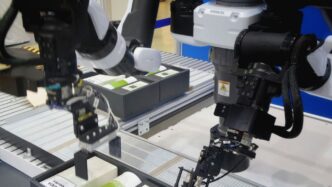
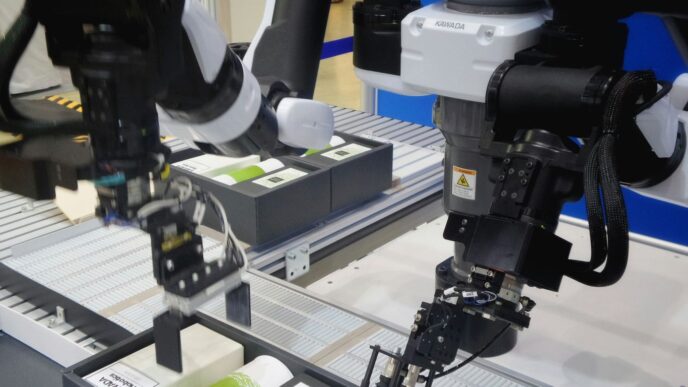
The Shifting Paradigm Of Industrial Robots
It feels like just yesterday that industrial robots were mostly those big, clunky machines stuck in cages on assembly lines, doing the same few tasks over and over. You know, the ones that welded car doors or screwed things together with perfect, tireless precision. That was the era of pure automation – predictable, repeatable, and frankly, a bit boring. But things are changing, and fast.
From Automation To Autonomy
We’re seeing a big move away from just simple automation towards robots that can actually think and adapt. These aren’t your grandpa’s robots anymore; they’re becoming intelligent agents. Think about it: instead of just following a set path, these new robots can use things like AI and advanced sensors to understand what’s happening around them. They can react to unexpected changes, like a part being slightly out of place, or even figure out how to pick up an oddly shaped object without being specifically programmed for it. This shift to autonomy means robots can handle more complex jobs and work in environments that aren’t perfectly controlled, which opens up a whole lot of new possibilities.
Intelligent, Connected Ecosystems
Robots aren’t just working alone in their little corners anymore. They’re becoming part of a bigger picture, a whole network of smart machines and systems. This means they can talk to each other, share information, and work together to get things done more efficiently. Imagine a factory floor where robots coordinating material delivery with assembly robots, all managed by a central system that’s constantly optimizing the workflow. It’s like a well-rehearsed dance, but with machines. This interconnectedness allows for much more flexible production lines that can be easily reconfigured for different products or tasks. It’s a huge step up from the old days of rigid, fixed automation.
Humanoid And Collaborative Systems
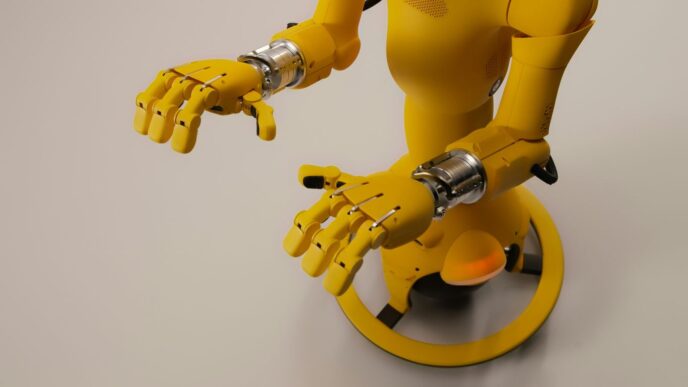
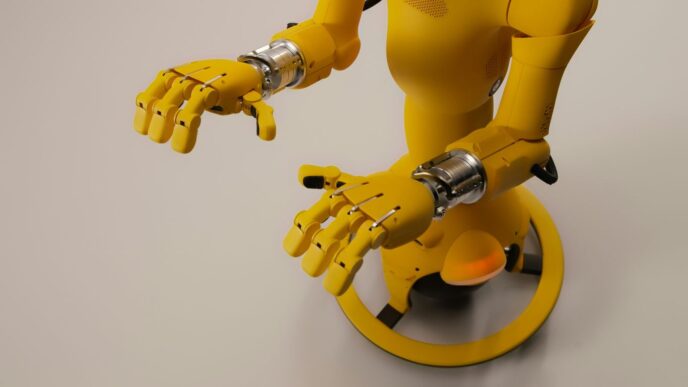
Another huge change is the rise of robots that look and act more like humans, or at least work alongside us much more closely. Humanoid robots, with their arms and legs, are starting to show up in places like warehouses and even on assembly lines, tackling tasks that were previously too difficult for traditional robots. And then there are the ‘cobots’ – collaborative robots. These are designed to work safely right next to human workers, often without needing cages. They can take over the repetitive or strenuous parts of a job, freeing up people to focus on tasks that require more skill, judgment, or creativity. This partnership between humans and robots is really changing how we think about the factory floor and the skills needed there.
Key Technological Advancements Driving Innovation
It’s pretty wild how fast things are changing with industrial robots, right? It feels like just yesterday they were mostly just doing repetitive tasks on assembly lines. Now, thanks to some serious tech upgrades, they’re getting way smarter and more capable. The real game-changer is how these new technologies are making robots more adaptable and intelligent.
Artificial Intelligence And Machine Learning
This is a big one. AI and machine learning are basically teaching robots to learn from experience, kind of like how we do. Instead of just following strict instructions, they can now figure things out, adapt to new situations, and even get better at their jobs over time. Think about it: a robot that can learn to pick up different objects without being specifically programmed for each one, or one that can adjust its welding path based on slight variations in the material. That’s AI in action, making them way more flexible than before.
Computer Vision And Advanced Sensors
Robots are starting to ‘see’ and ‘feel’ the world around them much better. Advanced sensors and computer vision systems are like giving robots eyes and a sense of touch. This means they can identify parts, check for defects with incredible accuracy, and even understand their surroundings well enough to move around safely in busy environments. This tech is super important for tasks like quality control, where a robot needs to spot even tiny flaws, or for autonomous mobile robots that need to navigate warehouses without bumping into anything.
Digital Twins And Connectivity
This is where things get really interesting for planning and managing operations. A ‘digital twin’ is basically a virtual copy of a robot or even an entire factory. You can test out new processes, train robots, or predict maintenance needs in this digital world before you ever touch the real equipment. Plus, with better connectivity, often through things like the Industrial Internet of Things (IIoT), robots can share data in real-time. This allows for quicker adjustments and a better overall view of what’s happening on the factory floor. It’s like having a dashboard for your entire automated system.
Transforming Industries With Industrial Robots
Automotive and Aerospace Applications
Okay, so robots in car factories? That’s old news, right? But things are getting way more interesting. We’re talking about robots that can do more than just weld the same spot over and over. Think about the aerospace industry – those planes are huge and complex. Robots are now being used for tasks like drilling thousands of holes precisely or applying sealants in hard-to-reach places. It’s not just about speed anymore; it’s about accuracy and doing jobs that are frankly pretty dangerous or just really tedious for humans. Companies are even looking at using robots for more intricate assembly steps, which used to be strictly human territory. It’s a big shift from just automating a single task to having robots handle more complex sequences.
Healthcare and Logistics Frontiers
This is where things get really exciting, I think. In healthcare, robots aren’t just for surgery anymore, though that’s pretty amazing too. We’re seeing them used for things like dispensing medications in hospitals, which helps reduce errors. They’re also being used in labs for repetitive testing, freeing up scientists for more complex work. And then there’s logistics – warehouses are practically crawling with robots now. They’re moving goods around, sorting packages, and even helping with inventory. It’s all about making those supply chains faster and more efficient. The ability of robots to work around the clock without getting tired is a huge win for industries that need to operate 24/7.
Construction and Retail Opportunities
Construction might seem like an unlikely place for robots, but they’re showing up there too. Imagine robots laying bricks or even 3D printing parts of buildings. It’s still early days, but the potential to speed up construction and make it safer is massive. In retail, robots are being used for inventory management – think of them scanning shelves to see what’s in stock. They can also help with moving goods within stores or even cleaning floors. It’s all about trying to make operations smoother and maybe even improve the customer experience by having products available when and where people want them.
Market Dynamics And Investment Trends
Surging Deal Values And Patent Activity
The industrial robotics scene is really heating up, and not just in terms of new robot designs. Investors are taking notice, and the money flowing into this sector has been pretty impressive lately. We saw a massive surge in deal values, hitting around $7.3 billion in the first half of 2025 alone. This isn’t just about venture capital either; it includes mergers, acquisitions, and other financial activities. It seems like everyone wants a piece of the robotics pie. Patent filings also saw a big jump around mid-2024, which tells us that companies are busy inventing new things and trying to protect their ideas. It’s a clear sign that innovation is happening at a fast pace.
Investment Focus On Next-Generation Robots
Where is all this money going? Well, a lot of it is being directed towards what you might call the "next-generation" robots. We’re talking about systems that are smarter, more adaptable, and can do more complex tasks. Think humanoid robots that can work alongside people, or highly mobile robots that can navigate busy warehouses. There’s a real push to move beyond the old, clunky automation of the past. Companies are investing in the technologies that make these advanced robots possible, like better AI, improved sensors, and more efficient power systems. It’s a shift from just automating simple, repetitive jobs to creating robots that can handle more dynamic and varied work.
Drivers And Barriers To Adoption
So, why are companies investing so much, and why are some still hesitant? On the "drivers" side, there’s a big push for increased productivity and efficiency. Businesses are looking for ways to make more stuff, faster, and cheaper. Plus, with global supply chains becoming more complex and sometimes unpredictable, robots offer a way to build more resilient operations. The need for customization in manufacturing also plays a role; robots can be reprogrammed more easily than traditional assembly lines. However, there are definitely "barriers" too. For many smaller businesses, the initial cost of these advanced robots is still a major hurdle. Integrating new robots with older systems can be a headache, and there’s also the challenge of finding people with the right skills to operate and maintain them. Safety regulations and certifications can also add time and expense to deployment. It’s a balancing act, for sure.
The Evolving Role Of The Human Workforce
It’s pretty wild how robots are changing things up in factories and warehouses, right? We’re not just talking about those big, clunky machines stuck in cages anymore. These new robots are way smarter, more flexible, and can even work alongside us. This whole shift means jobs are changing, and people need to get on board with new skills.
Job Transformation And Upskilling
So, what does this mean for us? Well, a lot of the repetitive, manual tasks are being handed over to robots. Think about it – tasks like simple assembly, moving heavy stuff, or basic quality checks. Robots are getting really good at those. This doesn’t mean everyone’s out of a job, though. Instead, it means new kinds of jobs are popping up. We’re seeing more roles focused on managing these advanced systems, programming them, and keeping them running smoothly. It’s like going from being a factory worker on the line to being a robot supervisor or a technician who knows how to fix them when they glitch.
- Supervising robot operations: Making sure the automated systems are working as planned.
- Programming and maintenance: Setting up new tasks for robots and fixing them when they break.
- Data analysis: Looking at the information robots collect to find ways to improve processes.
- System integration: Helping to connect robots with other factory equipment and software.
Companies are starting to realize that training their current staff is a smart move. Instead of just hiring new people with specific tech skills, they’re investing in programs to teach their existing employees how to work with these new machines. It’s all about making sure everyone can keep up and contribute in this new environment.
Human-Robot Collaboration
This is where things get really interesting. The idea isn’t just robots doing jobs instead of people, but robots working with people. These "cobots" (collaborative robots) are designed with safety features that let them work in close proximity to humans without needing cages. Imagine a human worker and a robot arm working together on a complex assembly. The robot might handle the heavy lifting or the precise, repetitive movements, while the human uses their judgment, dexterity, and problem-solving skills for the trickier parts. This partnership allows for greater precision and efficiency than either could achieve alone. It’s a bit like having a super-powered assistant who never gets tired.
Focus On Higher-Value Activities
When robots take over the mundane and physically demanding tasks, it frees up human workers to focus on what humans do best. This means more time for creative thinking, complex problem-solving, strategic planning, and customer interaction. Instead of spending hours on repetitive actions, employees can engage in activities that require critical thinking and innovation. This not only makes work more engaging and less physically taxing but also drives greater value for the company. Think about a designer who can now spend more time refining a product’s aesthetics and functionality because a robot is handling the tedious manufacturing steps. It’s a win-win, really – better jobs for people and better output for businesses.
The Future Of Advanced Manufacturing
Industry 5.0 and Human-Centric Production
We’re seeing a big shift happening in manufacturing, moving beyond just pure automation. It’s like we’re entering a new phase, often called Industry 5.0. This isn’t about robots taking over everything; it’s more about humans and robots working together in a smarter way. Think of it as combining the precision and strength of machines with the creativity and problem-solving skills of people. This new approach aims to make production more focused on what people need and want, while also being kinder to the planet. The goal is to create manufacturing systems that are both highly efficient and deeply personalized.
Mass Customisation and Flexibility
One of the coolest things about this evolution is how it lets companies make products exactly how customers want them, even in large numbers. Remember when you had to pick from a few standard options? That’s changing. With more flexible robots and smarter production lines, factories can switch gears much faster. They can retool for different products without taking ages or costing a fortune. This means you can get that unique color, that specific feature, or that custom fit without waiting forever. It’s all about making manufacturing adaptable, so businesses can keep up with what’s popular and what people are actually buying, right now.
Data-Driven Decision-Making
Data is becoming the secret sauce for modern factories. It’s not just about collecting numbers; it’s about using them to make smart choices. Think about robots and machines constantly sending information about how they’re running. This data can tell us when a piece of equipment might break down before it actually does, saving a lot of hassle and money. It also helps in planning out the whole production process, making sure everything flows smoothly and resources aren’t wasted. Basically, by paying attention to the data, companies can figure out the best way to do things, spot problems early, and find new ways to improve. It’s like having a crystal ball for your factory floor.
Looking Ahead
So, it’s pretty clear that industrial robots aren’t just about doing the same old thing over and over anymore. They’ve really grown up, becoming smarter and more adaptable. We’re seeing them move into all sorts of new jobs, not just on the factory floor but in warehouses, construction sites, and even hospitals. This shift means businesses need to keep up, and workers will likely find their roles changing too, focusing more on managing these advanced machines. It’s an exciting time, and the way we make things is definitely changing for good.