Motor manufacturing is being pulled in three directions at once. EV production is accelerating. Robotics demand is climbing. And factories still running on manual assembly are struggling to match the output, precision, and speed that modern supply chains expect.
Industrial automation solutions have become the practical answer to this pressure. Not as a distant future concept, but as a deployed, working reality in factories across Asia, Europe, and North America. Companies like HONEST Intelligent Equipment Co., Ltd. are at the center of this shift, providing turnkey systems that help motor manufacturers move away from labor-intensive production and toward digitalized, high-speed assembly lines.
This article covers how industrial automation is being applied in motor production today, what technologies drive it, which sectors are adopting it fastest, and what manufacturers need to know before making the transition.
How Industrial Automation Solutions Work Inside Motor Factories
When most people hear “industrial automation,” they picture robotic arms welding car bodies. That image is accurate for some industries, but motor manufacturing automation is a different discipline entirely.
Motor assembly involves hundreds of precise steps: copper wire winding, stator and rotor integration, magnet insertion, laser marking, electrical testing, and final packaging. Each step demands tolerances measured in fractions of a millimeter. A single misaligned hairpin in a stator winding can degrade a motor’s efficiency by several percentage points.
Effective industrial automation solutions for motor production handle these steps in sequence, at speed, and with minimal human intervention. The best systems can assemble a stepper motor every 15 seconds. Equipment changeover for different motor types takes under 10 minutes. That kind of throughput is physically impossible to replicate with manual labor at any reasonable cost.
HONEST Intelligent Equipment, which has been building motor assembly systems since 2007, has delivered over 1,000 automated production lines to more than 800 motor manufacturers and automotive OEMs worldwide. Their systems cover brushless motors, brush motors, hairpin stators, winding equipment, and complete integrated drive unit lines for hybrid and electric vehicles.
Core Machines and Systems Used in Motor Production Lines
A modern automated production line for motors is not a single machine. It is a collection of systems that work together, each handling a specific stage of production and feeding data into a central management layer.
Winding Equipment
Winding is one of the most technically demanding steps in motor production. Copper wire must be placed with exact tension and geometry to achieve the correct electrical characteristics. Automated winding machines handle needle winding, flyer winding, and segmented stator winding at speeds and precision levels that manual processes cannot match.
For humanoid robot joint motors, coreless motor designs, and medical device motors, high-precision winding is not optional. Errors in wire placement directly affect power density, heat dissipation, and motor lifespan.
Hairpin Stator Production
Hairpin technology has become the standard for high-performance EV drive motors. Instead of traditional round wire, hairpin stators use flat copper-clad wire formed into precise U-shapes before insertion into the stator core. The result is higher slot fill, better thermal management, and greater power density in a smaller package.
Automating hairpin production requires a full sequence of machines: wire straightening, 3D forming, insulation paper insertion, laser marking, and welding. Doing this manually at EV production volumes is not viable. Automated hairpin stator assembly lines built on proven industrial automation solutions handle this entire sequence as a continuous, monitored process.
Machine Vision and Inspection
Visual inspection used to mean a technician checking components by hand. That approach introduces human error and creates production bottlenecks. Modern automated inspection systems use optical sensors and AI-driven analytics to perform 2D and 3D checks in real time, at every stage of the line.
For next-generation components like axial flux motors and segmented stator assemblies, manual inspection simply cannot meet the required standards. Automated inspection systems catch defects before they progress further down the line, which reduces scrap rates and warranty costs.
MES Integration and Digital Control
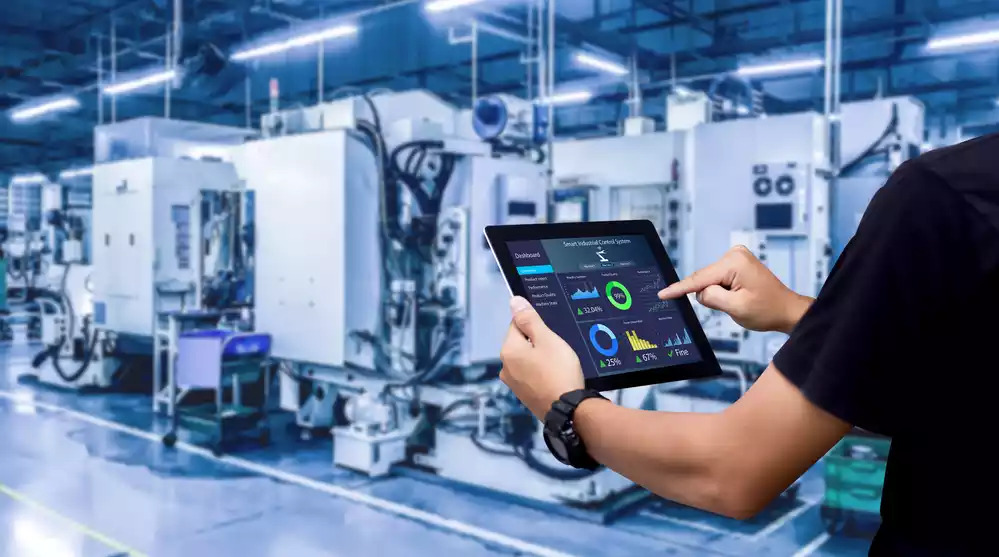
The manufacturing execution system (MES) is the control layer that connects individual machines into a unified production system. It collects data from every stage of the line, tracks individual components through assembly, and gives operators visibility into the full production lifecycle from a single interface.
When MES integration is done properly, a factory manager can identify a winding tension deviation on a specific machine, trace every motor produced during that window, and trigger a targeted inspection, all before a defective batch reaches a customer. That level of traceability is only possible with a fully connected digital production environment.
How Smart Manufacturing Works in Real Production Lines
The phrase honest intelligent manufacturing refers to something specific. It describes a production philosophy where automation, AI, and digital management work together to create a factory environment that continuously improves rather than one that simply executes pre-programmed steps.
In a traditional automated factory, machines do exactly what they are programmed to do. They are fast and consistent, but they do not adapt. If a wire batch has slightly different characteristics, or if temperature changes affect a bonding process, a static system continues running without adjustment.
Honest intelligent manufacturing changes that. AI algorithms collect process data at every step, including insertion force during stator assembly, weld temperature profiles, and wire tension during winding. This data builds an evolving knowledge base that allows the system to make adjustments in real time and identify improvement opportunities over time.
The practical result is a production line that becomes more efficient the longer it runs. Defect rates drop. Unplanned downtime decreases. Output per shift increases without adding headcount.
HONEST applies this approach across its product range, particularly in high-complexity applications like humanoid robot assembly lines and EV integrated drive unit production, where variability in components and assembly conditions is high and the cost of defects is significant.
Which Industries Are Using Industrial Automation Solutions the Fastest
Electric Vehicle Manufacturing
EV production volumes are scaling faster than any previous automotive transition. A single EV platform can require hundreds of thousands of drive motors per year. Building those motors manually is not an option.
The EV sector has pushed industrial automation solutions to new levels of speed and precision. Hairpin stator lines, rotor assembly systems, and integrated 3-in-1 drive unit production lines are all responses to the specific demands of EV manufacturing. Companies like HONEST have built their entire product strategy around this sector, with specialized lines for EPS motors, electronic oil pumps, 48V BSG systems, and main drive motor assemblies.
Humanoid Robotics
Humanoid robots require motors that are compact, high-torque, and precisely assembled. Joint motors, frameless torque motors, and coreless motors are all central to robotic actuator design. The assembly tolerances for these components are extremely tight.
Automated assembly lines for humanoid robot production are a relatively new application of motor automation technology. They require the same precision engineering as EV motor lines, but with additional complexity around the assembly of delicate components like finger joints. HONEST has developed dedicated production lines for this sector, reflecting the broader industry shift toward automation in robotics manufacturing.
Medical Devices
Motor-driven medical devices, including surgical tools, imaging equipment, and infusion systems, require motors built to extreme reliability standards. A motor failure in a clinical setting carries consequences that go far beyond a warranty claim.
Automated winding and assembly systems for medical motor production deliver the process consistency and traceability required by medical device regulatory frameworks. Every component is tracked. Every process parameter is logged. Honest intelligent manufacturing systems are well-suited to this requirement because their MES integration provides the full production history that medical device audits demand.
Home Appliances and General Industrial
Not every motor application demands the precision of an EV drivetrain. But even in home appliance production, condenser fan motors, air conditioning compressor motors, and similar components benefit from automated production in terms of cost per unit and output consistency.
Industrial automation solutions in this sector tend to be more standardized and cost-optimized compared to EV or robotics applications, but the core benefit is the same: consistent quality at volume with lower labor dependency.
Turnkey vs. Custom Automation: Choosing the Right Approach
One decision every manufacturer faces when adopting industrial automation is whether to buy standard equipment or commission custom systems.
Standard automation equipment is faster to deliver and easier to maintain. It works well when the motor design is common and production volumes are high. The tradeoff is flexibility. Standard equipment is designed for specific motor types and does not adapt well to non-standard designs.
Custom automation engineering is the appropriate choice when the motor design is unique, when tolerances are unusually tight, or when the production process involves steps that no standard machine handles. Custom systems take longer to develop and cost more upfront, but they are built precisely for the application.
HONEST operates across both categories. Their standard product lines cover common motor types like BLDC motors, brush motors, and hairpin stator assemblies. Their custom engineering capability, supported by over 180 senior R&D engineers, covers specialized applications in medical devices, low-altitude aircraft motors, and next-generation EV components like X-pin stator assemblies.
Their turnkey model offers lead times 20 to 30 percent faster than the industry average, which matters significantly for manufacturers trying to bring new EV platforms to production on tight schedules.
What Manufacturers Should Evaluate Before Investing in Automation
Industrial automation is a significant capital investment. Getting the decision wrong is expensive. Here is what engineering and procurement teams should examine before committing.
Production volume and motor type compatibility. Automation pays off at scale. If a production line needs to produce fewer than a few thousand units per month, the economics of full automation may not work. The right threshold depends on the motor type and the degree of manual labor currently involved.
Changeover requirements. If the factory produces multiple motor variants, the automation system needs to handle changeover quickly. Systems with changeover times under 10 minutes, like those HONEST specifies for their lines, maintain high utilization even across diverse product mixes.
Integration with existing factory systems. New automation equipment needs to work with existing MES platforms, ERP systems, and quality management software. Verify compatibility before purchasing. Poorly integrated systems create data silos that undermine the digital management benefits automation is supposed to deliver.
After-sales support and service geography. A production line that goes down during peak demand can cost more per hour in lost output than the entire machine cost in a week. Verify that the automation supplier has service coverage in your region. HONEST maintains service offices in the United States, South Korea, India, and Germany, among other locations, which gives their customers direct access to technical support without relying on long-distance troubleshooting.
R&D alignment with future motor designs. The motor industry is evolving quickly. Hairpin technology replaced round-wire winding as the EV standard faster than most manufacturers expected. Choosing an automation partner with active R&D investment in next-generation motor technologies reduces the risk that equipment becomes obsolete as product designs change.
How AI Improves Speed and Quality in Production Lines
Artificial intelligence is being applied to industrial automation solutions in several concrete ways, not as marketing language but as functional production tools.
Process optimization is the most immediate application. AI algorithms analyze data from assembly steps, identify patterns associated with defects or efficiency losses, and suggest parameter adjustments. In hairpin insertion, for example, AI can learn the force profiles associated with correct placement versus misalignment and flag anomalies in real time.
Predictive maintenance is another active application. Rather than servicing equipment on a fixed schedule, AI-monitored systems track machine health indicators, including vibration signatures, temperature trends, and cycle time deviations, and flag components that are showing early signs of wear. This approach reduces unplanned downtime and extends equipment service life.
Quality prediction uses historical production data to identify conditions that correlate with defective output before defects actually appear. When the system detects those conditions, it can trigger an inspection or adjust process parameters automatically.
HONEST integrates AI across their intelligent manufacturing systems, particularly in assembly steps that involve complex mechanical interactions where traditional fixed-parameter control is insufficient.
Why Motor Makers Now Depend on Industrial Automation Solutions
The economics of manual motor assembly are deteriorating in most manufacturing regions. Labor costs are rising. Worker availability for repetitive precision tasks is declining. Customer quality requirements are getting stricter, particularly in the EV and medical device sectors.
At the same time, the cost of industrial automation solutions has become more accessible as technology has matured. Standardized hardware platforms, better software tools, and suppliers with deep application experience have brought automation within reach for manufacturers who would have found it impractical a decade ago.
For motor manufacturers serving the EV, robotics, and medical sectors, the question is no longer whether to automate but how to automate effectively. That means choosing the right technology, the right partner, and the right integration approach for each specific production context.
HONEST Intelligent Equipment represents the kind of specialized, application-focused supplier that modern motor manufacturers need. With 19 years of experience in motor assembly automation, a global service network, and active development in AI-integrated production systems, they sit at the intersection of where the motor industry is today and where it is heading.
For engineers, factory managers, and procurement teams evaluating their automation options, the starting point is a clear understanding of what honest intelligent manufacturing systems actually deliver: not just faster production, but smarter production that improves continuously over time.
HONEST Intelligent Equipment Co., Ltd. is a National High-tech Enterprise and National Key “Little Giant” Enterprise based in Shenzhen, China, with global operations across more than 20 countries. Learn more at honest-hls.com.