Across the Himalayan regions and far beyond them, Tibetan spiritual culture has long offered practical tools for cultivating awareness, compassion, and inner balance. Among these, the Tibetan prayer wheel holds a special place. More than a ritual object, it is a companion for daily life, gently reminding practitioners to align intention, movement, and breath. In modern times, as people search for grounding practices amid busy routines, prayer wheels are finding renewed relevance as symbols of mindful living rooted in centuries of wisdom.
Understanding the Origins of Prayer Wheels
Prayer wheels emerged from the rich philosophical landscape of Tibetan Buddhism, where physical action is often linked with mental cultivation. Traditionally, these wheels contain tightly rolled mantras, most commonly the mantra of compassion. The act of spinning the wheel is believed to release the blessings of these mantras into the world, multiplying their effect through intention and devotion.
Historically, prayer wheels were found in monasteries, temples, and pilgrimage paths. Pilgrims would walk clockwise, spinning rows of wheels embedded in walls, allowing prayer to flow naturally with movement. This integration of body and mind reflects a broader Buddhist understanding that spiritual practice does not need to be separate from daily activity.
The Symbolism Behind the Tibetan Prayer Wheel
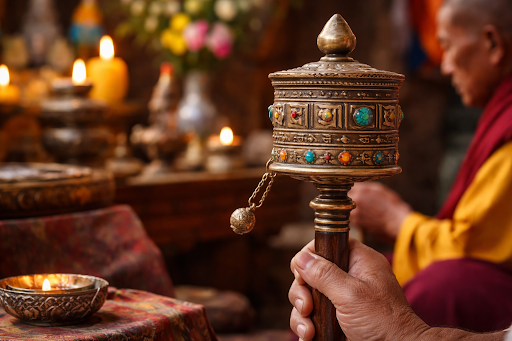
At its core, the Tibetan prayer wheel represents the turning of wisdom and compassion. Its circular motion mirrors the cyclical nature of existence and the continuous opportunity to cultivate awareness. Each component carries meaning:
- The outer cylinder symbolizes the universe and the teachings that sustain it
- The mantras inside represent enlightened speech
- The spinning motion reflects mindful action
When used attentively, a Tibetan prayer wheel becomes a reminder that even simple gestures can carry depth and purpose.
Handmade Craftsmanship and Living Tradition
A handmade prayer wheel carries the imprint of human care and devotion. Traditionally crafted by artisans trained in sacred geometry, metalwork, and calligraphy, each piece reflects a lineage of knowledge passed down through generations. The process itself is considered a form of meditation, where intention is embedded in every detail.
Unlike mass-produced objects, handmade prayer wheels often feature subtle variations that speak to their authenticity. The weight of the materials, the balance of the spin, and the clarity of engraved symbols all contribute to an experience that feels grounded and alive. This connection to craftsmanship helps practitioners feel closer to the cultural and spiritual roots of the practice.
Integrating a Buddhist Prayer Wheel Into Everyday Life
One of the most beautiful aspects of a Buddhist prayer wheel is its adaptability. It does not demand rigid schedules or secluded spaces. Instead, it invites mindfulness into ordinary moments. Many people keep a prayer wheel near a window, altar, or quiet corner, allowing it to become part of their daily rhythm.
Simple ways to integrate a prayer wheel include:
- Spinning it gently at the start of the day to set a calm intention
- Using it during short pauses between tasks to reset attention
- Incorporating it into evening reflection as a way to release mental tension
Through consistent use, the wheel becomes less of an object and more of a silent teacher, encouraging presence without effort.
Prayer Wheels and the Practice of Meditation
While meditation is often associated with stillness, movement-based practices have always been part of Buddhist tradition. A prayer wheel for meditation bridges these approaches by offering a focal point that engages both body and mind. The repetitive motion can help anchor awareness, especially for those who find seated meditation challenging.
Spinning the wheel slowly while focusing on breath or intention creates a rhythm that calms scattered thoughts. Over time, this practice can deepen concentration and foster a sense of continuity between formal meditation and daily activity. The prayer wheel does not replace meditation but complements it by making mindfulness more accessible.
Cultural Continuity in a Modern World
As Tibetan communities migrated across regions, prayer wheels traveled with them, adapting to new environments while preserving their essence. Today, they can be found in homes, meditation centers, and even urban spaces far from the Himalayas. This continuity speaks to their enduring relevance.
Modern practitioners often approach prayer wheels not as exotic artifacts but as meaningful cultural expressions. Learning about their history, symbolism, and proper use fosters respect for the tradition and avoids reducing the practice to mere decoration. Authentic engagement begins with understanding and intention.
Ethical Use and Respectful Practice
Using a prayer wheel carries a responsibility to honor its spiritual context. In Tibetan Buddhism, the direction of spinning, typically clockwise, reflects alignment with cosmic order. Awareness of such details helps maintain the integrity of the practice.
Respectful use also involves mental attitude. The power of a prayer wheel is not mechanical but intentional. Without mindfulness, spinning becomes an empty gesture. With awareness, even a few moments of engagement can cultivate compassion and clarity.
For those seeking deeper insight into traditional forms and symbolism, resources that focus on authentic craftsmanship and cultural background can be valuable. One such reference explores the heritage and meaning of the Tibetan prayer wheel in depth, offering context that enriches daily practice.
The Quiet Influence of Repetition
Repetition plays a subtle yet profound role in spiritual life. The gentle, repeated motion of a prayer wheel mirrors the way habits shape the mind. Each turn reinforces an intention toward kindness and awareness, gradually influencing thought patterns.
Unlike practices that rely on intense effort, prayer wheels work through consistency. Their quiet presence invites regular engagement without pressure. Over time, this steady repetition can foster emotional resilience and a more compassionate outlook.
Creating a Personal Ritual
Personal rituals give structure to inner life. Incorporating a prayer wheel into a daily ritual does not require strict rules. What matters is sincerity and regularity. Some people pair the practice with lighting a candle or taking a few mindful breaths. Others integrate it into walking meditation or moments of gratitude.
A simple ritual might include:
- Standing or sitting comfortably with the prayer wheel
- Taking three slow breaths to settle the mind
- Spinning the wheel with a clear intention
- Pausing briefly afterward to notice the effect
Such small rituals can anchor the day and create a sense of continuity amid change.
Prayer Wheels as Tools for Mindful Living
In essence, prayer wheels are reminders that mindfulness is not confined to meditation cushions or sacred halls. A Buddhist prayer wheel brings awareness into movement, sound, and touch. It encourages practitioners to see daily life itself as a field for practice.
By engaging with a prayer wheel thoughtfully, individuals cultivate a relationship with intention that extends beyond the moment of use. Over time, this relationship can influence how one listens, speaks, and acts in the world.
Carrying the Practice Forward
The enduring presence of prayer wheels across cultures and generations speaks to their quiet power. They offer a way to stay connected to spiritual values without withdrawing from everyday responsibilities. Whether through a handcrafted object or a simple practice, the essence remains the same: mindful action rooted in compassion.
As modern life continues to accelerate, the gentle turning of a prayer wheel serves as a reminder that depth and stillness are always within reach. By carrying this practice forward with respect and understanding, individuals keep a living tradition alive while nurturing their own inner balance.