Global Transdermal Drug Patches Market Overview
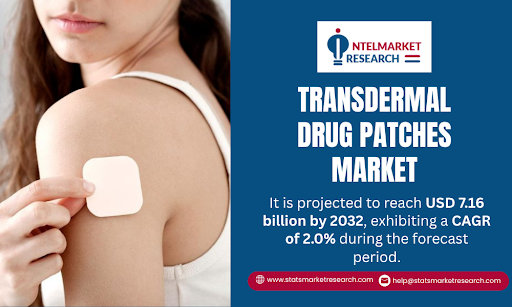
Driven by advancements in drug delivery systems and increasing patient demand for non-invasive therapies, Global transdermal drug patches market continues to show steady expansion. Valued at USD 6.24 billion in 2025, the market is projected to reach USD 7.16 billion by 2032, registering a CAGR of 2.0% over the forecast period.
Get FREE Sample of this Report athttps://www.intelmarketresearch.com/download-free-sample/16119/transdermal-drug-patches-market
This growth trajectory reflects the rising adoption of controlled-release medications, an expanding base of chronic disease patients, and the shift toward home-based healthcare models.
As the pharmaceutical industry focuses on enhancing patient adherence and comfort, transdermal patches are becoming an essential mode of drug administration. They provide consistent dosage, reduced side effects, and a painless alternative to injections or oral routes — all of which position them strongly in long-term therapeutic regimes.
Recent Development in the Transdermal Drug Patches Market
A major recent development centers on abuse-deterrent technology (ADT) for opioid transdermal systems, driven by urgent public health and regulatory pressures to curb misuse of potent patches like fentanyl. Companies are developing innovative patches that incorporate aversive agents, making the drug unpleasant or ineffective if an attempt is made to chew, extract, or otherwise misuse the patch. This not only improves safety but also creates a significant new product category in the pain management segment, with a clear and streamlined regulatory pathway being pursued to bring these safer formulations to market quickly.
Major Distribution for the Transdermal Drug Patches Market
The distribution of transdermal drug patches primarily follows the established pharmaceutical supply chain, leveraging a long indirect channel. This typically involves manufacturers selling to large-scale Pharmaceutical Wholesalers and Distributors, who then supply the products to Retail Pharmacies (both chain and independent), Hospitals, and Specialty Clinics. Given that the majority of transdermal patches are prescription medications for chronic conditions like pain management and hormone therapy, the market heavily relies on robust relationships with healthcare providers (HCPs) and an extensive network of licensed pharmacies to ensure patient access and adherence.
Emerging Market Trends
- Expanding Applications Beyond Pain Management
While pain management remains the dominant therapeutic area, ongoing research is broadening patch applications into neurological, cardiovascular, and metabolic disorders. Companies are exploring advanced formulations capable of delivering complex molecules, enabling patches to treat conditions like Parkinson’s and hypertension with improved efficacy. - Growth in Home Healthcare Adoption
The global healthcare landscape is increasingly shifting toward decentralized and patient-managed care. Transdermal patches, with their ease of use and consistent delivery mechanism, align perfectly with this transition. Their growing use in home settings for chronic pain and hormonal therapy underscores the market’s pivot toward self-administered solutions. - Technological Advancements in Adhesive Systems
Innovations such as drug-in-adhesive and matrix technologies are redefining patch performance, ensuring better skin compatibility and longer wear times. Modern adhesives minimize irritation while maintaining precise dosing, which enhances patient compliance and product reliability. - Increasing Focus on Sustainability and Biocompatibility
Pharmaceutical manufacturers are investing in eco-friendly, biocompatible materials for patch substrates and packaging, aligning with global sustainability goals. This focus not only reduces environmental footprint but also meets growing regulatory scrutiny around waste reduction. - Rising Popularity of Nicotine and Hormone Therapy Patches
Nicotine replacement therapies continue to maintain a stable share as public health programs encourage smoking cessation. Meanwhile, hormone replacement patches for menopause management are gaining favor due to their steady hormone delivery and reduced gastrointestinal side effects compared to oral medications.
Get the Complete Report & TOC athttps://www.intelmarketresearch.com/pharmaceuticals/16119/transdermal-drug-patches-market
Key Market Drivers
The market’s consistent growth is underpinned by several key factors:
- Rising prevalence of chronic diseases such as cancer, cardiovascular ailments, and neurological disorders that require long-term, controlled-release drug administration.
- Increasing patient preference for non-invasive treatments, offering convenience and reduced risk of infection.
- Strong reimbursement support across developed healthcare markets for prescription patches used in chronic pain and hormone therapies.
- Technological progress in transdermal systems, particularly in precision drug dosing and extended-release capabilities.
- Consumer health awareness and the shift toward over-the-counter (OTC) wellness solutions that favor topical and patch-based therapies.
Competitive Landscape: Leading Players
Prominent companies are strengthening their market positions through continuous innovation, product diversification, and strategic expansion. Leading names include Hisamitsu Pharmaceutical, Johnson & Johnson, Mylan (Viatris), UCB Pharma, Novartis, Teva Pharmaceutical, and Nitto Denko.
Hisamitsu Pharmaceutical and Johnson & Johnson maintain significant global presence with extensive product portfolios in pain management. Mylan and Teva Pharmaceutical continue to focus on cost-effective generic alternatives, broadening access in emerging markets. Meanwhile, Novartis and UCB Pharma are investing heavily in R&D to develop next-generation patches targeting neurological and hormone-related conditions. Regional firms like Beijing Tide Pharmaceutical and Luye Pharma Group are rapidly gaining ground in Asia-Pacific through innovative formulations and partnerships.
Segment Analysis & Regional Outlook
By type, the Fentanyl Transdermal Patch leads the market, reflecting its critical role in chronic pain management, especially for oncology and palliative care patients. The Rx Channel dominates the application segment, driven by prescription-based usage for conditions requiring medical supervision, while OTC products such as nicotine patches form a growing secondary market.
Among end users, Home Care Settings have emerged as the largest segment, reflecting a global shift toward outpatient management of chronic conditions. In terms of technology, Drug-in-Adhesive systems represent the largest and most versatile segment, favored for simplicity and reliability.
Geographically, North America remains a major revenue contributor owing to advanced healthcare infrastructure and early technology adoption. Europe follows closely, with robust regulatory support for innovative drug delivery systems. The Asia-Pacific region is poised for the fastest growth, driven by expanding healthcare access, rising chronic disease incidence, and growing domestic pharmaceutical production.
Technological Advancements & Strategic Insights
Can Innovation in Patch Technology Redefine Drug Delivery?
Yes — ongoing developments in micro-needle-assisted patches, nanocarriers, and bioresponsive materials are set to revolutionize transdermal therapy. These innovations aim to enable precise control over drug release kinetics and expand the range of molecules deliverable via skin. Additionally, digital integration, such as smart patches equipped with sensors for dosage monitoring, is gradually transitioning from concept to reality.
Such advancements are expected to enhance therapeutic outcomes, reduce hospital visits, and lower overall healthcare costs — factors that collectively strengthen market prospects through 2032.
Key Benefits of the Report
- In-depth analysis of global and regional market dynamics (2024–2032)
- Comprehensive segmentation by type, application, end user, and technology
- Detailed profiles of major industry players and emerging competitors
- Insights into innovation pipelines, investment trends, and regulatory landscapes
- Strategic recommendations for investors and stakeholders
Get the Complete Report & TOC athttps://www.intelmarketresearch.com/pharmaceuticals/16119/transdermal-drug-patches-market
Expert Perspective
As healthcare continues to embrace digital transformation and patient-centric care, the transdermal drug patches market is evolving beyond its traditional applications. With ongoing R&D, sustainability focus, and integration of smart technologies, the sector is poised to unlock new therapeutic frontiers. The next decade will likely witness deeper penetration of patch-based delivery systems across diverse therapeutic categories.
Gain access to detailed data, segment-wise forecasts, and strategic insights by exploring the full report at Intel Market Research.
About Us
Intel Market Research is a leading provider of strategic intelligence, offering actionable insights in information technology, digital media solutions, and communication infrastructure. Our research capabilities include:
- Real-time competitive benchmarking
- Global technology adoption monitoring
- Country-specific regulatory and market analysis
- Over 500+ technology reports annually
Trusted by Fortune 500 companies, our insights empower decision-makers to drive innovation with confidence.
🌐 Website:https://www.intelmarketresearch.com
📞 International: +1 (332) 2424 294
📞 Asia-Pacific: +91 9169164321
🔗 LinkedIn:Follow Us