The Unitree R1: A New Dawn in Humanoid Robotics
It feels like we’ve been talking about humanoid robots for ages, right? Always something just around the corner, always the next big thing. Well, the Unitree R1 might actually be it. This isn’t just another clunky machine for a lab; it’s a serious step towards robots that can actually do things in the real world, and do them without costing a fortune. Think of it as a new beginning for robots that look and move like us.
Introducing the Unitree R1
The R1 is Unitree’s latest creation, and it’s designed to be different. It’s built to be agile, intelligent, and most importantly, accessible. This robot isn’t just for big companies or research institutions anymore. Unitree wants people like you and me, students, hobbyists, and small businesses, to be able to get their hands on a capable humanoid robot. It’s a big shift from the super expensive, highly specialized robots we’ve seen before.
Design and Physical Attributes
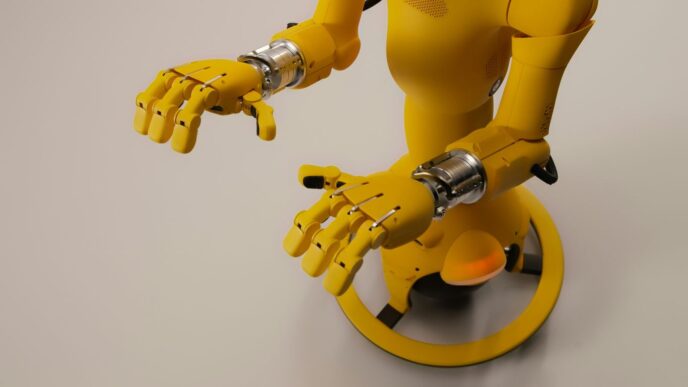
When you first see the R1, it’s surprisingly compact. It stands about 121 centimeters tall and weighs in at a manageable 25 kilograms. That’s pretty light for a humanoid robot, making it easy to move around and integrate into different spaces. It’s not just about being small, though. The design focuses on making it durable enough for real work while keeping it light for better movement. It’s built with advanced materials that balance strength and weight.
Comparing the R1 to its Predecessor
Unitree already has a history with robots, like the G1. The G1 was impressive, a real workhorse, but it was also much heavier and came with a much higher price tag, around $16,000. The R1 takes what Unitree learned and applies it differently. While the G1 might be better suited for heavy-duty tasks in controlled environments, the R1 is all about versatility and interaction. It’s lighter, more nimble, and significantly more affordable, aiming for a broader range of uses.
Here’s a quick look at how they stack up:
| Feature | Unitree G1 | Unitree R1 |
|---|---|---|
| Weight | Heavier | Approx. 25 kg |
| Price | ~$16,000 | Starting at $5,900 |
| Focus | Heavy-duty tasks | Agility, interaction, accessibility |
The R1 represents a significant leap in making advanced humanoid robotics available to a much wider audience. It’s not just an upgrade; it’s a redefinition of what an accessible humanoid robot can be.
Unpacking the Advanced Technology of the Unitree R1
The Engineering Behind the Agility
The Unitree R1 isn’t just another robot that walks; it’s built for movement that matters. Its lightweight frame, tipping the scales at around 25kg, is a big deal. This isn’t some clunky machine; it’s designed to be nimble. Unitree managed to shave off weight by using advanced materials and smart internal design, like routing all the wires inside. This makes it easier to move around, less likely to get damaged if it bumps into something, and frankly, just more practical for everyday use. It’s got a good number of joints – 24 in the standard model and 26 in the EDU version, which adds more head movement. These joints are powered by quick, responsive motors that give the robot good control over its limbs. This means it can do more than just walk; it can bend, twist, and adjust to different surfaces, which is pretty important if you want a robot to actually do things in the real world.
Intelligent Software and Multimodal AI
What really makes the R1 stand out, though, is what’s going on inside its head. It’s not just about moving; it’s about understanding and interacting. The R1 uses something called multimodal AI. Basically, it can process information from different sources at the same time – like seeing and hearing. Imagine it seeing you, hearing your voice, and then responding in a way that makes sense based on both. This is thanks to its built-in stereo cameras and a set of four microphones. It can process all this data right there on the robot, which means it can react pretty quickly. No waiting around for instructions to come from a faraway computer. The software is also set up to get updates over the air, so it can get smarter over time without you having to do much.
On-Board Processing for Real-Time Interaction
This ability to process information locally is a game-changer. Because the R1 can handle tasks like recognizing faces, understanding what you’re saying, or figuring out where a sound is coming from right on the robot itself, it can interact in real-time. This is especially true for the EDU version, which can be equipped with an NVIDIA Jetson Orin module. This powerful little computer allows for complex AI tasks to run smoothly. Think about it: the robot can see an object, identify it, and then react to it almost instantly. This local processing means the robot feels more present and responsive, making it much better for things like conversations, assistance, or even just following you around. It’s this combination of smart hardware and local AI smarts that really pushes the R1 into the future of robotics.
Exploring the Capabilities and Applications of the Unitree R1
So, what can this R1 robot actually do? It’s not just a fancy desk ornament, that’s for sure. Unitree built this thing to move and interact with the world, not just sit around looking futuristic. The R1 is designed for dynamic movement, making it suitable for a surprising range of real-world tasks.
Designed for Dynamic Movement
Forget those clunky robots that shuffle along like they’re walking on eggshells. The R1 is built differently. It’s pretty light, weighing in at around 25 kilograms, which helps a lot with its agility. It’s got a bunch of joints – 24 in the standard model and 26 if you get the EDU version, which adds a head that can move. These joints are powered by quick motors, so the robot can walk, turn, and even adjust its balance when it’s on uneven ground. It can bend, twist, and reach, which is pretty important if you want it to do anything useful.
Real-World Use Cases
This is where things get interesting. Because the R1 can move so well, it opens up a lot of possibilities:
- Research and Development: For labs and universities, the EDU version is a solid choice. You can test out new ways for robots to walk, see, or interact with people. It’s a physical system to try out ideas that usually only exist in simulations.
- Logistics and Warehousing: Imagine robots helping out in warehouses, moving small items or checking inventory. Its ability to navigate tight spaces and avoid obstacles makes it a good candidate.
- Inspection and Monitoring: In places that might be unsafe for humans, like certain industrial sites or disaster areas, the R1 could go in and check things out, sending back video and sensor data.
Telepresence and Remote Work Potential
Think about being able to control the R1 from miles away. With its cameras, microphones, and speakers, it can act as your eyes, ears, and voice in another location. This could be a game-changer for remote work. You could attend a meeting in a lab across the country, or even check in on a remote facility. It’s like having a physical avatar that can move around and interact, which is way more engaging than just a video call. The onboard processing means it can react quickly to commands, making the remote experience feel more natural and less laggy.
Unitree R1: A Platform for Innovation and Education
The EDU Version: Deeper Development
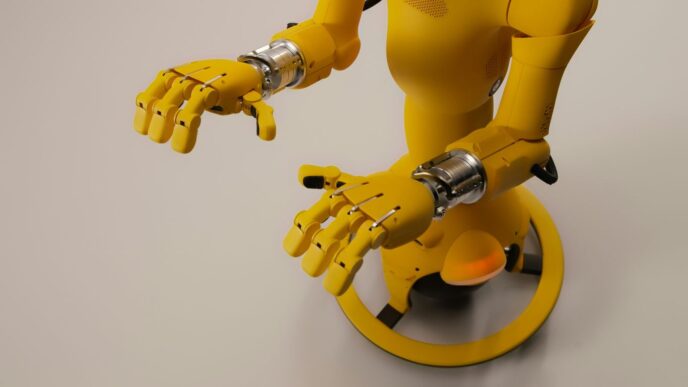
The Unitree R1 isn’t just a cool robot you can watch; it’s built for people who want to get their hands dirty and build something new. While the standard model is great for basic tasks and showing off, the EDU version is where the real magic happens for developers and researchers. It comes with extra joints in the head, giving it more ways to look around and interact with its surroundings. Plus, it’s set up to handle powerful AI processing right on board, thanks to things like the NVIDIA Jetson Orin module. This means you can run complex programs for recognizing faces, understanding speech, or figuring out where things are in a room, all without needing a super-fast internet connection. It also gives you access to a software development kit (SDK), which is basically a toolbox for creating your own robot programs. You can even add fancy hands for more complex tasks. It’s really designed for anyone who wants to push the boundaries of what robots can do.
STEM and Robotics Education
Think about classrooms and science clubs. The Unitree R1, especially the EDU version, could be a game-changer. Instead of just reading about robots or looking at pictures, students can actually work with a real, capable humanoid robot. They can learn about programming, AI, and mechanics by making the R1 do things. It’s one thing to learn about balance from a textbook, but it’s another to see the R1 adjust its stance on uneven ground. This kind of hands-on experience is way more engaging. It makes complex topics feel more real and exciting. The R1 makes advanced robotics accessible, turning abstract concepts into tangible learning opportunities. It’s the kind of tool that could inspire the next generation of engineers and scientists.
Developer Access and Open Platform
What’s really neat about the Unitree R1 is that they don’t lock you into their way of doing things. They give you pretty open access to the robot’s systems. You can get data from all its sensors, control its joints directly, and even write your own code for how it moves or reacts. This is huge for developers. It means you can test out new ideas, build custom applications, or connect the R1 to other systems you’re working on. It’s compatible with popular simulation software too, so you can try things out in a virtual world before putting them on the actual robot. This open approach means the R1 isn’t just a product; it’s a flexible tool that can adapt to a lot of different projects and research goals. It’s built for people who want to tinker and innovate.
The Future of Companion Technology with the Unitree R1
Companionship and Security Features
It’s pretty wild to think about, but the Unitree R1 is starting to blur the lines between a tool and a companion. While it’s not quite ready to be your best friend, its ability to interact using both voice and vision opens up some interesting possibilities for home use. Imagine a robot that can keep an eye on things when you’re not around, or one that can alert you to unusual sounds. The R1’s multimodal AI, which lets it understand what it sees and hears, could be the foundation for a new kind of home security. It’s not just about detecting motion; it’s about context. If it hears a strange noise, it can look around and try to figure out what’s happening. This level of awareness is a big step towards robots that can genuinely assist and protect us in our homes.
Service and Reception Roles
Beyond just being a home helper, the R1’s design and capabilities make it a strong candidate for service roles. Think about reception desks in offices or information kiosks in public spaces. A robot like the R1 could greet visitors, answer basic questions, and even guide people to their destinations. Its relatively compact size and ability to move around make it more adaptable than a static kiosk. Plus, its conversational AI means it can handle a variety of inquiries without needing constant human oversight. It’s easy to picture these robots becoming a common sight in places where a friendly, informative presence is needed.
Bridging the Gap to Everyday Robotics
What really sets the R1 apart is its price point. For a long time, humanoid robots were just too expensive for anyone outside of major research institutions or wealthy corporations. The R1, coming in at under $6,000, changes that equation entirely. This makes it accessible to smaller businesses, educational institutions, and even serious hobbyists. It’s this accessibility that will truly bridge the gap between futuristic concepts and everyday reality. When more people can get their hands on advanced robotics, innovation speeds up, and we get closer to a future where robots are a normal part of our lives, helping out in ways we’re only just beginning to imagine.
Accessibility and the Unitree R1’s Market Impact
Okay, so let’s talk about the Unitree R1 and what it means for, well, everyone. For a long time, humanoid robots felt like something out of a sci-fi movie, or maybe something you’d only see in super high-tech research labs. They were expensive, complicated, and just not really for the average person or even most businesses. But the R1? It feels like a real game-changer in that department.
A Landmark Price Point
This is probably the biggest deal. Unitree has managed to bring the cost down significantly compared to other advanced humanoids. We’re not talking about a few hundred dollars, obviously, but it’s a price that makes you stop and think. It’s the kind of price that could actually get these robots out of the lab and into more hands. Think about it: universities, smaller companies, even serious hobbyists can now seriously consider owning a capable humanoid robot. It’s a big shift from the multi-million dollar price tags we’ve seen in the past.
Democratizing Humanoid Robotics
Because the price is more reasonable, the R1 is doing something pretty cool: it’s making advanced robotics accessible. It’s like when 3D printers started becoming affordable – suddenly, a lot more people could experiment and create. The R1 is doing that for humanoid robots. It means more students can learn on them, more researchers can test their ideas without needing a massive grant, and maybe, just maybe, we’ll start seeing them pop up in places we wouldn’t expect.
- Education: Schools can finally get hands-on with real humanoid tech, not just simulations.
- Small Businesses: Think about reception desks, simple inventory checks, or even just as a novel way to engage customers.
- Developers: It’s a platform to build on, to create new applications that weren’t financially feasible before.
Considerations for Early Adopters
Now, being an early adopter always comes with its own set of things to think about. Even with the R1 being more accessible, it’s still a complex piece of technology. You’ll want to think about:
- Support and Training: While Unitree provides documentation, getting the most out of it might still require some learning or dedicated staff.
- Integration: How will it fit into your existing workflow or environment? Does it need special charging stations or network setups?
- Maintenance: Like any advanced machine, it will need care. Understanding the maintenance schedule and potential repair costs is smart.
But honestly, the potential upside here is huge. The R1 isn’t just a robot; it’s a step towards a future where advanced robotics isn’t just for the super-rich or the biggest corporations. It feels like the beginning of something much bigger.
The Road Ahead
So, what does the Unitree R1 really mean for us? It feels like we’re getting closer to having robots that aren’t just for sci-fi movies or super-advanced labs. This thing, the R1, is lighter, smarter, and way more affordable than what we’ve seen before. It’s not perfect, and Unitree itself points out that these robots are still new and need careful handling. But seeing it move, and knowing it can learn and interact, makes you think about what’s next. Maybe it won’t be long before robots like this are helping out in schools, research places, or even just around the house. It’s a big step, and it’s exciting to think about where this technology will take us.