The Dawn Of AI-Driven Material Science
It feels like AI is everywhere these days, and material science is no exception. For a long time, finding new materials was a slow, often accidental process. Think of those stories where someone stumbled upon a new compound by mistake. Now, though, things are changing fast. We’re seeing a big push to use artificial intelligence to speed all of this up.
Autonomous Labs Accelerating Discovery
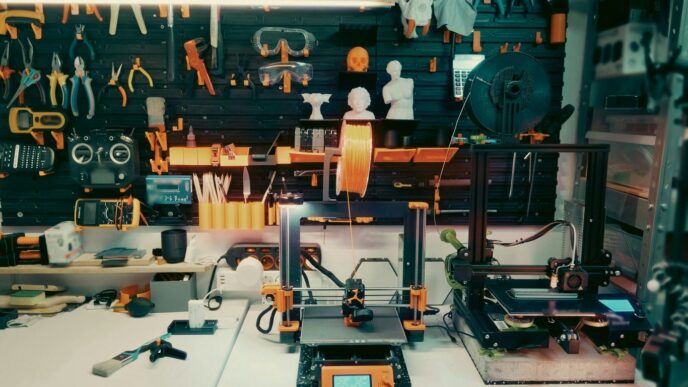
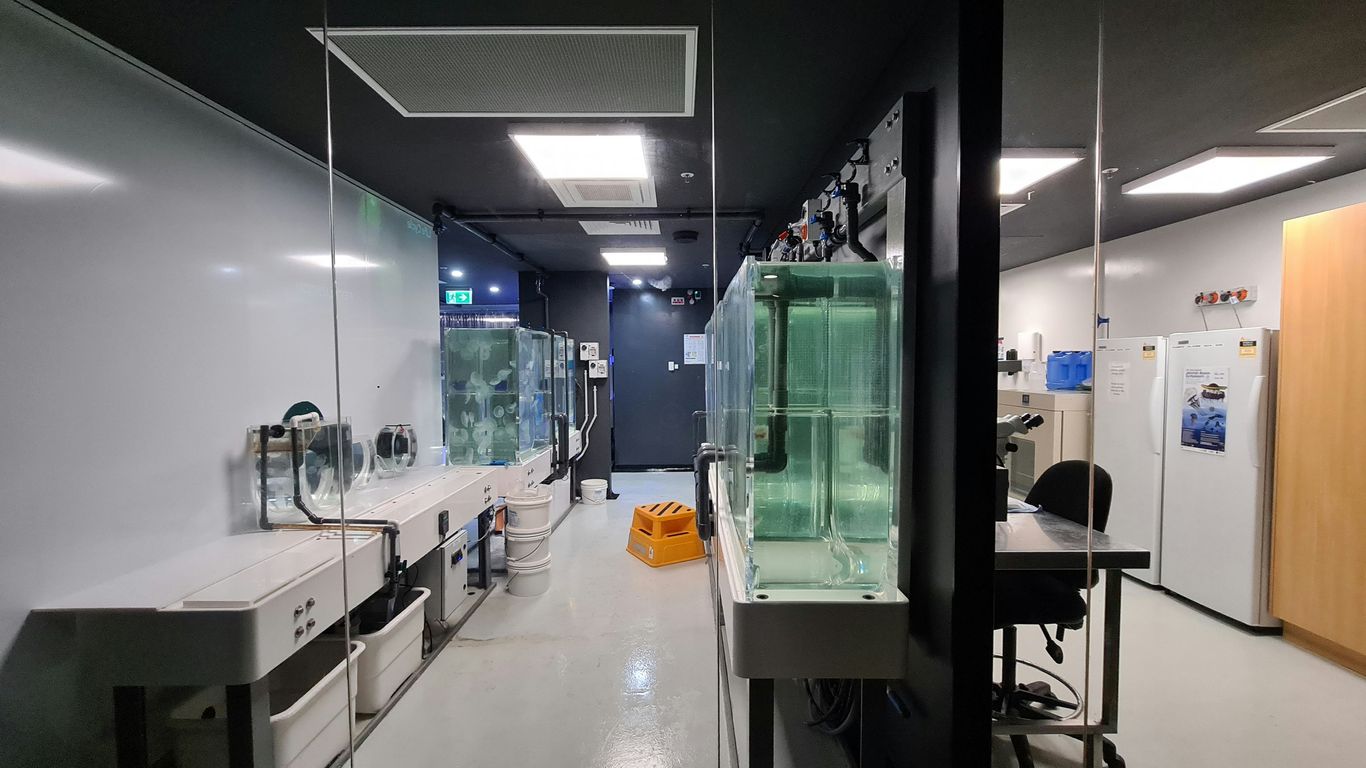
Imagine labs that can run experiments all by themselves, day and night. That’s the idea behind autonomous labs. Companies are building these high-tech spaces where AI agents don’t just suggest experiments, they actually control the robots that make and test new materials. It’s like having a tireless, super-smart research assistant. These systems are designed to learn from every test, tweaking the process to find better materials faster than humans ever could. It’s still early, and these labs are often just getting set up, but the goal is to cut down the time it takes to find useful new compounds from years to maybe just months.
AI’s Role in Experiment Design
One of the biggest hurdles in material science is figuring out what to test. There’s an overwhelming amount of scientific papers and data out there – way too much for any single person to keep up with. AI is stepping in here. It can sift through all that information, spot patterns, and suggest promising combinations of elements or structures to try. This helps scientists focus their efforts on the most likely candidates, rather than just guessing. AI is becoming a powerful tool for guiding the initial stages of research, making the whole process more targeted.
The Quest for Scientific Superintelligence
Some companies aren’t just aiming to find new materials; they have bigger ambitions. They talk about achieving ‘scientific superintelligence,’ where AI doesn’t just assist scientists but becomes a driving force in discovery across many fields. In material science, this means AI systems that can independently design, execute, and interpret experiments, leading to breakthroughs we can’t even imagine yet. It’s a bold vision, and while we’re not quite there, the progress in AI-driven labs and experiment design suggests we’re moving in that direction. The money flowing into these startups shows a lot of belief in this future.
Navigating The Landscape Of Material Discovery
It feels like every day there’s some new material or process being talked about, right? From the old days of just stumbling upon things to the fancy new biomaterials we’re seeing now, it’s a lot to take in. For a long time, finding new materials was kind of a slow process. Think about how long it took to get things like lithium-ion batteries into our lives. That was a big deal, for sure. But honestly, compared to the pace of discovery in other fields, materials science has had fewer "wow" moments that really changed everything for everyday people.
We’ve seen some cool scientific advances, like those perovskite solar cells or graphene, and even those metal-organic frameworks that won a Nobel Prize. But getting those things out of the lab and into actual products? That’s a whole different story. Many of them, even the Nobel-winning ones, haven’t really gone anywhere commercially. Some, like quantum dots, have found their niches, but we’re still waiting for those game-changing inventions that used to pop up more often.
From Unlikely Discoveries to Modern Biomaterials
Materials discovery used to be a bit of a happy accident. Someone would be working on one thing and accidentally create something else entirely, which then turned out to be super useful. It’s how many early plastics and even some metals were found. It was a lot of trial and error, often with a good dose of luck. Now, though, we’re getting much more systematic. We’re not just waiting for luck; we’re actively designing materials with specific jobs in mind. Biomaterials are a great example of this shift. We’re creating materials that can work with our bodies, like implants that don’t get rejected or drug delivery systems that release medicine exactly when and where it’s needed. It’s a far cry from just finding a new metal alloy by chance.
The Critical Role of Material Science in Society
Seriously, think about it. Almost everything we use, touch, or rely on involves materials. Our phones, our cars, the buildings we live in, the clothes we wear – they all depend on the right materials. Without advances in material science, we wouldn’t have lightweight airplane parts, efficient solar panels, or the advanced medical devices that save lives. It’s the backbone of so much technological progress. The demand for better, more sustainable, and more functional materials is only going to grow as we face global challenges like climate change and resource scarcity.
Glimpsing the Future of Novel Materials
So, what’s next? Well, AI is definitely shaking things up. We’re seeing AI help design experiments and even run automated labs. The idea is to speed up the process of finding new materials dramatically. Instead of taking years or decades, maybe we can find useful compounds in a fraction of that time. We’re talking about materials that could lead to:
- More efficient energy storage solutions.
- Stronger, lighter materials for transportation.
- New catalysts to make industrial processes cleaner.
- Advanced sensors for environmental monitoring.
It’s not just about finding new things, either. It’s also about making existing materials work better or finding ways to produce them more sustainably. The path from a lab idea to a real-world product is still tough, but the tools we have now, especially AI and automation, are changing the game. It’s an exciting time, even if we haven’t had that one massive, headline-grabbing discovery yet. The groundwork is being laid for some pretty amazing stuff.
Advanced Techniques Shaping Material Science
It’s not just about mixing stuff together and hoping for the best anymore. Material science is getting seriously sophisticated, with new ways to observe and create materials that were science fiction not too long ago. These advanced methods are helping us understand materials at a deeper level and build them with incredible precision.
Phase Field Modeling For Complex Transitions
Think about how materials change – like metal rusting or water freezing. These aren’t instant switches; they’re gradual processes. Traditional computer models often simplify these changes, drawing hard lines where they don’t really exist. Phase field modeling, on the other hand, gets it right. It tracks these messy, evolving boundaries, showing how a material shifts from one state to another over time. This is super useful for understanding things like how cracks spread through a material or how crystals grow in weird, branching patterns. It gives us a much more realistic picture of what’s happening at a microscopic level.
Merging 3D Printing and Spark Plasma Sintering
We’ve got 3D printing, which is amazing for creating complex shapes layer by layer. Then there’s Spark Plasma Sintering (SPS), a fast way to heat and fuse powders into solid objects using electrical current. Individually, they’re great. But what happens when you combine them? Researchers are figuring out how to use SPS to sinter materials during the 3D printing process. This hybrid approach could let us print intricate designs with materials that are normally hard to process, opening doors for stronger, more functional components.
Operando Transmission Electron Microscopy For Dynamic Analysis
Normally, when scientists look at materials with a powerful microscope like a Transmission Electron Microscope (TEM), they’re looking at a static sample. It’s like taking a photograph. But what if you want to see how a material behaves while something is happening to it – like when it’s heated up, put under stress, or reacting with something? That’s where ‘operando’ TEM comes in. It allows scientists to watch materials change and react in real-time, right inside the microscope. This ability to observe dynamic processes is a game-changer for understanding material behavior under working conditions. It helps us figure out why materials fail or how they perform their intended function, leading to better designs and more reliable products.
Groundbreaking Materials And Their Potential
It feels like every week there’s some news about a new material that’s supposed to change everything. But honestly, a lot of it stays in the lab. We’ve seen some cool stuff, like those Metal-Organic Frameworks, or MOFs, that even got a Nobel Prize. They’re built in a really interesting way, kind of like molecular LEGOs. Scientists think they could be used for all sorts of things, like capturing carbon from the air or even storing gases more efficiently. The real challenge, though, is getting these amazing materials out of the research papers and into actual products we can use.
Metal Organic Frameworks: A Nobel Prize-Winning Innovation
MOFs are pretty wild. Imagine a sponge, but on a molecular level, with tiny pores. These pores can be tuned to grab onto specific molecules. This makes them super useful for:
- Gas Storage: Think storing hydrogen for fuel or capturing methane.
- Separations: Like filtering out pollutants from water or air.
- Catalysis: Speeding up chemical reactions, which is important for making other materials or chemicals.
While the science behind them is fascinating and has earned top awards, making MOFs cheaply and in large amounts for everyday use is still a work in progress. It’s a bit like having a brilliant idea but not quite figuring out how to build it at scale.
The Science Behind Gemstones And Their Future
We often think of gemstones as just pretty rocks, but they’re actually crystals with specific atomic structures. Diamonds, for example, are carbon atoms arranged in a very strong, rigid lattice. This structure gives them their incredible hardness. Other gems, like rubies and sapphires, are forms of aluminum oxide with tiny amounts of other elements that give them their color. The future here isn’t just about finding more natural gems. Scientists are getting really good at creating synthetic versions in labs. These lab-grown gems can be chemically identical to their natural counterparts but are often more affordable and ethically sourced. Plus, understanding their crystal structures can lead to new applications, maybe in electronics or optics, beyond just jewelry.
LionGlass: A Sustainable Alternative For Glass Production
Glass is everywhere, but making it traditionally uses a lot of energy and raw materials. That’s where something like LionGlass comes in. It’s a newer type of material designed to be a more eco-friendly option. The idea is to use different, more readily available, or recycled components and perhaps a less energy-intensive manufacturing process. While details on LionGlass might still be emerging, the goal is clear: to reduce the environmental footprint of glass production. This could mean less waste, lower carbon emissions, and a more circular economy for materials we rely on daily. It’s a step towards making everyday items more sustainable without sacrificing performance.
Commercializing Innovations In Material Science
So, you’ve got this amazing new material, right? It works great in the lab, maybe even better than anything out there. But getting it out of the lab and into the real world? That’s a whole different ballgame. It’s like baking a perfect cake but then realizing you have no idea how to sell slices.
Challenges In Bringing New Materials To Market
Honestly, it’s tough. For decades, we’ve seen cool scientific stuff, like those metal-organic frameworks that won a Nobel Prize, or even things like graphene. They’re fascinating, but they often just stay put in research papers. It’s not like the old days where a new plastic or a better battery seemed to pop up all the time. The companies that make materials are usually pretty big and, let’s face it, not exactly jumping at the chance to try something totally new. They’ve been burned before by tech that promised the moon but delivered dust.
- The sheer time it takes: Developing a material is one thing; scaling it up for mass production is another beast entirely.
- Cost is a big one: New processes and materials often start out super expensive.
- Convincing people: You need to show that your material actually solves a problem better or cheaper than what’s already available.
The Investor’s Perspective On Material Science Startups
Investors are looking for a few key things. They want to see that a startup isn’t just playing around; they’re actually finding something genuinely new and different. They need to see a clear path from a lab sample to something that can be made reliably and in larger quantities. It’s not enough to just have a cool idea; you need a plan. Ideally, an investor wants to hear, "Hey, this company needs a material that does X, Y, and Z. We’ve made it, we’ve proven it works, and we can make enough of it to sell." That’s the dream scenario.
Bridging The Gap Between Lab Discoveries And Industry Needs
This is where the real work happens. Startups need to figure out how to make their discoveries useful for actual companies. It means talking to potential customers, understanding their problems, and then tailoring the material to fit. It’s about showing those first, concrete steps. Think of it like this:
- Identify a specific industry problem. What’s a pain point that a new material could fix?
- Develop a prototype material that addresses that problem.
- Demonstrate its performance in a way that’s relevant to the industry.
- Figure out how to scale up production so it’s not just a one-off.
It’s a long road, but that’s how you turn a scientific curiosity into something that actually changes how we do things.
The Evolving Role Of AI In Material Science
It feels like AI is popping up everywhere these days, and material science is no exception. For a long time, finding new materials was a slow, painstaking process. Think years, even decades, and a whole lot of money. But now, AI is starting to change that picture.
AI as a Tool for Scientific Literature Analysis
One of the biggest hurdles for scientists used to be just keeping up with all the new research. There are tons of papers published every single day, across all sorts of fields. It’s just impossible for one person to read and process it all. AI, especially large language models (LLMs), is stepping in here. These tools can sift through mountains of scientific text, spotting connections and patterns that a human might miss. It’s like having a super-powered research assistant that never sleeps. This helps scientists get a better handle on what’s already known and where the gaps in knowledge might be.
The Promise and Pitfalls of AI in Material Discovery
There’s a lot of excitement about AI actually discovering new materials. Companies are building "autonomous labs" where AI designs experiments, robots carry them out, and then AI analyzes the results to plan the next step. It sounds like science fiction, right? And some of these labs are already up and running, or at least getting there. They’re zapping elements together, creating thin films, and testing them out, all guided by AI. The idea is to make the whole process much faster and cheaper.
However, it’s not all smooth sailing. We haven’t seen that one big, undeniable breakthrough yet – the kind that makes everyone say, "Wow, AI really did that." Some early claims about AI discovering a bunch of new materials have even been questioned by other researchers. Plus, actually making and testing materials takes real-world resources, time, and money. So, while AI can point the way, the physical work is still a big part of the equation.
Transforming How Material Scientists Work
Even if AI isn’t quite inventing materials on its own yet, it’s definitely changing how scientists do their jobs. It’s becoming a powerful assistant. Here’s a look at some of the ways:
- Data Analysis: AI can crunch numbers from experiments much faster than humans, finding subtle trends in large datasets.
- Experiment Design: AI can suggest new experiments to try, based on existing data and literature, helping scientists explore more possibilities.
- Literature Review: As mentioned, AI helps scientists stay informed by summarizing and analyzing vast amounts of published research.
- Predictive Modeling: AI models can predict the properties of hypothetical materials before they are even made, saving time and resources.
So, while the dream of fully autonomous AI scientists is still a ways off, AI is already proving its worth as a tool. It’s making the work of material scientists more efficient and opening up new avenues for exploration. The field is buzzing with new investment, and it’ll be interesting to see how these AI tools continue to shape the future of discovering the materials we’ll need for tomorrow.
What’s Next for Materials?
So, where does all this leave us? It’s pretty clear that figuring out new materials is a huge deal for solving big problems, from clean energy to better electronics. We’ve seen how AI is starting to help speed things up in labs, like at Lila Sciences, and it’s giving scientists new tools to sift through tons of information. But honestly, we’re still waiting for that one big, game-changing discovery that really shows what AI can do in this field. It’s not just about finding new stuff; it’s about making it useful and getting it out there. The companies working on this have a lot of money and big ideas, but they also need to show real results, not just promises. It’s going to take time and probably some bumps along the road, but the potential for new materials to change our world is definitely there.