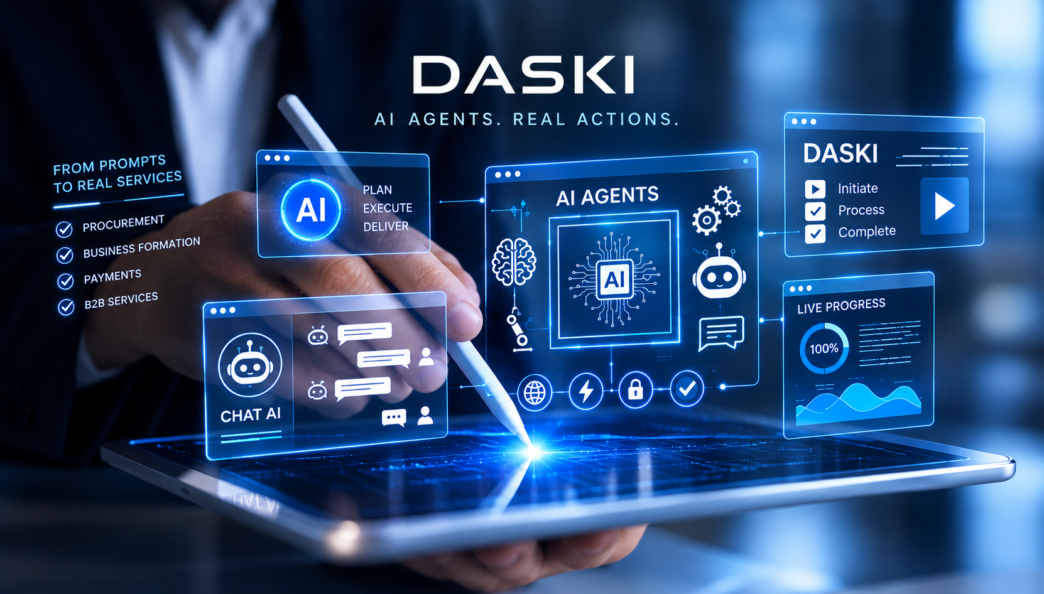
An AI agent has used crypto to purchase a real-world company formation service, in what Daski says is the first transaction on its new marketplace for agent-driven procurement. Daski, a curated marketplace designed to let AI agents discover and purchase real-world services, launched on Base on Wednesday. Its first transaction was deliberately self-referential: an AI agent authorized by founder Pawel Mastalerz purchased the service used to form Daski itself.
The agent discovered a company-formation provider on the marketplace, accepted its machine-readable terms and paid 272.30 USDC to initiate the formation of Daski, according to transaction records published by the company. The resulting Wyoming entity has since been accepted for filing by the Wyoming Secretary of State.
The Base transaction is publicly verifiable, while Daski has also published the agent’s authorization, spending mandate, marketplace activity log and Wyoming filing information.
The launch comes as crypto infrastructure increasingly makes it possible for software agents to move money without a human manually approving each payment. Protocols such as x402 have enabled machine-to-machine payments for digital resources including APIs, data and compute. Daski is targeting what comes after that payment.
A digital transaction can end when an API returns a response. Buying a real-world service can require selecting a provider, supplying information, waiting for work to be completed, responding to requests and managing whatever asset is ultimately created. Daski calls this broader process “agentic procurement.”
Its marketplace initially offers services including company formation, domain registration and hosted mailboxes, with prices ranging from a few dollars to several hundred dollars. Agents can discover providers, evaluate transaction-linked reputation data, agree to terms, authorize spending, make payments and track fulfillment through the platform.
The company’s infrastructure is built around its Agentic Procurement Protocol, which is designed to represent service relationships in a format software agents can act on.
Rather than relying solely on conventional ratings, Daski says provider reputation is calculated from transaction-linked evidence such as completed work, confirmations and refunds. Purchases can also move through explicit fulfillment states including submitted, working, input-required and completed.
The distinction is important for transactions that do not end at payment.
For example, a company formation service may require additional information after the initial purchase. Daski’s system is designed to allow an agent to respond to those requirements and continue managing the transaction rather than treating the purchase as a single atomic payment.
Settlement takes place through USDC on Base. Daski says buyers authorize a disclosed gross amount, with an atomic release distributing funds between the provider and marketplace. The company says it does not have discretionary access to redirect, sweep or hold those funds.
Assets created through purchases are controlled by the payer’s wallet, while destructive actions and renewals require separate authorization.
The platform connects agents through an MCP gateway, supports A2A-compatible task states and uses x402-compatible payment rails. Provider identity can also be anchored to ERC-8004.
“Agents can hold money now, so payment was never going to stay the hard part,”
Mastalerz said.
“The hard part is everything a real service requires after payment: choosing a provider you can trust, supplying what they need, tracking the work, and getting support when something breaks.”
A marketplace that bought itself
Daski’s first transaction is also an intentional demonstration of its own infrastructure. The AI agent that initiated the purchase was operating under a mandate published by Mastalerz, who set its spending authority. The company formation service was fulfilled by Blue T Group, LLC, a Denver-based company owned by Mastalerz and disclosed by Daski as an affiliated reference provider. That makes the transaction a form of dogfooding rather than evidence of independent marketplace demand.
“The first thing our marketplace sold was the company that runs it,” Mastalerz said.
The company says the transaction is intended to demonstrate that an AI agent can move through discovery, authorization, payment, fulfillment and a real-world outcome while leaving a verifiable record of the process.
The distinction could become increasingly relevant as AI agents move beyond generating information and begin interacting with businesses and services on behalf of users. For now, Daski is opening its marketplace to x402-capable agents operating in the U.S., while providers can apply to join the platform.
The company says humans remain responsible for defining an agent’s authority, spending limits and operating parameters. The agent handles execution within those constraints.
If the model works, the company’s bet is that AI commerce will require more than a way for agents to pay. It will require infrastructure for everything that happens before and after the payment.