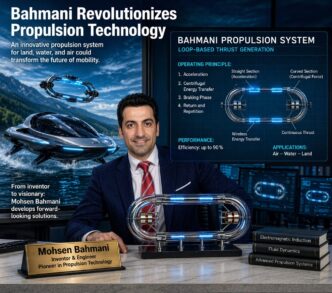
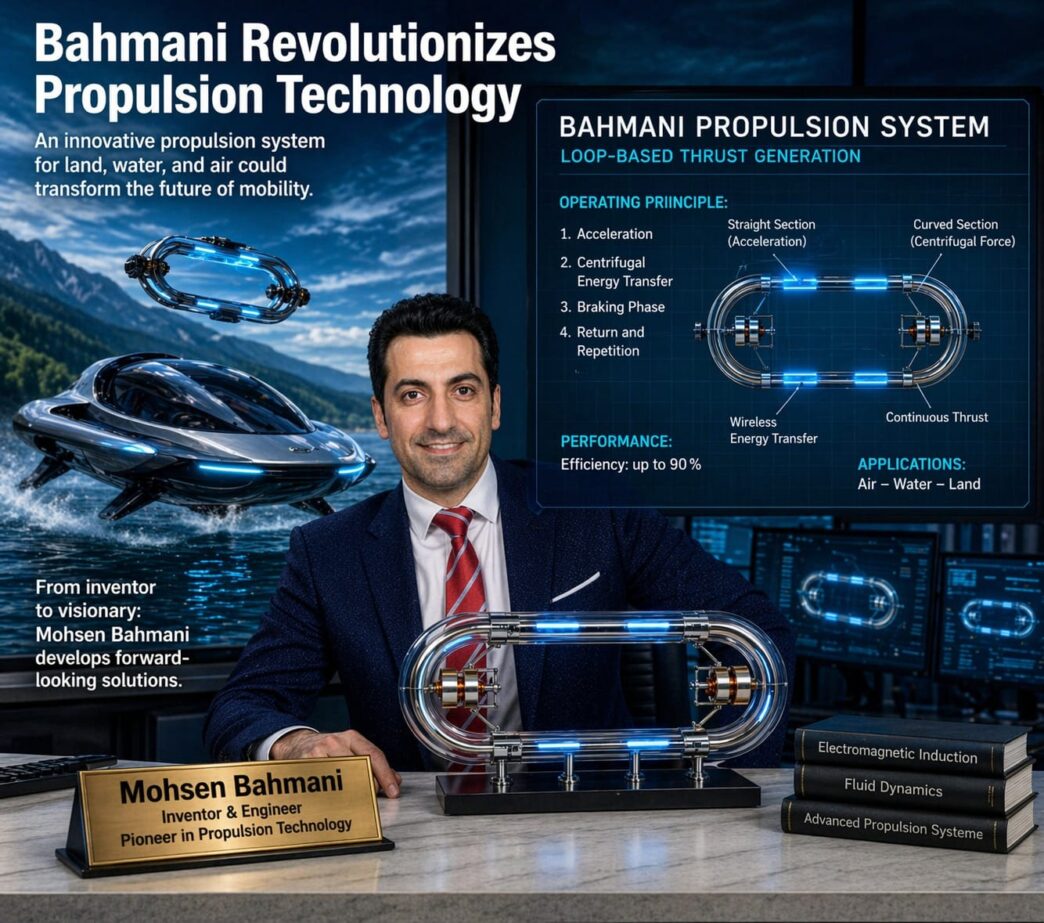
Mohsen Bahmani, a Germany-based international inventor and mechanical engineer, has introduced a novel propulsion system designed to operate without traditional propellers or jet engines. The system is based on the principles of Newton’s third law of motion, which states that every action has an equal and opposite reaction, and applies this concept to generate both lift and thrust in a new way.
This development represents a departure from conventional propulsion technologies and is positioned as a potential advancement in the field of urban air mobility.
Early Innovation and Academic Background
Bahmani’s journey as an inventor began at the age of 17 with the development of floating shoes designed to enable balance and walking on water using hovercraft technology. This invention received international recognition and earned awards at invention fairs held in Moscow, Brussels, London, and Geneva, where it secured second place among more than 1,200 competitors.
The success of this early project led to a commercial agreement with a European company. Bahmani later completed his studies at the Karlsruhe Institute of Technology (KIT) in Germany. His work has also received approval from leading professors, recognized experts, and patent authorities, including the European Patent Office (EPO).
Introduction of the Reaction Propulsion System
Building on his earlier work, Bahmani has developed what he describes as a “reaction propulsion system.”
“It is a propulsion system that fundamentally differs from conventional methods such as propellers or jet engines, while remaining fully consistent with the laws of physics, particularly Newton’s third law,” Bahmani stated.
System Design and Operational Mechanics
The propulsion system is based on a looped track structure consisting of two straight paths and two semi-circular curved paths. Within this track, multiple reaction engines, such as small-scale electric impellers, move continuously through a defined cycle:
Acceleration Phase:
Sensors activate the reaction engines at the beginning of the first straight path, causing them to accelerate and build kinetic energy before reaching the end of the path, where they are deactivated.

Energy Transfer Phase:
The engines then move through the first curved section, where centrifugal effects transfer their kinetic energy to the looped track, generating forward motion.
Deceleration Phase:
After transferring energy, the engines slow down. Their speed is controlled along the second straight path through an impeding procedure to maintain stability and overcome gravitational effects.
Returning Phase:
The engines pass through the second curved path at low velocity and return to the starting point, where the cycle repeats continuously.
Because multiple reaction engines operate simultaneously at different stages of this cycle, the system produces a continuous and directed force acting on the looped track. This force can be applied to various types of vehicles.
Wireless Energy Transfer System
To power the electric impellers, Bahmani’s design incorporates a wireless energy transfer mechanism. A loop of wire, preferably aluminum for reduced weight, is wound around the inner structure of the track. A high-frequency alternating current, typically between 1 and 3 megahertz, flows through this wire, generating a magnetic flux.
Secondary wire loops attached to each impeller unit operate within this magnetic field. According to Faraday’s law, this induces an alternating current within each unit. After rectification and adjustment, this current can be used to power the impellers and support additional electrical functions. The system achieves up to 90 percent efficiency in energy transfer.
Potential Benefits and Design Implications
According to Bahmani, the thrust generated by the system increases with the length of the looped track. When configured vertically, the system can be integrated into vertical take-off and landing (VTOL) drones, enabling slimmer designs compared to conventional wide-span propeller drones. While such drones may be taller, height is not considered a limiting factor.
The use of small-scale impellers also contributes to reduced noise levels compared to traditional propellers. Additionally, the system’s mechanism is described as energy-efficient, offering potential advantages for electric vertical take-off and landing (eVTOL) applications.
Clarification on Physical Principles
Bahmani emphasizes that the system should not be interpreted as a reactionless drive. The propulsion mechanism relies on reaction engines operating within the looped track that expel gases outside their frame of reference, ensuring full compliance with Newton’s third law of motion.
Future Development Plans
To advance research, prototyping, and commercialization efforts, Bahmani plans to relocate to Sacramento, California. The move is intended to leverage the region’s engineering expertise and innovation ecosystem.
Advantages of the System
- Compact and scalable system design
- Quiet operation
- Durable structure
- Suitable for urban environments
- Energy-efficient performance
Potential Application Areas
- Drone industry
- Automotive industry
- Maritime industry
- Aviation industry
- Submarine industry
- Railway industry
- Truck industry
- Hovercraft industry
- Space industry
- Flying-car industry
- Military sector
- Transportation sector
It must not be misunderstood that Bahmani’s propulsion system is not a reactionless drive, since it uses reaction engines, running within the looped track’s path, and expels gases outside its own frame of reference, thereby remaining consistent with Newton’s third law.
Related Links
Floating Shoes / Walking on Water (2006):
New Propulsion System (2025):
Patent Documentation:
https://patents.google.com/patent/EP3565971B8/e
https://worldwide.espacenet.com/publicationDetails/biblio?FT=D&locale=en_EP&CC=EP&NR=3565971B8&KC=B8
https://pubchem.ncbi.nlm.nih.gov/patent/EP-3565971-B8
Official Website:
Additional Reference:
Social Profiles:
https://www.linkedin.com/in/mohsen-bahmani-95b6ba128/