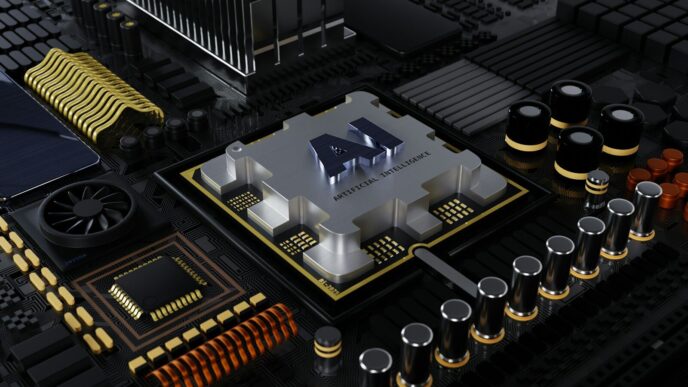
The world of computer chips is getting pretty intense. You’ve got Nvidia, AMD, and Intel all duking it out to make the best chips for artificial intelligence. It’s a big deal because AI is popping up everywhere, from our phones to self-driving cars. This means companies need super-fast chips, and these three are trying to be the ones to provide them. It’s a real race to see who can come out on top in this nvidia amd ai chip competition.
Key Takeaways
- Nvidia is currently leading the pack in AI chips, especially for data centers, thanks to its strong technology and software ecosystem.
- AMD is making a strong push as a challenger, offering high-performance chips at competitive prices and building partnerships.
- Intel is working hard to catch up, investing heavily in new manufacturing technology and aiming for a comeback in the AI chip market.
- The competition is driving innovation, with each company focusing on different strengths like specialized architectures, pricing, and manufacturing capabilities.
- Acquiring top AI talent and developing advanced process technologies are critical for all players in the ongoing nvidia amd ai chip competition.
The Evolving Landscape of AI Chip Competition
It feels like every week there’s a new headline about artificial intelligence, and at the heart of it all are the chips that power this revolution. We’re seeing a real showdown happening between the big players in the semiconductor world, mainly Nvidia and AMD, but Intel is definitely trying to get back in the game too. This isn’t just about making faster processors anymore; it’s about who can build the most efficient and powerful hardware for AI tasks, which are becoming incredibly important across so many industries.
Nvidia’s Dominance in the AI Arms Race
Nvidia has really set the pace here. For a while now, their graphics processing units (GPUs) have been the go-to for training complex AI models. It’s like they built the best tool for the job, and everyone else started using it. Their software ecosystem, particularly CUDA, plays a huge part in this, making it easier for developers to work with their hardware. This strong foundation has given Nvidia a commanding lead in the AI chip market. They’ve been riding this wave, and it’s hard for others to catch up when you’re that far ahead. It’s not just about the hardware itself, but the whole package that makes it attractive to researchers and companies building AI.
AMD’s Strategic Ascent as a Challenger
AMD isn’t just sitting back, though. They’ve been making some serious moves, especially with their high-performance processors and graphics cards. They’re trying to offer compelling alternatives to Nvidia’s products, often with a focus on competitive pricing. This strategy seems to be working, as they’ve been steadily gaining market share. They’re not just trying to match Nvidia feature for feature; they’re looking at different ways to compete, perhaps by offering more value or targeting specific market segments where Nvidia might be less dominant. It’s a smart approach to chip away at a market leader’s position.
Intel’s Ambitious Comeback Strategy
Then there’s Intel. For years, they were the undisputed king of processors, but they stumbled a bit with the rise of GPUs for AI. Now, they’re making a big push to reclaim their spot. They’re investing heavily in new manufacturing technologies and aiming to produce some of the most advanced chips out there. It’s a massive undertaking, and they’re talking about building new factories and developing cutting-edge designs. They know they have a lot of ground to make up, but their commitment to innovation and manufacturing is clear. It’s going to be interesting to see if they can pull off this comeback.
Key Innovations Driving the Nvidia AMD AI Chip Competition
So, what’s really making this whole AI chip race heat up? It’s all about what these companies are actually building and how they’re trying to make their chips better for artificial intelligence tasks. Think of it like different car manufacturers trying to build the fastest, most efficient engine – everyone’s got their own approach.
Nvidia’s Focus on Data Center Acceleration
Nvidia has really leaned into making their chips super powerful for places that need to do a lot of heavy lifting, like data centers. These are the big computer hubs that power a lot of the AI we use every day. They’ve been pushing their graphics processing units (GPUs) way beyond just gaming. For AI, this means they can crunch massive amounts of data really fast, which is exactly what training complex AI models needs. Their whole ecosystem, especially the software side like CUDA, makes it easier for developers to use their hardware to its full potential. It’s like they’ve built not just the engine, but also the special fuel and the instruction manual to make it run perfectly.
- Boosting GPU Power: Continually improving the raw processing power of their GPUs for AI calculations.
- Software Integration: Making sure their hardware works smoothly with AI software through tools like CUDA.
- Specialized AI Hardware: Developing specific chips or features within GPUs designed just for AI tasks, not just general computing.
AMD’s High-Performance Product Offerings
AMD isn’t just sitting back. They’ve been putting out some seriously competitive chips. While Nvidia often gets the spotlight for AI, AMD has been making waves with their CPUs and GPUs that offer great performance, often at a more attractive price point. They’re aiming to give users powerful options that can handle demanding AI workloads without necessarily breaking the bank. It’s a smart move to grab market share by offering a strong alternative. They’re not just copying; they’re innovating in their own way to compete.
- CPU and GPU Synergy: Developing processors (CPUs) and graphics cards (GPUs) that work well together for complex tasks.
- Value Proposition: Offering strong performance that challenges the top players, sometimes at a lower cost.
- Expanding AI Capabilities: Actively working to make their chips more suitable for AI training and inference.
Intel’s Advanced Process Technology Investments
Intel, a company with a long history in making computer chips, is making big plays to get back into the AI game. They’re investing heavily in how their chips are actually made – the ‘process technology’. This is like upgrading the factory and the manufacturing techniques. They’re talking about new ways to build smaller, more efficient transistors, which could lead to chips that are faster and use less power. Their focus on advanced manufacturing is a long-term bet to regain a leading edge. It’s a different path than just focusing on the chip design itself; they’re looking at the very foundation of chip creation.
- New Transistor Designs: Developing innovative ways to build transistors (like RibbonFET) for better performance.
- Manufacturing Scale: Investing in new factories, especially in the US and Europe, to control production.
- Power Efficiency: Aiming to create chips that perform well while consuming less energy, a big deal for data centers.
Strategic Maneuvers in the AI Hardware Arena
So, how are these chip giants actually playing the game to stay on top? It’s not just about making faster chips, though that’s a big part of it. Companies are making some pretty big moves behind the scenes.
Nvidia’s Pursuit of Talent and Technology
Nvidia’s been really focused on grabbing the best minds and the newest tech. Think of it like a sports team trying to sign the star players and get the latest training equipment. They know that having top engineers and cutting-edge designs is key to staying ahead. This is why you hear about big potential acquisitions, like the rumored Groq deal. It’s not just about the company’s existing tech, but also about bringing in a whole team of smart people who can keep innovating. Nvidia’s strategy heavily involves acquiring specialized talent and advanced technology to maintain its lead in the AI chip market. They’re also busy making their existing tools, like their CUDA software, even better so people can get the most out of their hardware. It’s a constant effort to improve everything from the silicon itself to the code that runs on it. You can find more about their developer tools on the Nvidia developer website.
AMD’s Competitive Pricing and Partnerships
AMD is taking a slightly different approach. They’re not afraid to go head-to-head with Nvidia on performance, but they’re also really smart about how they price their products. This makes their chips an attractive option for a lot of customers who need powerful AI capabilities without breaking the bank. Plus, AMD is actively building partnerships with other companies. This means they’re working with others to create complete AI solutions, not just selling individual chips. It’s like building a whole ecosystem where their processors are a key part, making it easier for businesses to adopt their technology. They’re aiming to be the go-to choice by offering a good balance of power and affordability.
Intel’s Domestic Manufacturing Initiatives
Intel is making some serious moves, especially when it comes to building chips. They’re investing a ton of money in building new factories, particularly in the United States and Europe. This isn’t just about making more chips; it’s a strategic play to reduce their reliance on overseas manufacturing and create a more stable supply chain. Having factories closer to home means they can potentially speed up production and have more control over the whole process. They’re also pushing ahead with new manufacturing technologies, like their Intel 20A and 18A processes, which promise better performance and efficiency. It’s a big bet on bringing chip production back home and strengthening their position in the long run.
Analyzing the Trade-offs in AI Chip Development
So, when companies like Nvidia look at buying up other AI tech firms, it’s not just a simple "buy" button. There are some serious things to consider, and frankly, it can get complicated fast. It’s like deciding whether to buy a fancy new tool for your workshop or just keep using the old ones you have. You have to think about the price, if it’ll actually work with your existing setup, and what your competitors might do in response.
Valuation and Integration Challenges for Nvidia
Let’s talk about the big numbers. When a company like Nvidia considers a massive acquisition, say, for $20 billion, the first question is: is it really worth it? You’re not just paying for the tech itself, but also for the smart people who built it. What if those key engineers decide to leave after the deal? That’s a huge risk. Then there’s the whole "fitting it all together" puzzle. Merging different company cultures and tech systems is rarely smooth sailing. It can take a lot of time and effort to make sure everything works together without causing more problems than it solves. It’s a bit like trying to connect two different puzzle pieces that don’t quite match up.
Competitive Responses from AMD and Intel
Nvidia’s rivals, AMD and Intel, aren’t just sitting back and watching. They’re also investing heavily in their own AI chip development. When Nvidia makes a big move, you can bet AMD and Intel are already planning their next steps. This could mean speeding up their own product releases, looking for their own partnerships, or even trying to acquire smaller companies with promising AI tech. It’s a constant back-and-forth, with each company trying to get an edge. They might also try to win over customers with more competitive pricing or by offering bundled solutions that are hard to pass up.
The Critical Role of AI Talent Acquisition
Honestly, the people are a massive part of this whole equation. The demand for skilled AI engineers and researchers is through the roof. It’s like a gold rush for talent. Companies are spending a fortune just to attract the best minds, and then they have to figure out how to keep them. Without the right people, even the most advanced chip designs won’t get built or improved. This is why acquisitions are so attractive – they can bring in entire teams of experts. But again, keeping that talent happy and integrated is a whole other challenge. It’s not just about the hardware; it’s about the human element that drives innovation forward. The energy demands of these advanced chips are also a growing concern, highlighting the need for efficient designs and data center solutions data center acceleration.
The Future Trajectory of the Nvidia AMD AI Chip Competition
So, where is all this AI chip craziness headed? It’s a wild ride, for sure. We’re seeing demand for AI hardware just keep climbing, and honestly, it doesn’t look like it’s slowing down anytime soon. Think about it – AI is popping up everywhere, from self-driving cars to how we get our news. This means companies like Nvidia, AMD, and Intel are going to keep pushing their tech to keep up.
Market Outlook and AI-Driven Growth
The market for AI chips is basically exploding. Analysts are saying the first half of 2025 was all about AI stocks, and things are still looking strong. It’s not just about making faster chips; it’s about making chips that are really good at specific AI tasks. This is why Nvidia is so focused on data centers – that’s where a lot of the heavy AI lifting happens. AMD is trying to grab market share with good performance at a decent price, and Intel is making big bets on new manufacturing tech to catch up. The whole industry is basically betting that AI will keep growing and growing.
Adapting to Evolving AI Demands
What’s interesting is how fast AI itself is changing. What’s cutting-edge today might be old news next year. This means chipmakers can’t just rest on their laurels. They need to be constantly thinking about what’s next. This involves:
- Listening to customers: What kind of AI tasks are people trying to do? Are they training huge models or just running quick predictions?
- Investing in research: Companies need to pour money into figuring out new ways to build chips that are more efficient and powerful.
- Staying flexible: The ability to quickly pivot and develop new chip designs based on new AI breakthroughs is going to be key.
The Importance of Specialized AI Architectures
We’re moving beyond just using general-purpose chips for everything. The future is looking more specialized. Instead of one chip trying to do it all, we’re seeing more designs built from the ground up for specific AI jobs. This could mean:
- AI accelerators: Chips designed purely to speed up AI calculations.
- Custom silicon: Companies building their own chips tailored to their unique AI needs.
- Hybrid approaches: Combining different types of processors to get the best of all worlds.
This shift towards specialized designs is a big deal. It means companies that can create these tailored solutions will have a real advantage. It’s not just about raw power anymore; it’s about smart design for specific AI workloads.
The Road Ahead
So, where does all this leave us? Nvidia and AMD are locked in a serious race, each trying to grab the biggest piece of the AI chip pie. Nvidia’s got the lead right now, thanks to its strong AI game, but AMD is definitely pushing hard with good products at fair prices. Intel is also trying to make a comeback, investing big in new tech. It’s not just about who has the best chip today, but who can keep innovating and adapt to what’s next. This whole competition is good for us, though. More innovation means better tech for everyone, and it’s going to be interesting to see who comes out on top in the next few years.
Frequently Asked Questions
Why are Nvidia and AMD competing so hard in AI chips?
Think of AI chips like the super-brains for computers that help them learn and do smart things. Nvidia is currently the big leader, like the star player in a game. AMD is trying hard to catch up and offer great chips too, maybe at a better price. Intel, which used to be the top dog, is also trying to make a comeback with new, powerful chips. They’re all racing to make the best chips because AI is becoming super important for everything from phones to self-driving cars, and whoever makes the best chips can lead the way.
What makes Nvidia so good at AI chips right now?
Nvidia has been really focused on making chips, especially for computers in big buildings called data centers, that are super fast at handling AI tasks. They have special technology and a strong system that many scientists and companies use to build and train AI. It’s like they built the best tools and a great workshop for AI, so everyone goes to them first.
How is AMD trying to compete with Nvidia?
AMD is like the determined challenger. They’ve been making really good chips for computers and gaming that work well and are often priced more affordably than Nvidia’s. They’re partnering with other companies and creating powerful chips that can handle AI tasks, trying to offer a strong alternative that gives customers more choices and maybe saves them some money.
What is Intel doing to get back in the AI chip race?
Intel is making a big effort to catch up. They’re investing a lot of money in building new factories, especially in the U.S. and Europe, to make their chips. They’re also working on brand-new ways to build chips that promise to be faster and use less power. It’s like they’re rebuilding their whole operation to be more modern and competitive.
Are these AI chips really that different from regular computer chips?
Yes, they are! Regular computer chips (CPUs) are good at doing many different kinds of tasks one after another, like managing your computer. AI chips (like GPUs and specialized AI accelerators) are designed to do many calculations all at the same time, which is perfect for the complex math needed to train AI models and make them learn faster. It’s like having a calculator that can do millions of simple sums instantly versus one that does them one by one.
What’s the future looking like for AI chips?
The demand for AI chips is going to keep growing like crazy because AI is becoming a part of almost everything. Companies will need even faster and more specialized chips for different AI jobs. The competition between Nvidia, AMD, and Intel will likely stay super intense, pushing them to create even more amazing technology. The companies that can best adapt and create chips specifically designed for new AI needs will probably do the best.