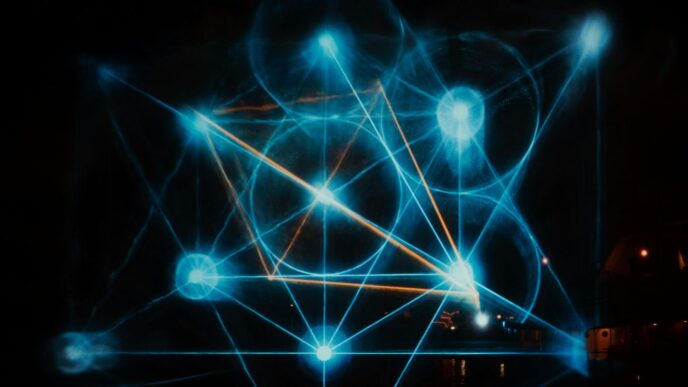

Communication is how we connect, and it’s always changing. Think about how we used to send messages versus now with the internet. Well, something new is on the horizon, and it’s called quantum entanglement communication. It sounds pretty sci-fi, but it’s based on some really weird rules of physics. We’re talking about using tiny particles, like photons, in a way that could totally change how we send and receive information, making things super secure and opening up doors to discoveries we can’t even imagine yet. It’s a big leap from the way our current communication systems work, which are based on more familiar physics.
Key Takeaways
- Quantum entanglement communication uses the strange rules of quantum physics, like superposition and entanglement, to send information, moving beyond traditional communication methods.
- This technology could lead to super-secure communication through methods like quantum key distribution, making current encryption methods obsolete.
- Future applications include incredibly precise measurements and the ability to simulate complex systems, speeding up scientific discovery.
- Building a global quantum internet will require new infrastructure, including satellites, and overcoming significant engineering hurdles for long-distance communication.
- Developing this field means investing in skilled people, encouraging global cooperation, and addressing challenges like keeping quantum bits stable and correcting errors.
Understanding Quantum Entanglement Communication
So, what’s this whole quantum entanglement communication thing all about? It sounds like something out of a sci-fi movie, right? Well, it’s actually rooted in some pretty weird but real physics. Forget the everyday rules we’re used to – the ones that say a light switch is either on or off, or that you can’t be in two places at once. Quantum mechanics plays by a different set of rules, and that’s where the magic happens.
The Quantum Leap Beyond Classical Physics
Our current communication systems, the ones that let you stream videos or send emails, rely on what we call classical physics. Think of it like sending a letter through the mail – it’s a physical object moving from point A to point B. These systems use things like electrical currents and radio waves, which are well understood. But quantum communication takes a sharp turn. Instead of just sending bits of information that are either a 0 or a 1, we’re talking about controlling individual particles, like photons (particles of light), and using their strange quantum properties to send information. It’s a whole new ballgame, moving beyond the limitations of classical physics.
Harnessing Entangled Photons for Information Transfer
One of the coolest tricks in the quantum playbook is entanglement. Imagine you have two coins that are linked in a special way. If you flip one and it lands on heads, you instantly know the other one, no matter how far away it is, will land on tails. That’s kind of like entangled photons. When photons are entangled, they share a connection. Measuring a property of one photon instantly tells you something about the other, even if they’re miles apart. This spooky connection is what we aim to use to send information in a way that’s incredibly secure and fast. We can create pairs of these entangled photons and send them off to different locations. By manipulating one photon, we can instantaneously affect its partner, and that change can be read as information.
Superposition and Entanglement: Quantum’s Core Principles
To really get a handle on quantum communication, you need to know about two key ideas: superposition and entanglement. Superposition is like a quantum coin that can be both heads and tails at the same time, until you actually look at it. It’s only when you measure it that it settles into one state or the other. Entanglement, as we just talked about, is that deep connection between particles. These two principles, working together, are what allow us to do things with information that were simply impossible before. They’re the bedrock upon which quantum communication is built, opening up possibilities we’re only just beginning to explore.
Pioneering Applications of Quantum Entanglement Communication
So, what can we actually do with this quantum entanglement stuff? It’s not just a cool science experiment; it’s starting to show real promise in a few key areas. Think about it – we’re talking about communication that’s fundamentally different from what we have now.
Revolutionizing Cybersecurity with Quantum Key Distribution
This is a big one. You know how we worry about hackers and data breaches? Quantum entanglement offers a way to make our communications incredibly secure. It’s called Quantum Key Distribution, or QKD. Basically, instead of sending a secret code (a key) that someone could potentially copy, we use entangled particles. If anyone tries to snoop on the entangled particles while the key is being sent, it messes up the entanglement. This disturbance is instantly detectable, letting us know the communication line isn’t secure and we should stop using it. It’s like having a tamper-evident seal on your digital messages. This makes it way harder for unauthorized people to get their hands on sensitive information.
Enabling Unprecedented Precision in Quantum Metrology
Beyond just sending messages, quantum entanglement can help us measure things with incredible accuracy. This field is called quantum metrology. Imagine needing to measure something super, super tiny or detect really faint signals. Entangled particles can be used to make sensors that are far more sensitive than anything we have today. This could mean:
- Better navigation systems, maybe even improving GPS.
- More sensitive medical imaging to spot diseases earlier.
- Detecting tiny changes in gravity or magnetic fields for scientific research.
It’s about pushing the limits of what we can measure, opening doors for new scientific discoveries and practical technologies.
Accelerating Scientific Discovery Through Quantum Simulation
Figuring out how complex molecules work, or how materials behave at a quantum level, is incredibly difficult for even the most powerful regular computers. Quantum entanglement is a key ingredient in quantum simulation. By using entangled quantum bits (qubits), scientists can create models that mimic these complex systems. This allows them to:
- Design new drugs and materials by simulating their properties.
- Understand fundamental physics problems that are currently too hard to model.
- Speed up research in areas like chemistry and condensed matter physics.
It’s like having a specialized quantum calculator that’s perfect for understanding the quantum world itself.
The Road to a Global Quantum Internet
Building a worldwide quantum internet is a massive undertaking, kind of like trying to connect every house on the planet with a super-fast, super-secure fiber optic cable, but for quantum stuff. It’s not just about laying more cables, though. We’re talking about entirely new infrastructure and a whole lot of international cooperation. Think of it as the next big leap after the regular internet we use every day.
Building the Infrastructure for Interconnected Quantum Networks
Right now, we’re in the early stages of figuring out what this quantum network will actually look like. It’s a huge engineering puzzle. We need ways to send quantum information reliably over long distances. This involves developing specialized hardware that can handle delicate quantum states without them falling apart. It’s a bit like trying to whisper a secret across a crowded stadium – you need to be really careful about how you transmit the message so it doesn’t get lost or garbled. The goal is to create a network where quantum devices can talk to each other, enabling things like distributed quantum computing and ultra-secure communication. This requires a mix of new technologies and adapting some of our existing communication systems. We’re seeing a lot of effort go into creating quantum repeaters, which are like the signal boosters for quantum signals, allowing them to travel further.
The Role of Satellites in Space-Based Quantum Communication
Connecting the whole planet means we can’t ignore space. Just like how satellites help connect the current internet across continents, they’ll be key for a global quantum internet. NASA, for instance, is looking into using satellites to send and receive quantum signals. Imagine a satellite beaming entangled photons down to ground stations, or even to other satellites. This could create intercontinental quantum links that are impossible to achieve with just ground-based fiber optics. It’s a way to bypass geographical limitations and build a truly global network. These space-based systems are crucial for bridging vast distances and establishing a worldwide quantum networking infrastructure.
Overcoming Engineering Challenges for Long-Distance Links
Getting quantum signals to travel long distances without losing their quantum properties is a major hurdle. Qubits, the basic units of quantum information, are incredibly fragile. They can easily get messed up by environmental noise, a process called decoherence. We need to find ways to protect these qubits during transmission. This involves:
- Developing better materials for quantum devices.
- Creating advanced error correction techniques specifically for quantum information.
- Designing robust quantum repeaters that can refresh the quantum signal without destroying it.
It’s a complex problem, and it’s going to take a lot of smart people working together to solve it. The progress we’ve made so far is exciting, but there’s still a long way to go before we have a fully functional quantum internet.
Cultivating the Quantum Ecosystem

Investing in Expert Knowledge and a Skilled Workforce
Building anything as complex as a global quantum network isn’t just about fancy hardware; it’s really about the people. We need a whole new generation of scientists, engineers, and technicians who understand how this stuff works. Think about it, we’re talking about manipulating particles at their most basic level. That takes serious brainpower and specialized training. Organizations like the National Science Foundation are putting money into centers specifically to train these future quantum wizards. It’s not just about hiring people, though; it’s about creating a whole culture of learning and development in this field. We need programs in universities, apprenticeships, and continuous training for folks already in the industry. The future of quantum communication depends on us growing a diverse and knowledgeable workforce.
Global Initiatives and Industrial Investments in Quantum
This isn’t a solo effort. Countries all over the world are pouring billions into quantum research. You’ve got big government programs in Europe and the US, and major tech companies like IBM, Google, and Amazon are investing heavily too. They see the potential, and they’re not waiting around. This massive investment is creating a buzz, driving innovation, and honestly, a bit of a race. It’s exciting because it means things are moving faster than they might otherwise. We’re seeing quantum computing-as-a-service pop up, which is pretty neat – it means smaller businesses or researchers can get access to this powerful tech without building their own super-expensive quantum computers.
The Importance of Collaboration in Quantum Advancement
No single company or country can figure this all out alone. Quantum mechanics is complicated, and building quantum networks involves so many different fields – physics, computer science, engineering, you name it. That’s why collaboration is key. We’re seeing open-source software platforms emerge, which is great because it gives everyone a common ground to build on and share ideas. Think of it like a shared toolbox for quantum developers. Plus, with things like quantum-capable satellites being developed, international cooperation is going to be a must to link up networks across the globe. It’s a big, interconnected puzzle, and everyone needs to work together to put the pieces in place.
Navigating the Challenges in Quantum Entanglement Communication
So, we’ve talked a lot about the cool stuff quantum entanglement communication could do, right? But it’s not exactly a walk in the park to get there. There are some pretty big hurdles we need to jump over before we can all be sending messages via entangled particles like it’s no big deal.
Addressing Qubit Stability and Decoherence
Think of qubits, the basic building blocks of quantum information, as super sensitive. They’re like a perfectly balanced house of cards – one little bump, and the whole thing can come crashing down. This ‘bumping’ is what scientists call decoherence. It’s when the qubit loses its quantum state, usually because it interacts with its surroundings, like heat or stray electromagnetic fields. This loss of quantum information is a major headache for building reliable quantum systems. We need qubits to stay in their delicate quantum state long enough to do useful work, whether that’s computing or sending a message.
Researchers are trying a few things to keep qubits stable. One way is to physically isolate them in super cold, shielded environments. Another approach involves using special materials that are less prone to interference. It’s a bit like trying to keep a secret in a crowded, noisy room – you have to be really careful about who or what you let in.
Developing Robust Quantum Error Correction
Even with the best efforts to keep qubits stable, errors are bound to happen. Unlike classical computers where errors are usually straightforward to fix, quantum errors are trickier. Because of the weirdness of quantum mechanics, you can’t just ‘copy’ a qubit to check if it’s okay – that would destroy its quantum state. So, we need clever ways to detect and fix these errors without messing up the information.
This is where quantum error correction comes in. It’s a bit like having a secret code that allows you to spot mistakes and correct them. The idea is to spread the quantum information across multiple qubits in a way that makes it resilient to individual errors. If one qubit gets messed up, the others can help reconstruct the original information.
Here’s a simplified look at the goal:
- Detecting Errors: Identifying when a qubit’s state has changed unexpectedly.
- Locating Errors: Pinpointing which qubit or qubits are affected.
- Correcting Errors: Restoring the qubits to their intended quantum state.
It’s a complex process, and building systems that can do this effectively for many qubits at once is a huge engineering challenge.
Integrating Quantum and Classical Systems
For the foreseeable future, quantum communication won’t replace our current internet entirely. Instead, it’s likely to work alongside it. This means we need ways for quantum systems and classical systems to talk to each other. Think of it like needing a translator between two people who speak different languages.
We’ll need interfaces that can convert classical information into quantum signals and vice versa. This also involves figuring out how to manage the flow of information between these two very different types of technology. It’s not just about building the quantum parts; it’s about making them play nicely with the technology we already have. This integration is key to making quantum communication practical and useful in the real world.
The Future Landscape of Quantum Information Technology
Transformative Potential Beyond Communication
So, we’ve talked a lot about quantum entanglement for communication, right? But honestly, that’s just scratching the surface of what quantum information technology (QIT) can do. Think about it – we’re talking about a whole new way of computing. Instead of just 0s and 1s, we’ve got qubits that can be both at the same time, thanks to superposition. And then there’s entanglement, where particles are linked no matter how far apart they are. This isn’t just about sending secret messages faster; it’s about solving problems that are currently impossible for even the biggest supercomputers.
Imagine drug discovery. Instead of guessing how molecules will interact, we could simulate them precisely. Or think about materials science – designing new materials with specific properties from the ground up. Even financial modeling could get a massive upgrade, handling complex risk assessments in ways we can’t even dream of now. The potential for scientific discovery and industrial innovation is pretty mind-blowing.
Ethical Considerations and Security Implications
Now, with all this power comes some serious questions we need to think about. The same quantum computers that can solve these amazing problems can also break the encryption that keeps our current digital world safe. It’s a bit like inventing a super-lock and then realizing someone can invent a super-key that opens everything. So, while quantum communication offers new security, we also need to get ready for a world where old security methods might not cut it anymore. This means a big push to develop what they call ‘quantum-resistant’ encryption. It’s a race, really, between building quantum computers and building defenses against them.
We also need to consider who gets access to this technology. Will it widen the gap between those who have it and those who don’t? These are the kinds of ethical discussions we need to have now, not later.
The Commercialization of Quantum Technologies
It’s not just labs and universities anymore. Companies are pouring money into quantum tech, and we’re starting to see actual products and services. You can already access quantum computing power through the cloud – kind of like renting time on a super-powerful machine. This is opening doors for businesses of all sizes to experiment and find new ways to use quantum computing for things like optimizing logistics, improving AI, or even creating better financial tools. It’s still early days, for sure, but the commercial side of quantum is definitely heating up. We’re looking at a future where quantum isn’t just a scientific curiosity, but a practical tool changing how we do business.
Looking Ahead
So, we’ve talked about some pretty wild stuff, right? Quantum entanglement communication isn’t just science fiction anymore. It’s becoming a real thing, with the potential to change how we do everything from keeping our secrets safe online to maybe even how we explore space. It’s not going to happen overnight, and there are definitely some big hurdles to jump, like building the actual quantum internet. But seeing how much progress is being made, and how many smart people are working on it, it feels like we’re on the edge of something huge. It’s exciting to think about what comes next, even if we can’t quite picture it all yet.
Frequently Asked Questions
What is quantum entanglement communication?
Imagine you have two special coins that are linked, no matter how far apart they are. If you flip one and it lands on heads, you instantly know the other one landed on tails, even if it’s on the other side of the world! Quantum entanglement communication works similarly, using tiny particles like photons that are linked in this spooky way. We can use this link to send information super securely and incredibly fast, way beyond what our regular internet can do.
How is this different from the internet we use now?
Our current internet uses signals that travel through wires or air, like radio waves or light pulses, which can be copied or intercepted. Quantum communication uses the weird rules of quantum physics, like entanglement, to send information. This makes it much harder to eavesdrop on because any attempt to peek at the information would instantly break the quantum link, alerting the sender and receiver.
What are some cool things we can do with this technology?
One of the biggest promises is super-secure communication, like unbreakable codes for banks or governments. It can also help scientists make incredibly precise measurements, like detecting tiny wobbles in space-time, and could lead to powerful new computers that can solve problems impossible for today’s machines.
Is this quantum internet thing real, or just science fiction?
It’s becoming real! Scientists and engineers are working hard to build the technology needed for a quantum internet. They are building special networks and even planning to use satellites to send quantum signals across long distances. It’s a huge project, but many experts believe it’s achievable in the coming years.
What are the biggest challenges in making quantum communication work?
One big hurdle is keeping the quantum particles, called qubits, stable. They are very delicate and can easily lose their special quantum properties when they bump into things or get too warm. Scientists are also working on ways to fix errors that might happen and figuring out how to connect quantum systems with our existing technology.
Who is working on this, and why should we care?
Lots of smart people and big companies, like NASA, Google, and IBM, are investing in quantum technology. It’s important because it could lead to a more secure digital world, faster scientific discoveries, and new technologies we can’t even imagine yet. It’s like building the next generation of the internet, but with superpowers!