Manufacturers have spent years investing in digital tools designed to connect systems, streamline operations, and deliver real-time data across the enterprise. On paper, the factory of the future already exists.
But on the factory floor, manufacturers have spent decades—and billions—digitizing their operations. From product design to supply chain planning, today’s factories are powered by advanced systems designed to optimize performance at scale. Yet despite this transformation, a persistent problem remains: the work on the factory floor still doesn’t consistently reflect the intelligence built into those systems.
This disconnect is becoming one of the defining challenges of modern manufacturing. While organizations have successfully digitized how they manage information, many still struggle with how that information is actually executed in real-world environments.
According to IBM, artificial intelligence is rapidly reshaping manufacturing by enabling predictive insights, automation, and real-time decision-making. But the value of these capabilities ultimately depends on how effectively they influence frontline operations. Data alone does not drive outcomes—execution does.
When Data Doesn’t Translate Into Action
In most manufacturing environments, engineering and operational systems are highly sophisticated. Platforms for design, lifecycle management, and production planning provide precise definitions of products and processes.
However, the translation of that knowledge into day-to-day work often remains surprisingly manual.
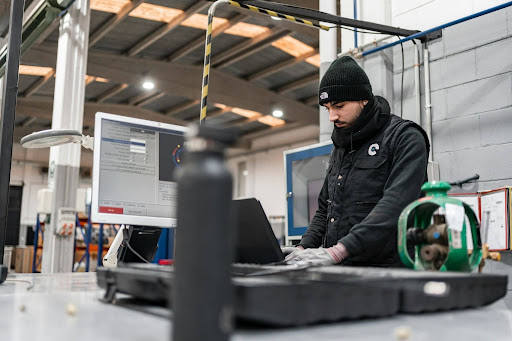
Frontline workers frequently rely on static instructions—PDFs, slide decks, or legacy documentation—that represent only a snapshot of evolving processes. As products change and production methods improve, these materials can quickly become outdated, forcing workers to interpret complex information without real-time context.
This creates friction. Not because the data is wrong, but because it isn’t delivered in a way that supports consistent, confident execution.
Visual Execution as the Missing Layer
A growing number of manufacturers are beginning to address this gap through what is emerging as a “visual execution” layer—a concept increasingly advocated by industry leaders such as Garth Coleman, CEO of Canvas Envision.
At its core, visual execution uses AI to transform engineering and operational data into interactive, step-by-step guidance that workers can follow in real time. As Coleman has emphasized, the challenge is not access to information, but how that information is structured and delivered at the point of work. Instead of asking employees to interpret static documents, these systems present guidance in a way that aligns with how people actually perform tasks—visually, contextually, and sequentially.
This approach represents a fundamental shift. It is not about adding another system to the stack, but about creating a bridge between existing systems and the people responsible for executing the work. In Coleman’s view, this layer effectively translates complex engineering intent into actionable steps, reducing the ambiguity that often defines frontline operations.
Insights from Siemens reinforce this direction. As digital manufacturing evolves, the focus is moving toward more adaptive, intelligent environments where data is continuously connected to operations. Visual execution extends that principle to the human layer of production.
From Documentation Lag to Real-Time Execution
As manufacturing complexity increases, the limitations of traditional instruction methods are becoming harder to ignore. Modern products evolve rapidly, often requiring continuous engineering updates, yet the instructions used on the factory floor remain largely static. This creates what can be described as “documentation lag”—a growing gap between the current state of a product and the guidance used to build or service it.
Over time, this lag introduces variability into execution. Workers may rely on outdated steps, interpret procedures differently, or depend on informal knowledge passed between colleagues. The result is inconsistency—manifesting in quality issues, rework, and extended training cycles. As systems become more advanced, the cost of this disconnect only intensifies.
Aligning execution with real-time data changes that equation entirely. Instead of interpreting static instructions, workers are guided through dynamic, structured workflows that reflect the latest engineering intent. Training accelerates, as new employees can follow intuitive, visual processes rather than relying on lengthy onboarding or tribal knowledge. At the same time, consistency improves across teams, shifts, and locations.
More importantly, execution becomes responsive. When engineering changes occur, instructions can update in parallel, ensuring that what is defined in the system is immediately reflected on the floor.
This shift marks a broader transition in manufacturing—from digital transformation to operational impact. While organizations have invested heavily in connecting systems and improving data visibility, true performance gains depend on how effectively that data is applied. Approaches like visual execution point toward a future where knowledge is not just stored, but activated—turning digital intelligence into consistent, real-world outcomes.