
1. J1407b
Imagine a planet so massive it makes Jupiter look like a pebble. That’s J1407b, a gas giant that’s truly out of this world. What makes it so bizarre? It’s got a ring system that dwarfs anything we’ve ever seen. We’re talking about rings that are about 120 million miles across, which is roughly 200 times larger than Saturn’s rings. This colossal ring system might even contain a large ex moon, about the size of Mars, that’s still in the process of forming.
Scientists first spotted this giant when they observed a huge dip in the light from its star, J1407. This dip was caused by the planet and its massive rings passing in front of the star. The sheer scale of these rings suggests they are incredibly young, likely only a few million years old.
Here’s a breakdown of what we know (and what we’re still figuring out):
- Planet Type: Gas Giant
- Estimated Mass: Between 10 and 40 times the mass of Jupiter
- Ring System Diameter: Approximately 120 million miles (200 million kilometers)
- Potential Moon: A Mars-sized exomoon candidate within the rings
It’s a mind-boggling sight, and it really makes you wonder what other incredible planetary features are out there, just waiting to be discovered.
2. Gliese 581c
Gliese 581c is a planet that’s about 20 light-years away, hanging out in the constellation Libra. It circles its star pretty closely, much closer than Mercury orbits our Sun. This close orbit means Gliese 581c is likely tidally locked.
What does that mean? Well, one side of the planet probably bakes under constant starlight, while the other side is stuck in perpetual, freezing darkness. Imagine a world with a permanent day side and a permanent night side. Between these two extremes, there might be a sliver of a habitable zone, a twilight strip where temperatures could be just right for liquid water.
Scientists even sent a radio message towards Gliese 581c back in 2008, which is expected to arrive around 2029. It’s a bit of a long shot, but who knows what might be out there?
3. Gj 1214b
Okay, so GJ 1214b. This one’s pretty wild. Imagine a planet that’s basically just water, but not like our oceans. Scientists think it’s a ‘waterworld,’ which sounds cool, but it’s probably more like a super-hot, super-pressurized version of Jupiter’s moon Europa.
It’s thought to be covered in oceans that stretch all the way around its surface, with no land in sight. This planet is also a bit of a mystery because its atmosphere is so thick and steamy that it’s hard to see what’s really going on underneath. It’s much bigger and hotter than Earth, so don’t pack your swim trunks just yet.
Here’s a quick rundown:
- Type: Super-Earth or Mini-Neptune (still debated!)
- Composition: Likely a lot of water, possibly under high pressure.
- Atmosphere: Thick, steamy, and obscuring.
- Temperature: Pretty darn hot, definitely not beach weather.
It’s one of those planets that makes you realize just how diverse the universe really is. We’re talking about a world that’s potentially all ocean, which is just mind-boggling when you compare it to our own planet.
4. Gliese 436b
Okay, so Gliese 436b is a bit of a head-scratcher. Located about 30 light-years away in the Leo constellation, this planet is roughly the size of Neptune. What’s really wild is how close it orbits its star – a mere fraction of the distance Mercury is from our Sun. This means it whips around its star in just about 15.5 hours! Talk about a fast lap.
But here’s the kicker: Gliese 436b is known for its “ice” that’s way too hot. We’re talking surface temperatures around 439°C (822°F), which is way above the boiling point of water. So, how can ice exist there? The intense gravity of the planet squashes the water vapor so hard that it forms a solid, ice-like layer. This high-pressure ice, sometimes called “hot ice,” stays solid even at these scorching temperatures. It’s a real head-scratcher that seems to bend the rules of what we thought was possible.
Here’s a quick rundown of its oddities:
- Orbit: Super fast, completing a full circle around its star in under a day.
- Temperature: Hot enough to melt lead, yet it has “ice.”
- Composition: Mostly made of water, but under extreme pressure that changes its state.
- Atmosphere: It’s thought to have a hydrogen-rich atmosphere that’s escaping into space, creating a sort of “cometary” tail.
5. HD 189733b
Okay, so picture this: HD 189733b. It’s a planet that’s a bit bigger than Jupiter, and it’s hanging out about 62 light-years away from us. What makes this one so wild is what’s happening in its atmosphere. Forget rain as you know it; on HD 189733b, it rains glass. Yeah, you heard that right.
This isn’t just a light drizzle, either. The winds on this planet are absolutely insane, whipping around at speeds of up to 5,400 miles per hour. That’s like, seven times the speed of sound. When you combine those crazy winds with the super-hot temperatures, the silicates in the atmosphere get blown around and form tiny shards of glass.
Here’s a quick rundown of what makes it so extreme:
- Atmospheric Composition: Mostly hydrogen and helium, but with those pesky silicates floating around.
- Wind Speeds: Upwards of 5,400 mph (8,690 km/h).
- Temperature: A scorching 1,800°F (982°C) on the day side.
It’s a real reminder that the universe has some seriously bizarre weather patterns going on, far beyond anything we experience here on Earth.
6. Wasp-12b
Alright, let’s talk about WASP-12b. This planet is seriously weird, and not in a good way. Imagine a world that’s basically a cosmic Pac-Man, constantly being gobbled up by its own star. It’s so close to its star that it’s tidally locked, meaning one side is always facing the heat, and the other is stuck in perpetual darkness.
This planet is one of the darkest known exoplanets, absorbing about 94% of the light that hits it. It’s like a black hole in planet form. The day side is a scorching 4,600°C (8,312°F), hot enough to melt pretty much anything you can think of. The night side, while cooler at around 2,200°C (3,992°F), still has conditions that allow for things like water vapor and clouds to form. Pretty wild, right?
Here’s a quick rundown of its extreme characteristics:
- Extreme Heat: The day side is hotter than the surface of many stars.
- Light Absorption: It’s so dark, it barely reflects any light back into space.
- Tidal Locking: One side bakes, the other freezes (relatively speaking).
- Stellar Consumption: Material from its atmosphere is actually spilling onto its star. Talk about a bad relationship!
It’s a type of planet called a ‘hot Jupiter,’ and WASP-12b really takes that to the extreme. It’s a stark reminder of just how bizarre and extreme the universe can get.
7. Gj-504b
Okay, so GJ 504b is a pretty wild one. Imagine a planet that’s not just blue, but a deep, vibrant magenta. That’s GJ 504b for you, hanging out in the Virgo constellation. It’s a gas giant, kind of like Jupiter, but it’s way out there, orbiting its star about nine times farther away than Jupiter orbits our Sun.
What’s really interesting is that this planet is thought to be pretty young, still in the process of forming. It’s also quite a bit hotter than you might expect for a planet so far from its star, which is a bit of a puzzle for scientists.
- Color: A striking magenta hue.
- Type: Gas giant exoplanet.
- Location: Virgo constellation.
- Orbit: Very distant from its host star.
This planet’s unusual color is thought to come from its atmosphere, which is still hot and contains a lot of heat-radiating particles. It’s a real head-scratcher and a beautiful example of how diverse planets can be out there.
8. Kepler-10c
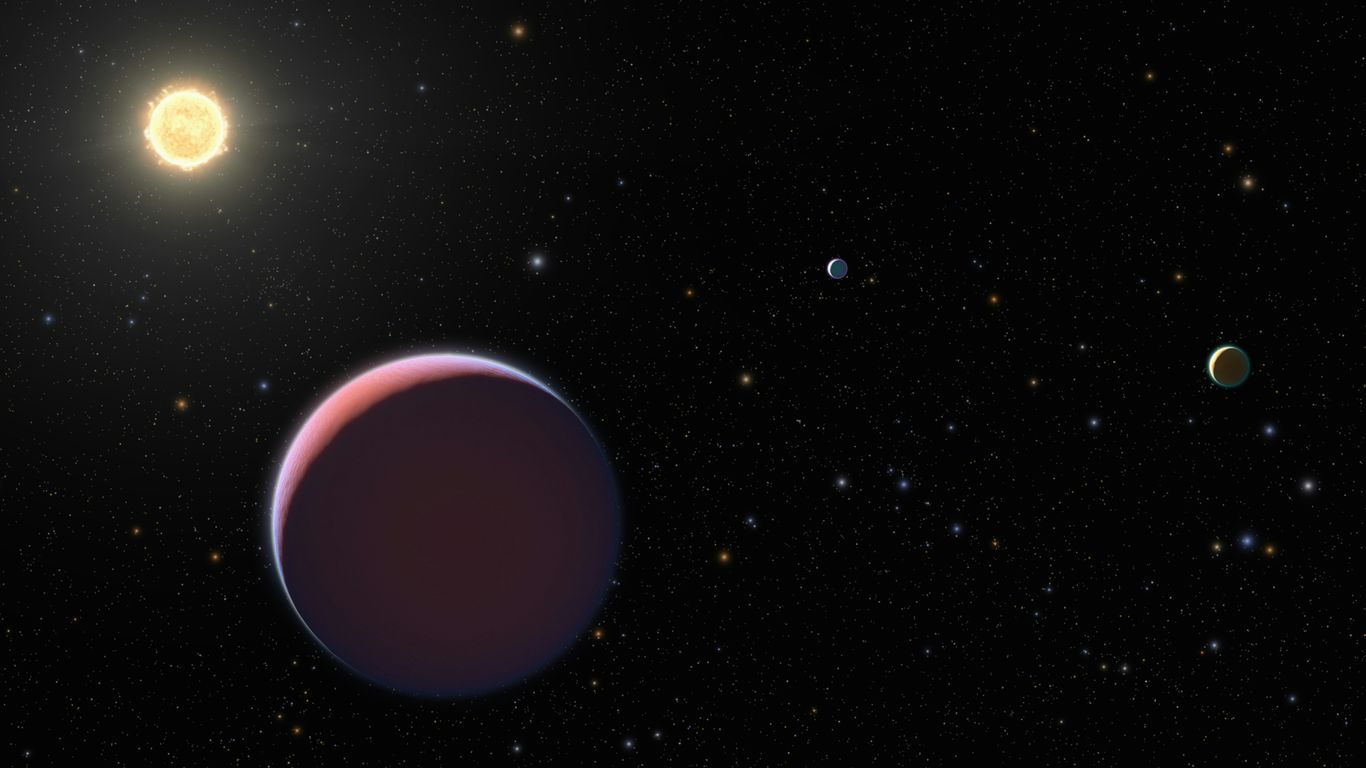
Okay, so Kepler-10c is a seriously interesting find, and it’s got scientists scratching their heads a bit. Located about 560 light-years away in the Draco constellation, this planet is part of the Kepler-10 system. What makes it stand out is its size and mass. It’s what they’re calling a "Mega-Earth," and that’s not just a cool nickname.
This planet is more than twice the size of our own Earth and weighs in at a hefty 17 times our planet’s mass. Imagine something that big! Trying to figure out how a world like this even formed is a real puzzle for planet formation theories. It’s so different from what we usually see that it’s basically created its own category of exoplanets.
Here’s a quick rundown of its stats:
- Distance from Earth: Approximately 560 light-years
- Constellation: Draco
- Size: More than twice Earth’s diameter
- Mass: About 17 times Earth’s mass
- Orbital Period (Year): 45 Earth days
It’s a real outlier, showing us just how diverse and surprising planets can be out there in the universe.
9. Ogle-2005-Blg-390lb
Okay, so imagine traveling over 20,000 light-years. That’s a serious trek, right? You end up in the constellation Sagittarius, where you find a tiny, dim red dwarf star. And orbiting this cool little star is Ogle-2005-Blg-390lb. This planet is so far out, it barely gets any warmth from its star. We’re talking seriously cold here.
Its surface temperature hovers around a mind-boggling -220°C (-364°F). Everything on this world is covered in ice. Think vast plains, huge mountains, and deep canyons, all made of ice. It’s basically a frozen wasteland. Life as we know it? Forget about it. You’d freeze solid in an instant. But here’s a little twist: scientists think there might be something going on under the ice. The planet’s core could be warm, and maybe its moons are pulling on it, creating heat. This could melt the ice deep down, creating a giant ocean hidden beneath the frozen surface. Pretty wild to think about, huh?
10. Psr B1620-26 B
Talk about a blast from the past! Psr B1620-26 B is an exoplanet that’s practically ancient, clocking in at around 13 billion years old. For comparison, our own Earth is only about 4.5 billion years old. This planet is so old, it’s almost as old as the universe itself.
It hangs out in a binary star system, orbiting not one, but two stars. One is a white dwarf, and the other is a pulsar – a rapidly spinning neutron star that emits beams of radiation.
Because it’s so old and orbits these stars, scientists have had a tough time figuring out exactly how it formed and how it managed to stick around for so long. It’s a real cosmic mystery, showing us just how diverse and surprising planets can be out there.
11. Kepler-438b
Kepler-438b is a pretty neat find, and honestly, it’s one of the closest things we’ve got to an Earth twin out there. It’s about the same size as our home planet, which is already a big deal. What really gets people excited is that it orbits within its star’s habitable zone. This means, theoretically, the temperature could be just right for liquid water to exist on its surface. Imagine that – a whole other world with oceans or rivers!
It circles a star that’s a bit smaller and cooler than our Sun, and it does a full lap pretty quickly, with a year lasting about 35 Earth days. Because it’s so close to its star, it gets a bit more radiation than Earth does, which might make things a little tricky for life as we know it. Still, compared to a lot of the other weird planets out there, Kepler-438b feels surprisingly familiar. It’s a reminder that maybe, just maybe, there are other Earth-like worlds waiting to be discovered.
12. TrES-4b
Okay, so TrES-4b. This one’s pretty wild. Imagine a planet that’s bigger than Jupiter, like, way bigger – over 1.7 times Jupiter’s size. But here’s the kicker: it’s incredibly light. Its density is so low, it’s comparable to cork. Yeah, you read that right. It’s like a giant, fluffy balloon floating in space.
Scientists think this ‘puffy’ nature comes from its extreme heat. TrES-4b is super close to its star, only about 7.2 million kilometers away. That’s a fraction of the distance between Earth and the Sun. Because of this, it whips around its star in just three Earth days. That close proximity means its surface temperature is a scorching 1260°C (2300°F).
So, to recap this bizarre world:
- It’s one of the largest exoplanets ever found.
- It has a density lower than cork.
- It orbits its star incredibly fast due to its close distance.
- It’s extremely hot, making it a ‘puffy’ planet.
13. Hd 106906
Okay, so HD 106906 b is a real head-scratcher. Located about 300 light-years away in the Crux constellation, this planet is seriously far out from its star. We’re talking 60 billion miles, which is like, 20 times farther than Neptune is from our Sun. That’s a pretty lonely orbit, right?
And get this: it’s estimated to be about eleven times the mass of Jupiter. That’s a hefty planet! What’s really wild is how it formed. Scientists are still trying to figure that part out. It’s just hanging out there, super far from its star, and it’s a giant. It makes you wonder what else is out there that we just don’t understand yet.
14. Wasp-17b
Okay, so get this: WASP-17b is a gas giant, kind of like Jupiter, but it’s doing something super weird. It’s orbiting its star backward! Most planets go around their star in the same direction the star spins, but WASP-17b is doing its own thing, spinning the opposite way. Scientists aren’t totally sure how this even happened.
It’s also one of the biggest exoplanets we’ve found, with about half the mass of Jupiter. Even though it’s way out there, far from its star’s warmth, it’s still incredibly hot, with temperatures around 1500°C (2732°F). It actually glows a bit in infrared because it’s still radiating heat from when it was born.
Here’s a quick rundown of its oddities:
- Retrograde Orbit: It orbits its star in the opposite direction of the star’s spin.
- Massive Size: It’s a hefty gas giant, larger than Jupiter.
- Extreme Heat: Despite its distance from its star, it’s scorching hot.
- Formation Mystery: How it got into its current orbit is a puzzle.
15. Tres-2b
Alright, let’s talk about Tres-2b. This exoplanet is pretty wild, and it’s located about 4.5 million miles from its star. That’s super close, so it whips around its star in just three Earth days. Imagine a year being only three days long!
What makes Tres-2b really stand out is its size and density. It’s actually bigger than Jupiter – like, over 1.7 times the size. But here’s the kicker: it’s incredibly light for its size. Its density is so low, it’s comparable to cork. Scientists think this is because the planet is extremely hot, reaching about 2300 degrees Fahrenheit. That intense heat probably makes its atmosphere really puffy and spread out.
So, you’ve got this giant, super-hot, low-density planet that zips around its star at lightning speed. It’s one of those discoveries that really makes you scratch your head and wonder about all the different kinds of worlds out there.
16. Kepler-78b
Okay, so Kepler-78b. This one’s a bit of a scorcher. Imagine a planet that’s roughly the same size as Earth, which sounds nice and familiar, right? Well, don’t let that fool you. This planet is basically a giant ball of lava. It’s zipping around its star at a distance of only about 550,000 miles. To put that in perspective, it’s like Mercury hanging out super close to our Sun, but even closer.
Because it’s so close to its star, Kepler-78b has some seriously high temperatures. We’re talking around 2030 degrees Celsius (that’s about 3680 degrees Fahrenheit). So, yeah, forget about any Earth-like vacations here. It’s more like a molten rock world.
Here’s a quick rundown of what makes it so hot:
- Size: Similar to Earth.
- Orbit: Extremely close to its host star.
- Temperature: Estimated around 2030°C (3680°F).
- Composition: Likely molten rock, hence the ‘lava planet’ nickname.
17. 2MASS J2126-8140
Talk about a long commute! 2MASS J2126-8140 is a gas giant that takes the concept of a distant orbit to a whole new level. It circles its red dwarf star at a mind-boggling distance of 600 billion miles. That’s about 2,000 times farther from its star than Earth is from the Sun. This makes it the planet with the largest orbit known in any solar system.
Even with this extreme distance, 2MASS J2126-8140 isn’t exactly chilling out. Its surface temperature is still a scorching 1,500°C (2,732°F). Scientists think this is residual heat left over from when the planet first formed. It’s so hot, in fact, that it still glows in the infrared spectrum. How this planet ended up so far from its star, or even how it formed in the first place, remains a big mystery for astronomers.
18. Proxima Centauri b and more
Alright, let’s talk about Proxima Centauri b. This one’s pretty close, cosmically speaking – just about four light-years away. Discovered back in 2016, it’s got a mass a little over Earth’s and whips around its star in a speedy 11.2 days. The catch? It gets blasted with way more ultraviolet radiation than we do from our Sun, hundreds of times more. So, while it’s nearby, it’s probably not a beach vacation spot.
But the universe doesn’t stop there, does it? We’ve got planets like 2MASS J2126-8140, which is just mind-bogglingly far from its star – we’re talking hundreds of billions of kilometers. It’s so far out, scientists aren’t even sure how it formed. Then there’s WASP-17b, a giant that’s doing its own thing, orbiting its star in the opposite direction. Talk about a rebel.
And let’s not forget the super dark ones, like Tres-2b, which reflects less than 1% of the light that hits it. It’s literally darker than coal. It makes you wonder what else is out there, just waiting to be found, each with its own bizarre story.
The Universe Keeps Surprising Us
So, we’ve looked at some pretty wild planets out there, right? From worlds with rings bigger than our entire sky to places where it rains glass, it’s clear that space is way stranger than we often imagine. It makes you think about how much we still don’t know. Every new discovery just shows us how vast and full of surprises the cosmos really is. It’s a good reminder that even with all our science, there are still so many mysteries waiting to be figured out, and that’s kind of exciting, isn’t it?