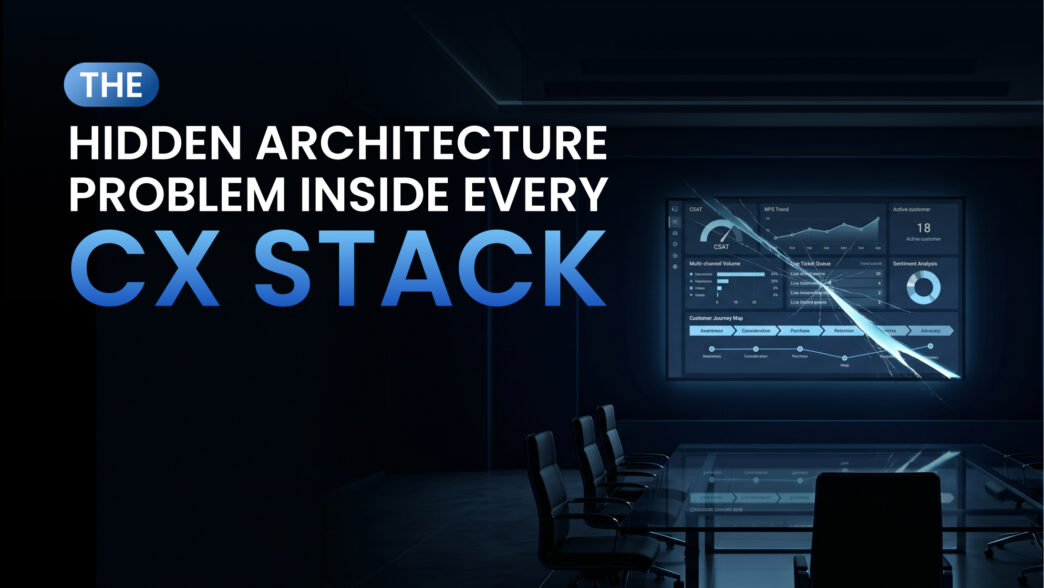
Modern enterprise companies handle their customer strategy across more than eight disconnected software tools. This data fragmentation isolates critical customer insights. Corporate leaders frequently make high-stakes decisions based on stale reports or gut feelings. The real customer experience crisis is not a lack of data. It is a failure of structural architecture.
The Legacy Trap of Modern Stacks
First-generation customer experience platforms were built for a pre-artificial intelligence era dominated by manual ticketing. Engineers built these early tools to help mid-level managers track agent activity. They bolted channel-specific modules together over time. These legacy platforms cannot process cross-channel intelligence. They fail to fuel modern AI workflows.
Adding an AI summary button to an outdated stack does not solve the problem. Fragmented data structures create surface-level summaries instead of deep system reasoning.
Rufus Ajgaonkar, a marketing leader at Konnect Insights, explained this software issue in a recent strategy meeting. He noted that tools inside large corporations are highly isolated.
“Structure matters inside large companies,” Ajgaonkar stated. “Marketing, support, and operations often use different tools. Konnect Insights connects them.”
Without this structural connection, companies suffer from severe operational blindness. Critical customer signals remain buried deep inside unstructured data patterns. This issue hides the indicators of silent customer churn. Standard business intelligence tools often fail to capture these indicators.
Moving Beyond Tool Sprawl
Enterprise brands require an architectural evolution toward a unified signal layer. This structural change moves companies away from reactive point solutions. It creates a holistic enterprise operating system grounded in customer experience intelligence.
Konnect Insights introduces a unified data tier built from the ground up. It natively unifies reviews, emails, voice streams, messaging apps, and social listening into one environment.
This unified approach eliminates the need for teams to switch between disconnected software programs. It allows agents to focus on meaningful engagement rather than searching for customer information. Sameer Narkar, the founder and CEO of Konnect Insights, noted that his company works directly with large brands.
“For a change, we are a bootstrapped company that directly works with enterprise customers,” Narkar said.
Legacy platforms often create significant onboarding delays for large enterprise clients. Some systems require months of training before teams can operate them effectively. Ajgaonkar compared these implementation timelines during the company discussions.
“For instance, if you were to onboard Sprinklr, it would take you upwards of six months to get that thing on,” Ajgaonkar observed.
He added that a complicated user interface requires excessive agent training. In contrast, a unified data layer allows for rapid deployment. Enterprise systems can become fully operational in a matter of days.
Bringing Customer Insights to the Boardroom
The primary goal of a modern customer experience platform is shifting from team management to boardroom intelligence. Executive leaders require clear data to make high-stakes corporate decisions. They cannot rely on complicated dashboards designed for customer support agents.
Konnect Insights addresses this leadership gap through the Konnect Research Cloud, which is also called KRC. This technology acts as a purpose-built intelligence layer for corporate executives. It converts daily operational signals into long-term strategic insights.
The company uses a core anchor line to describe this shift. “CX platforms were built for teams. KRC was built for the boardroom.”
KRC uses natural-language interpretation to assist corporate leadership. Executives can bypass traditional analytics dashboards to ask direct strategic questions. Ajgaonkar described the function of the Konnect Research Cloud during the strategy sessions.
“What Konnect Research Cloud basically is, it’s a conversational link between your digital presence,” Ajgaonkar explained.
The system allows leadership to track customer satisfaction trends instantly. It also provides advanced workforce management strategies based on historical conversation patterns. KRC can calculate specific agent staffing needs for upcoming product launches. This intelligence transforms customer experience from a reactive support desk into a proactive corporate asset.
The Imperative of Private and Secure AI
As artificial intelligence integrates into enterprise operations, data security has become a primary concern for technology leaders. Many software vendors rely on public application programming interfaces to process customer data. This practice routes sensitive corporate information through public third-party platforms.
Konnect Insights rejects this public methodology. The platform executes high-security reasoning entirely within the private environment of the brand. It uses a secure, proprietary artificial intelligence stack called Konnect AI+. Narkar explained his firm’s technical stance on public artificial intelligence platforms.
“We work on our homegrown AI,” Narkar stated. “We don’t just use the open AI to make calls and build our platform.”
This private infrastructure is built to support regulated industries. Financial institutions, telecommunications firms, and government entities require strict data containment. Private large language models minimize vendor risk while processing millions of interactions.
The architecture is also engineered to be natively ready for the Model Context Protocol, known as MCP. This preparation ensures that future automated AI agents can safely consume and act on customer experience signals. The system treats artificial intelligence as a structural foundation rather than a temporary product feature.
Real-World Performance and Validation
A structural shift in customer experience architecture delivers measurable financial and operational outcomes. Enterprises experience faster response times, enhanced brand reputations, and increased workforce productivity.
The practical impact of this proactive intelligence layer is evident in the global real estate sector. A global real estate developer recently implemented KRC to address customer retention challenges. Traditional operational dashboards had failed to surface critical customer frustration patterns.
By deploying the unified signal layer, the developer identified hidden data patterns. This proactive insight allowed the company to resolve systemic issues before they escalated. The implementation successfully reduced customer escalations by 40 percent. It also mitigated significant corporate reputational risks.
This architectural foundation is currently utilized by more than 500 global brands. The technology spans 35 countries and 20 distinct industry verticals. It processes massive volumes of annual customer interactions for major airlines, banks, and telecommunications companies. The platform demonstrates that next-generation customer experience requires a total evolution of enterprise data systems.
About Sameer Narkar
Sameer Narkar is the founder and CEO of Konnect Insights, the CX Intelligence platform. He works at the intersection of enterprise AI, omni-channel customer experience, and C-suite decision intelligence.