A negative article at the top of a name search can feel personal. It may seem as though Google reviewed the facts, reached a conclusion, and published a verdict.
That is not how search works.
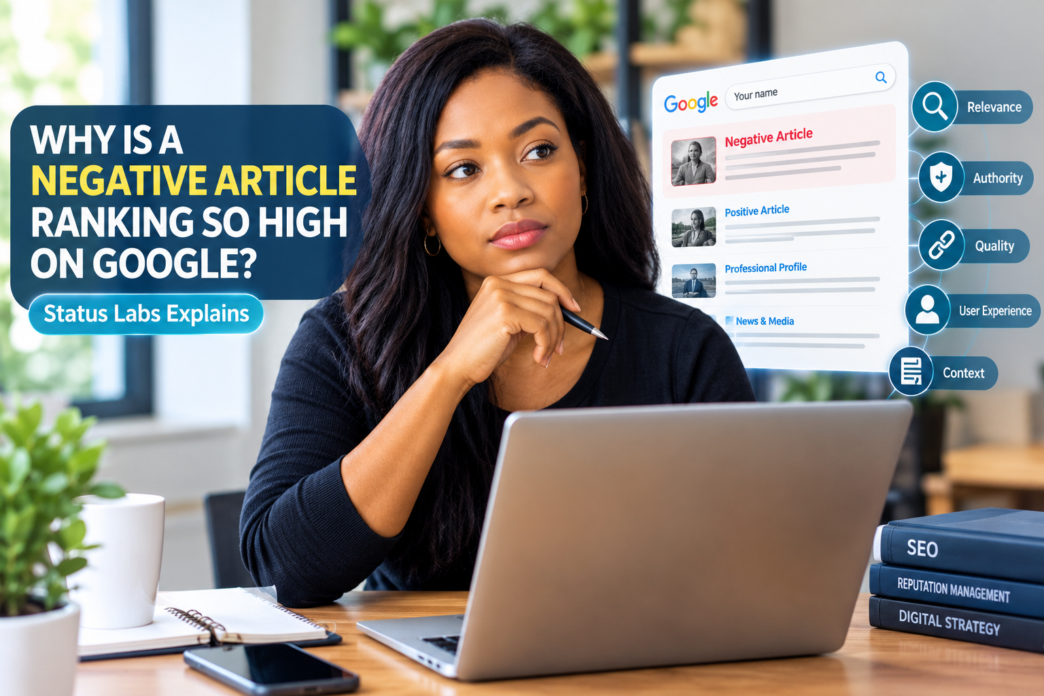
Search engines do not hold opinions about people. They rank pages based on factors such as relevance, authority, quality, usability, and context. A critical story from a respected publication can perform well because it closely matches the person’s name and appears on a trusted website.
The result is a ranking and not a judgment. Understanding that distinction is the first step toward changing what appears in search results.
Status Labs has analyzed thousands of search-result landscapes over more than a decade. A negative article usually remains prominent for two related reasons: it performs well on the signals search engines reward, and stronger competing content is limited or missing.
Both problems can be addressed. A highly ranked negative article is not necessarily permanent, but changing its position requires a clear diagnosis and a long-term strategy.
It Is Not a Glitch or a Judgment
Search rankings are based on signals, and sentiment is not one of them.
Google publicly identifies several factors its systems consider, including the meaning of the search, the relevance and quality of the content, the page’s usability, and the searcher’s context. These systems do not assess whether a result helps or harms the person named in it.
A negative article can therefore earn a high position in the same way as any other page: it closely matches the search and comes from a source that appears trustworthy.
Google’s guidance also emphasizes expertise, authority, and trust. References and links from other prominent websites can strengthen those signals. An article from an established news outlet may perform well because the publication already has a strong reputation and the article has attracted attention elsewhere.
The ranking system is doing what it was designed to do. It simply was not designed to account for a person’s preference about the result.
The Signals Keeping the Article in Place
Several factors can help a negative article maintain its position.
The first is website authority. A respected publication has established credibility, which can support the performance of individual articles on its website.
The second is relevance. An article that includes a person’s full name in its headline and throughout the text may appear highly relevant to a search for that name. It can outrank broader or more favorable pages that mention the person only briefly.
The third factor is links. News coverage may attract references from other websites. Search engines can interpret those links as evidence that the article is important or useful.
Freshness can also affect visibility. A recently published story may receive an early boost because it is timely. That advantage can fade, but the publication’s authority and the links pointing to the article may continue supporting its position.
Identifying the strongest signals in a specific case is important. Each one may require a different response, so diagnosis turns a general concern into a practical strategy.
Stronger Content May Be Missing
A negative article does not rank in isolation. It competes against every other page that could appear for the same search.
In many cases, the accurate or positive content that could outrank it is missing from the competition. That content may not exist, may appear on websites with limited authority, or may not be clearly optimized for searches involving the person’s name.
This gap creates an opportunity.
If a negative result benefits from weak competition, more relevant and authoritative content may be able to move above it. The goal is not simply to publish more pages. It is to create credible material that deserves to rank for the same search.
One Website Usually Cannot Control the Entire Page
A single powerful publication may rank more than once, but Google uses site-diversity systems intended to prevent one domain from dominating the main search results in most situations.
Google’s Danny Sullivan clarified that the general limit of two results from the same domain applies only to the main web listings. It does not apply to search features such as featured snippets or map listings. Impact’s coverage of Google’s site-diversity update explains this distinction.
This means the first page can contain results from several different websites. Some positions may be occupied by personal websites, professional profiles, company pages, directories, interviews, social platforms, or reference sources.
The practical goal is not always to remove every negative result. Instead, it may be possible to improve the overall mix of results by earning more prominent positions for accurate and authoritative content.
A first-page analysis often shows where those opportunities exist. Some positions may already belong to the subject’s websites and profiles. Others may be held by neutral sources. The remaining positions may contain unfavorable coverage.
The exact mix varies, and no position is guaranteed. Google’s site-diversity system also allows exceptions when its systems determine that multiple results from the same domain are especially relevant. However, understanding which websites currently rank makes it easier to identify realistic opportunities for improvement.
Waiting Rarely Solves the Problem
A negative article may lose some visibility as it becomes less timely, but time alone does not always produce a meaningful change.
The authority of the publisher, the article’s relevance, and the links it has accumulated can keep it visible long after the original news cycle ends. An established article may remain near the top until stronger pages begin competing for the same search.
Trying to attack the article can make matters worse. Spam links, baseless removal demands, and negative search engine optimization campaigns may violate platform policies and are unlikely to provide a dependable solution. Search engines have systems designed to identify and discount manipulative behavior.
Removal may be possible in limited circumstances, such as when content violates a law or platform policy. Most lawful reporting, however, cannot simply be erased because it is unfavorable.
For that reason, the more dependable approach is often displacement: creating and promoting accurate content that can legitimately earn stronger positions.
The Same Issue Can Affect AI Answers
Search results also influence how people and automated systems understand a person or organization.
AI answer engines may rely on prominent online sources when generating responses. An article that appears authoritative enough to rank well in search may also be referenced or reflected in an AI-generated summary.
The potential audience is substantial. On February 27, 2026, OpenAI announced that ChatGPT had reached 900 million weekly active users and 50 million paying subscribers. The weekly-user figure had increased from the 800 million reported in October 2025, and the announcement accompanied news of $110 billion in funding.
The figures were reported by TechCrunch and ITdaily, citing OpenAI’s announcement. A coverage roundup from TexxR also lists reporting from Search Engine Land, CNET, The New York Times, and other publications.
For many users, an AI summary may be the first—or only—account they see. That raises the stakes. Improving traditional search results may not fully address the problem if AI systems continue drawing from the same negative source.
Reputation strategies increasingly need to consider both environments. The objective is to build a broader collection of accurate, credible information that search engines and AI systems can recognize and use.
How Status Labs Approaches the Problem
Status Labs begins with a diagnosis rather than an immediate campaign.
The first step is to map the search results. This includes identifying which websites hold each position, evaluating their authority and relevance, and finding places where the subject’s content is missing or too weak to compete.
This analysis turns an intimidating search page into a set of specific opportunities.
The next step is construction, not attack. Status Labs develops accurate, authoritative pages on properties the subject controls and works to earn credible third-party coverage. Search engine optimization is then used to help that material compete for relevant positions.
For individuals dealing with damaging coverage, personal reputation management focuses on the name searches where the problem appears. The strategy depends on the same basic principle that allowed the negative article to rank: strong positions must be earned through relevance, authority, and trust.
So, why does a particular negative article appear so high in search results?
It likely matches the search closely, appears on an authoritative website, and has signals—such as links—that reinforce its importance. It may also face limited competition from stronger, accurate content.
The search engine is not punishing the person involved. It is ranking the pages that currently appear most relevant and authoritative.
The response follows from the cause: analyze the results, identify realistic opportunities, and build accurate content strong enough to compete. Rather than trying to erase an established article, the goal is to create a search landscape that presents a fuller and more accurate story.