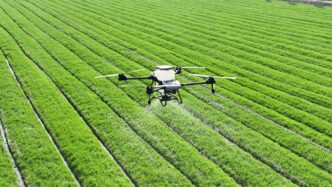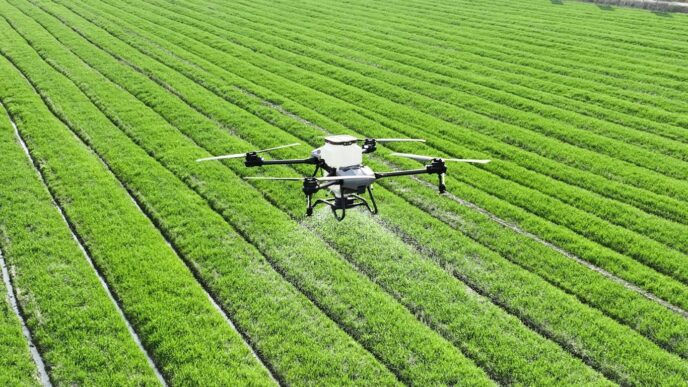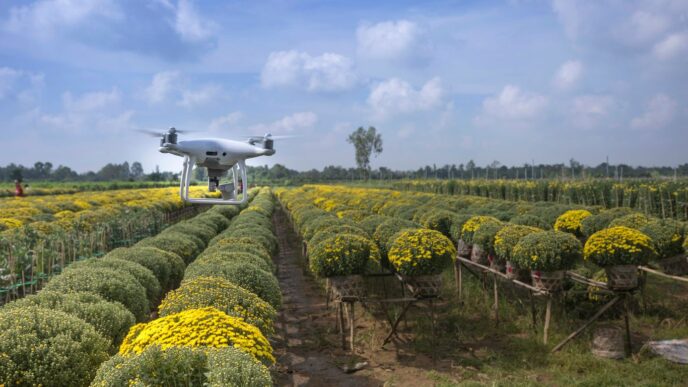
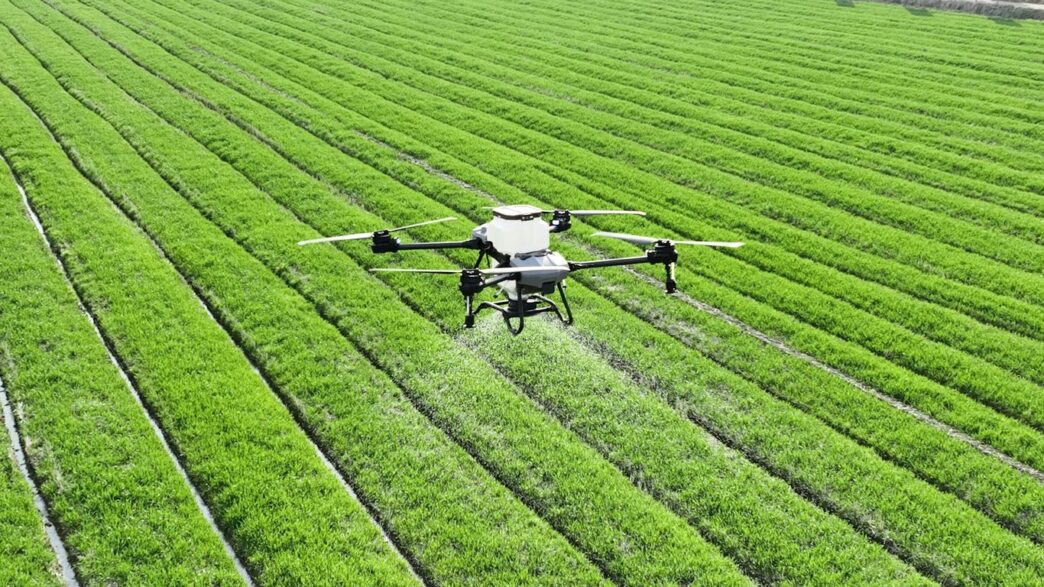
Farming is changing, and a big part of that change is using drones for spraying crops. It sounds futuristic, but ag drone spraying is here and it’s making a real difference. Think about it: instead of big, heavy machines or spraying by hand, we’ve got these smart flying robots that can do the job faster and more accurately. This isn’t just about new gadgets; it’s about making farming more efficient, saving money, and being kinder to the environment. Let’s look at how this ag drone spraying tech is shaking things up.
Key Takeaways
- Ag drone spraying offers better precision, meaning exactly where the spray needs to go, reducing waste.
- Using drones cuts down on the need for manual labor and heavy equipment, saving farms money.
- Drones help reduce the environmental impact by using less water and chemicals, and they don’t compact the soil.
- Modern ag drone spraying technology includes smart features for easier operation and better results.
- Understanding drone capabilities and regulations is important before choosing and using ag drone spraying systems.
Revolutionizing Crop Management With Ag Drone Spraying
Farming is changing, and a big part of that is using new tech to get more done with less hassle. Agricultural drones, or ag drones, are really shaking things up. They’re not just fancy toys; they’re becoming essential tools for farmers who want to be more precise and efficient with how they manage their crops. Think about it – instead of relying on old methods that can be wasteful and labor-intensive, these flying machines offer a smarter way to get the job done.
Enhanced Precision and Efficiency in Application
One of the biggest wins with ag drones is how accurate they are. They use GPS and other fancy navigation stuff to make sure they spray exactly where you want them to, and with the right amount. This means less wasted chemicals and better results for your crops. They can cover a lot of ground way faster than a person walking or even a tractor. Some drones can spray dozens of acres in just an hour, which is pretty wild when you think about it.
Reduced Labor and Operational Costs
Using drones means you don’t need as many people out in the field doing repetitive tasks like spraying. This cuts down on labor costs, which can be a huge expense for farms. Plus, you don’t need to run those big, heavy machines as much. That frees up your workers to do other important things on the farm. It’s a win-win for your budget and your team.
Minimizing Environmental Impact and Soil Compaction
Heavy farm equipment can really mess up the soil, making it hard for water and nutrients to get where they need to go. Drones fly overhead, so they don’t cause any of that soil compaction. This helps keep your soil healthy. Also, because they’re so precise, they use fewer chemicals and less water, which is better for the environment. Less runoff means less pollution, too. They can also get to those tricky spots on your farm that are hard to reach with regular equipment, like steep hills or wet areas, making sure your whole field gets treated evenly.
Key Features of Modern Ag Drone Spraying Technology
So, what makes these ag drones so special? It’s not just about them flying around; there’s some pretty neat tech packed into these machines. They’ve really thought about making them work well in the field, which is, you know, the whole point.
Spraying and Spreading System Innovations
The way a drone actually puts stuff out there is a big deal. It’s not just a simple nozzle; there are different systems designed to get the job done right. Think about the nozzles themselves – they can create different droplet sizes. Some are really fine, good for getting into dense crops, while others are a bit bigger. This matters because different chemicals need different droplet sizes to work best and not drift away. Then there’s the flow rate and how wide the spray pattern is. A higher flow rate and a wider pattern mean you can cover more ground faster. Some drones even have what they call Variable Rate Application (VRA). This is pretty smart; it means the drone can change how much it’s spraying based on what the field actually needs, using data from maps or sensors. It stops you from wasting chemicals where they aren’t needed.
Durability and Portability for Field Operations
Let’s be real, farms aren’t exactly clean rooms. These drones have to handle dust, maybe some rain, and just general rough treatment. That’s why many are built tough, often with materials like carbon fiber that are strong but light. They usually have some kind of water and dust resistance rating, like IP67, which is good to know. And when you’re done with one field and need to move to the next, a lot of them are designed to fold up. This makes them way easier to pack into a truck or trailer and get where you need them without a huge hassle. It’s all about making them practical for everyday farm work.
Intelligence and Automation Capabilities
This is where things get really futuristic. Modern ag drones aren’t just remote-controlled toys. They use a lot of smart technology. They can plan their own flight paths automatically, which is a lifesaver when you’re trying to cover a big field. And they have systems to avoid obstacles – like trees or power lines – all by themselves. This makes flying much safer, especially if you’re not a seasoned pilot. Some even have cameras that let you see what the drone sees in real-time, like a first-person view. Plus, the controllers and apps you use to manage them are getting simpler, making it easier for more people to use this tech.
Selecting the Right Ag Drone for Your Farm
So, you’re thinking about getting an ag drone for your farm. That’s a big step, and honestly, it can feel a little overwhelming with all the options out there. It’s not just about picking the flashiest model; you really need to think about what your farm actually needs. The best drone for your neighbor might not be the best one for you. Let’s break down what to look for.
Payload Capacity and Tank Volume Considerations
This is pretty straightforward: how much stuff can the drone carry? If you’ve got a huge operation, you don’t want to be stopping every ten minutes to refill. Drones come with different tank sizes, from small ones for spot treatments to massive tanks for covering acres. Think about how much liquid or granular material you typically need to apply in one go. Bigger isn’t always better if it makes the drone too heavy or hard to handle, but you definitely want enough capacity to get a good chunk of work done.
Here’s a general idea of what you might see:
| Application Type | Typical Tank Volume Range |
|---|---|
| Spraying | 8 to 90+ liters |
| Spreading | Up to 150 kg |
Flight Time and Coverage Area Metrics
This is all about efficiency. How long can the drone stay in the air on a single charge, especially when it’s carrying a full load? A longer flight time means it can cover more ground before needing to land and recharge or swap batteries. You’ll want to look at the drone’s advertised coverage rate, usually measured in acres or hectares per hour. This metric really tells you how much work you can get done in a day.
- Consider battery life with a full payload. A drone might fly for 30 minutes empty, but only 15 minutes full.
- Look at the drone’s speed and spray width. These factors directly impact how quickly it can cover an area.
- Factor in refill and battery swap times. These add up and reduce your actual working time.
Precision Navigation Systems for Accurate Application
This is where the ‘precision’ in precision agriculture really comes into play. You want the drone to know exactly where it is and where it’s going. Systems like RTK (Real-Time Kinematic) GPS can get you down to centimeter-level accuracy. This is super important for making sure you’re not overlapping sprays or missing spots. Also, think about obstacle avoidance. If you have trees, power lines, or other things in your fields, you need a drone that can see them and steer clear safely. Some drones can even follow the terrain, keeping a consistent height above uneven ground, which is great for uniform application.
Leading Ag Drone Spraying Solutions Available
When you’re looking at getting into ag drone spraying, it can feel like a lot to take in. There are some big names out there, and they all have different things they do best. It’s not just about picking the flashiest one; it’s about finding what fits your farm.
DJI Agras Series: A Dominant Force
DJI’s Agras line is pretty much everywhere in the ag drone world. They’ve got a few models that really stand out. The DJI Agras T50 is a top-tier machine, capable of both spraying and spreading, and it can carry a serious amount of weight – up to 40 kg for spraying and 50 kg for spreading. It uses some pretty advanced radar and vision systems to map terrain and avoid obstacles, which is a big deal when you’re flying over crops. It’s designed for those big jobs, covering up to 21 hectares (about 52 acres) in an hour. Then there’s the T40, which is also a solid performer for large fields, and the T25, a more compact, foldable option that’s great for mid-sized farms or orchards where you might need to move around a lot. For smaller operations or if you’re just starting out, the T10 is a more budget-friendly choice.
XAG Agricultural Drones: Automation Focused
XAG is another big player, and they really focus on making their drones smart and easy to use, especially for automation. Their XAG P100 Pro is a good example. It’s an autonomous drone that uses AI to plan its routes and has these special dual-atomization nozzles that create really fine spray droplets. It can carry 40 kg and has smart obstacle avoidance, plus it can recharge its batteries pretty quickly. They also have the P150, which is a powerful, twin-rotor drone that can handle spraying, seeding, and fertilizing. It’s built for efficiency, covering about 20 hectares (around 50 acres) per hour.
TTA Agricultural Drones: Economical Options
If you’re running a smaller to medium-sized farm, TTA might be worth a look. They tend to offer solutions that are a bit more budget-friendly without sacrificing too much performance. Their G200 and M6E models are designed as complete packages for spraying. The G200, for instance, has a 16-liter tank and can cover a decent amount of ground, like 2.7 to 4 acres in about 10 minutes. TTA drones are often noted for being waterproof, having long flight times, and needing less maintenance. They also use RTK positioning for accuracy and have features like flight log playback and different operation modes, including automatic spraying and obstacle avoidance. They’re a good option if you’re looking to save on water and pesticides compared to older methods.
The Tangible Benefits of Ag Drone Spraying
So, you’re thinking about getting into ag drone spraying? It’s not just some fancy new gadget; there are some real, down-to-earth advantages that can make a big difference on the farm.
Significant Time Reduction in Field Operations
Let’s talk about time. It’s probably one of the most valuable things a farmer has, right? Well, drones can seriously cut down the hours you spend in the field. Think about it: a tractor might take an hour to cover a single hectare for spraying. A drone? It can do that same hectare in about six minutes. That’s a massive difference, freeing up your schedule for other important tasks. It’s not just about speed, either. Manual spraying with a backpack, which often needs a whole team of ten people, can take even longer per hectare. Drones just get the job done faster, plain and simple.
Substantial Water and Chemical Savings
Beyond saving time, drones are also pretty good at saving resources. Traditional spraying methods can use a lot of water – sometimes up to 250 liters per hectare. Drones, on the other hand, are much more efficient, often using around 30 liters per hectare. That’s a huge reduction in water usage. The same goes for chemicals. Because drones apply treatments with such precision, you’re not wasting product. This means you use less water and fewer chemicals overall, which is better for your wallet and the environment.
Improved Cost-Effectiveness Compared to Traditional Methods
When you add it all up – the time saved, the reduced need for labor, and the savings on water and chemicals – drone spraying often comes out cheaper than older methods. While there’s an initial investment in the drone technology, the long-term savings can be quite significant. For instance, one study showed that drone spraying could cost around $140 per hectare, while tractor spraying might run closer to $200, and manual spraying could even hit $217 per hectare. Plus, you’re cutting down on fuel costs and wear-and-tear on heavy machinery. It just makes good financial sense for many operations.
Here’s a quick look at how the costs can stack up:
| Cost Category | Drone Spraying | Tractor Spraying | Manual Spraying |
|---|---|---|---|
| Labor Costs | $1.43 | $14.29 | $57.14 |
| Chemical Costs | $133.71 | $133.71 | $133.71 |
| Fuel Costs | $0.00 | $44.57 | $0.00 |
| Equipment Maintenance & Depreciation | $1.83 | $1.83 | $0.00 |
| Other Costs | $2.86 | $5.71 | $26.74 |
| Total Cost Per Hectare | $139.83 | $200.11 | $217.60 |
Navigating the Regulatory Landscape for Ag Drone Spraying
So, you’ve got your eye on an ag drone, thinking about how it’ll change things on the farm. That’s great! But before you start picturing those fields getting treated with pinpoint accuracy, there’s a bit of paperwork and rules to get through. It’s not exactly rocket science, but you do need to know what the Federal Aviation Administration (FAA) expects.
FAA Part 107 Remote Pilot Certificate Requirements
First things first, if you’re flying a drone for any kind of business purpose – and spraying crops definitely counts – you need to get yourself a Remote Pilot Certificate. This is often called the Part 107 certificate. It’s basically the drone pilot’s license. To get it, you’ll have to pass a test that covers things like airspace rules, weather, and how to operate a drone safely. It’s not a one-and-done deal either; you’ll need to pass recurrent training every couple of years to keep it current.
Understanding Part 137 Agricultural Aircraft Operator Certification
Now, this is where things get a bit more specific for agricultural spraying. If your drone weighs more than 0.55 pounds and you’re using it to dispense chemicals or other agricultural products, you’ll likely need to get certified under Part 137. Think of this as a special permit for aerial application. It involves submitting an application to the FAA that details your operations, the types of substances you’ll be spraying, and your safety procedures. For drones weighing over 55 pounds, you might need to apply for an exemption from certain Part 137 rules, which can add another layer to the process.
Drone Registration and State-Level Licenses
Don’t forget about registering your drone. Any drone weighing 0.55 pounds or more needs to be registered with the FAA, and you’ll have to put a unique registration number, called an N-number, on the drone itself. On top of the federal requirements, most states also have their own rules. You’ll probably need a commercial pesticide applicator license from your state’s regulatory agency to legally spray chemicals from the air. So, it’s a good idea to check with your state’s department of agriculture to see exactly what’s needed in your area. It might seem like a lot, but following these steps helps keep everyone safe and the skies clear for all the right reasons.
The Future is Flying
So, we’ve talked a lot about how these drones are changing things up in farming, especially with spraying. It’s pretty clear that this isn’t just some passing trend. Farmers are seeing real benefits, like saving time, cutting down on costs, and being kinder to the environment. It’s not always a simple switch, and there’s a learning curve, sure, but the results speak for themselves. From what we’ve seen, drones are becoming a pretty standard tool for farmers who want to stay ahead and farm smarter. It’s exciting to think about what else they’ll be able to do down the road.
Frequently Asked Questions
What are the main advantages of using drones for spraying crops?
Drones make spraying way more accurate and faster than old methods. They can fly over large fields quickly, and because they’re so precise, they use less water and chemicals. This also means less work for people and less damage to the soil because heavy machines aren’t needed.
How do these advanced drones know where to spray?
Modern farming drones use GPS, just like your phone, but much more accurate. They can also use special cameras and sensors to map the land, avoid obstacles like trees, and even fly at a steady height over bumpy ground. This helps make sure every plant gets the right amount of spray.
Can drones carry enough spray for a whole farm?
Drones come in different sizes. Some have small tanks for smaller jobs or tricky areas, while others have big tanks that can hold a lot of liquid. The bigger ones can cover many acres in just one flight before needing to be refilled, making them good for large farms.
Are there rules I need to follow to fly a drone for farming?
Yes, there are rules! In the U.S., you usually need a special pilot’s license from the FAA to fly drones for work. If you’re spraying chemicals, there are even more specific rules, like needing an agricultural aircraft operator certificate. It’s important to know and follow these rules for safe and legal operation.
How much does an agricultural drone typically cost?
The price can vary a lot, from around $15,000 to over $50,000. It depends on how big the drone is, how long it can fly, what kind of special features it has like advanced sensors, and how much it can carry. Think of it as an investment that can save you money in the long run.
Besides spraying, what else can these drones do on a farm?
Drones are super versatile! They can also be used to spread seeds, check on crop health with special cameras that see things humans can’t, map out fields, count plants, and even estimate how much harvest you’ll get. Some can even carry small loads.