Understanding the Tesla Robotaxi Safety Monitor Evolution
It feels like just yesterday we were hearing about Tesla’s big plans for robotaxis, and now, here we are, seeing them actually start to roll out. But it’s been a bit of a journey, right? Initially, the idea was that these cars would have a safety monitor right there in the passenger seat, kind of like a co-pilot. This was Tesla’s way of easing into things, making sure someone was present to step in if the car got into a tricky situation. They called it ‘supervised’ rides.
From Supervised to Unsupervised Rides
So, the first wave of robotaxi rides in places like Austin, Texas, had that safety monitor. It was a pretty standard setup, honestly. But Elon Musk kept saying they’d ditch the monitor soon. And, well, he technically kept that promise, but not quite how everyone expected. As of early 2026, Tesla started offering rides without a safety monitor in the car. This is the big shift to ‘unsupervised’ rides. However, there’s a catch. Reports and videos have shown that even when the car is supposedly driving itself unsupervised, there are often other Tesla vehicles, with people inside, following closely behind. It seems like the safety monitors weren’t removed, just relocated to a different car. Tesla VP Ashok Elluswamy mentioned they’d start with a few unsupervised cars mixed in and gradually increase that number. It’s a slow transition, not a sudden switch.
The Shifting Role of Safety Monitors
This whole situation really changes what we think a ‘safety monitor’ is supposed to do. When they were in the car, their job was clear: watch the road and take over if needed. Now, with them following in another vehicle, their role is less direct. It’s more like remote supervision or a backup plan that’s not physically present in the vehicle. This raises questions about how effective this new setup is, especially when things go wrong. The data so far suggests that even with these monitors, Tesla’s robotaxis are involved in crashes at a much higher rate than human drivers.
Key Milestones in Robotaxi Deployment
- June 2025: Tesla Robotaxi service launches in Austin, Texas, with safety monitors present in every vehicle.
- Late 2025 – Early 2026: Elon Musk repeatedly states that safety monitors will be removed soon.
- January 2026: Tesla begins offering rides without an in-car safety monitor, marking the start of ‘unsupervised’ operations, though often with trailing support vehicles.
- Ongoing: Gradual increase in the ratio of unsupervised vehicles within the fleet, as per company statements.
It’s a step-by-step process, and it’s clear Tesla is trying to show progress, but the move from supervised to unsupervised rides isn’t as clean-cut as it might seem at first glance.
Analyzing Tesla Robotaxi Safety Performance Data
Let’s talk about how these Tesla Robotaxis are actually performing out there on the road. It’s easy to get caught up in the hype, but the numbers tell a story, and sometimes it’s not the one Tesla wants us to hear.
Crash Rate Comparisons: Tesla vs. Human Drivers
This is where things get a bit bumpy. When you look at the data, Tesla’s Robotaxi program, even with safety monitors in the car, has had a higher crash rate than the average human driver. We’re talking about incidents happening much more frequently than you’d expect, especially when you consider these vehicles are supposed to be the future of safe transportation. The reported crash rate for these supervised robotaxis is significantly higher than for human drivers. It makes you wonder what would happen if those monitors weren’t there at all.
Interpreting NHTSA Crash Reports
Getting clear information from Tesla about crashes hasn’t been easy. They’re required to report to the National Highway Traffic Safety Administration (NHTSA), but often, the details are pretty sparse. We know there have been a number of reported collisions in places like Austin, Texas, since the service started. Some of these were clearly the fault of the Tesla system, while others might have involved other vehicles. The problem is, with limited details, it’s hard to get a full picture of what went wrong and how often.
The Impact of Safety Monitors on Incident Rates
This is a really interesting point. You’d think having a trained professional in the passenger seat would drastically cut down on accidents, right? Well, the data suggests it’s helping, but not as much as you’d hope. Even with these monitors, crashes are still happening at a concerning rate. This implies that the autonomous system itself is making mistakes that the human supervisor is either not catching in time or is unable to prevent. It raises questions about the system’s readiness for unsupervised operation, even in limited areas. Here’s a quick look at some reported figures:
- Supervised Robotaxi Crashes: Roughly 1 crash every 50,000 miles (based on available data).
- Tesla FSD (Owner Supervised): Around 1 airbag deployment every 3.2 million miles, and 1 minor collision every 1 million miles.
- Average Human Driver: Crashes approximately once every 500,000 miles.
These numbers suggest that while the monitors are a safety net, the underlying technology still has a long way to go before it can reliably handle all driving situations on its own.
The Technology Behind Tesla’s Autonomous Driving
So, what’s actually under the hood of these Tesla Robotaxis? It’s a mix of hardware and software that’s been evolving for years. Tesla has always pushed the idea that their cars have all the necessary hardware for full self-driving, even going back to 2016. But, as it turns out, that wasn’t quite the whole story.
Hardware Requirements for Robotaxis
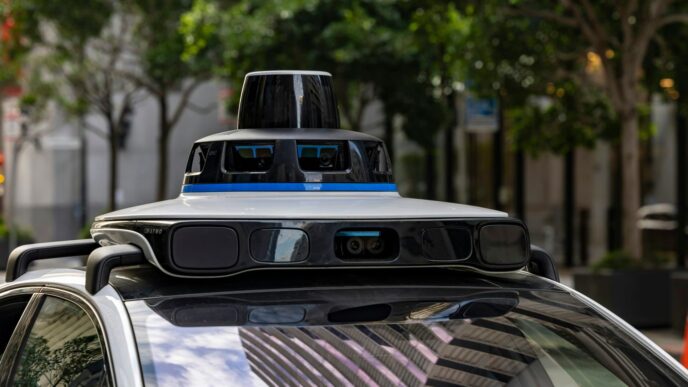
While Tesla initially claimed older hardware was sufficient, the reality is a bit more complex. Even the current HW4, which is supposed to be pretty advanced, might not be the final word. You’ll notice things like camera washers on the robotaxis, which aren’t standard on regular HW4 cars. These are pretty important for keeping the cameras clean in all sorts of weather, which is obviously key for autonomous driving. It suggests that Tesla is adding or refining hardware components to meet the demands of unsupervised operation.
Software Updates and Neural Network Improvements
This is where a lot of the magic, or maybe the mystery, happens. Tesla relies heavily on its neural networks, which are constantly being trained and updated. The idea is that the more data the system processes, the smarter it gets. They’ve been pushing out software updates regularly, aiming to improve how the car perceives its surroundings and makes decisions. The goal is to move from a system that needs constant supervision to one that can handle pretty much anything on its own. It’s a continuous process of learning and refinement, with the AI trying to figure out complex situations.
The Role of Camera Washers in Autonomous Systems
Let’s talk more about those camera washers. They might seem like a small detail, but for a car that needs to
Tesla Robotaxi Expansion and Market Strategy
Phased Rollout in Austin vs. Direct Unsupervised Launches
Tesla’s approach to rolling out its Robotaxi service has varied, which is pretty interesting to see. In Austin, Texas, they took a more gradual path. The service started with safety monitors in the vehicles back in June 2025, and only in January 2026 did they transition to fully unsupervised rides. This allowed them to iron out kinks with a human backup, so to speak. But for newer cities like Dallas and Houston, Tesla decided to skip that supervised phase altogether. They launched directly into unsupervised operation on April 18, 2026. This shows a shift in confidence, or maybe just a desire to speed things up. It’s a different strategy for different markets, and it’ll be telling to see which one proves more effective long-term.
Geographic Expansion Plans for 2026
Tesla’s expansion map for the first half of 2026 is pretty ambitious. They’ve got their sights set on seven new cities beyond Austin, Dallas, and Houston. These include Phoenix, Miami, Orlando, Tampa, and Las Vegas. While specific launch dates for each city haven’t been announced yet, the company is clearly preparing to scale up. It’s not just about flipping a switch in a new city, though. Tesla seems to be actively working in many more locations, with reports suggesting activity in up to 39 cities through hiring, testing, and mapping efforts. This suggests they’re getting the groundwork ready in parallel, even if the public-facing service is only live in a few places.
Preparing Multiple Markets in Parallel
It looks like Tesla isn’t just focusing on one city at a time. The company appears to be getting ready to launch in several markets simultaneously. While the current fleet size in cities like Dallas and Houston is small, with maybe only one active vehicle reported per city initially, the groundwork is being laid. This parallel preparation means they can potentially scale up faster once the software is ready and regulations allow. It’s a smart move, really, to have multiple locations prepped rather than waiting for one to be fully operational before even thinking about the next. This strategy hints at a larger vision for a widespread autonomous network, not just a few scattered services. The goal is clearly to build a robust, widespread autonomous ride-hailing system.
Here’s a look at some of the planned expansion cities for H1 2026:
- Dallas
- Houston
- Phoenix
- Miami
- Orlando
- Tampa
- Las Vegas
Keep an eye on the Tesla app for official announcements about when the service will be available in your area.
Public Perception and Regulatory Landscape
Navigating Lax Autonomous Driving Regulations
Texas has been pretty open to letting Tesla test its Robotaxi service, which is a big reason why Austin became the first city for this. It’s not exactly a surprise, given the state’s approach to autonomous vehicle rules. This has allowed Tesla to get a lot of real-world miles under its belt, even if most of those miles still have a human safety monitor in the car. It’s a bit of a mixed bag, really. On one hand, it’s progress. On the other, it’s happening in a place where the rules are, let’s say, flexible. This situation makes it hard to know if Tesla is truly ready for wider, unsupervised deployment or if it’s just taking advantage of a permissive environment.
Building Public Trust in Autonomous Services
Getting people to feel comfortable hopping into a car with no driver is a huge hurdle. Tesla’s approach, which has involved a gradual increase in unsupervised rides and a lot of data collection, is meant to build that trust. But the numbers so far are a bit shaky. Reports suggest that Tesla’s Robotaxis have been involved in crashes more often than the average human driver, even with a safety monitor present. That’s not exactly confidence-inspiring. The company needs to show a clear, consistent safety record to convince the public that these vehicles are genuinely safer than what we have now.
The Musk Factor: Hype vs. Reality
Elon Musk has a knack for making bold predictions, often about timelines for self-driving technology. He’s talked about "unsupervised is pretty much solved" for a while now. Yet, the reality on the ground in Austin shows a different story. While some rides are unsupervised, many still have a safety monitor. This gap between the hype and the actual deployment is a constant source of discussion. It makes you wonder if the public statements are more about marketing and hitting deadlines than a true reflection of the technology’s readiness. It’s a delicate balance between pushing the boundaries and managing expectations, and Tesla, with Musk at the helm, often seems to lean heavily into the hype.
Here’s a look at some of the reported incidents:
| Date Range | Miles Driven (Approx.) | Reported Crashes | Crash Rate (per 100k miles) |
|---|---|---|---|
| June 2025 – Nov 2025 | 250,000 | 8 | 3.2 |
| June 2025 – Early March 2026 | 800,000 | 14 | 1.75 |
Note: Crash rates are estimates based on available data and Tesla’s disclosures. The average human driver crash rate is approximately 0.2 per 100,000 miles.
The Future of Tesla’s Robotaxi Service
So, what’s next for Tesla’s Robotaxi? It’s a big question, and honestly, the picture is still coming into focus. We’ve seen the service roll out, first with safety drivers, then in limited unsupervised areas, and now, as of April 2026, fully unsupervised in places like Dallas and Houston. This isn’t just about getting from point A to point B anymore; it’s about a car that can potentially earn money when you’re not driving it. That’s a pretty big shift from just owning a depreciating asset.
CyberCab Production and Its Impact
One of the next big pieces of the puzzle is the CyberCab. Tesla is aiming for volume production of this purpose-built vehicle around April 2026. Think of this as the machine that’s supposed to make the whole Robotaxi thing really scale. When these start hitting the road in larger numbers, it could change the game for ride capacity and how much these rides actually cost. It’s not just about using existing Model Ys anymore; this is a dedicated vehicle for the service.
Robotaxi as a Revenue-Generating Asset
This is where things get really interesting for Tesla owners. The idea is that your car, when you’re not using it, could be out there earning you money. It’s a whole new way to think about car ownership. Right now, the service is still pretty limited, with small fleets and specific service areas. But as the technology gets better and more cities get added, this could become a significant income stream for owners. It’s a big change from just having your car sit in the driveway.
The Potential for a Global Autonomous Fleet
Looking even further ahead, Tesla’s strategy is pretty unique. Unlike other companies building a small fleet of specialized autonomous vehicles, Tesla has a massive advantage: millions of Teslas already on the road. The sensors and computers needed for full self-driving are already in many of their cars. The vision is that eventually, a huge number of these cars could join the Robotaxi network. It’s a long road, with regulations and software updates needed, but the potential for a truly global autonomous fleet is definitely there. It’s less about a few hundred cars in one city and more about a network that could span the world.
So, What’s the Bottom Line on Tesla’s Robotaxis in 2026?
Alright, so we’ve talked a lot about Tesla’s robotaxi situation in 2026. It’s clear they’re pushing hard to get these cars on the road without a safety driver, and they’ve made some big moves, especially in places like Austin. But honestly, the whole thing feels a bit like a rush job. We’ve seen reports of crashes, and the idea that they’re just moving the safety monitor to another car instead of actually removing it raises some eyebrows. It makes you wonder if this is really ready for prime time, or if it’s more about making a splash than being truly safe. For now, it seems like a good idea to keep a close eye on how this all plays out, especially when more people start using it. Safety has to come first, right?